A cabbie who takes any fare, anywhere
Taxi Driver follows Travis Bickle, a Vietnam veteran unable to sleep, who takes a job driving a New York City taxi through the night shift and the roughest fares other drivers turn down. Scorsese and screenwriter Paul Schrader are not building a crime plot in the ordinary sense; Travis’s disgust at the city’s pimps, drug dealers and indifferent crowds accumulates gradually into a private moral crusade, first aimed at a presidential candidate he stalks after a failed courtship with one of the man’s campaign workers, then redirected toward the pimp controlling a twelve-year-old girl Travis has fixated on rescuing. The film keeps its distance from explaining Travis fully, presenting his loneliness and rage as a condition the city itself seems to be generating rather than a case history with a clean diagnosis.
A campaign volunteer who cannot read the room
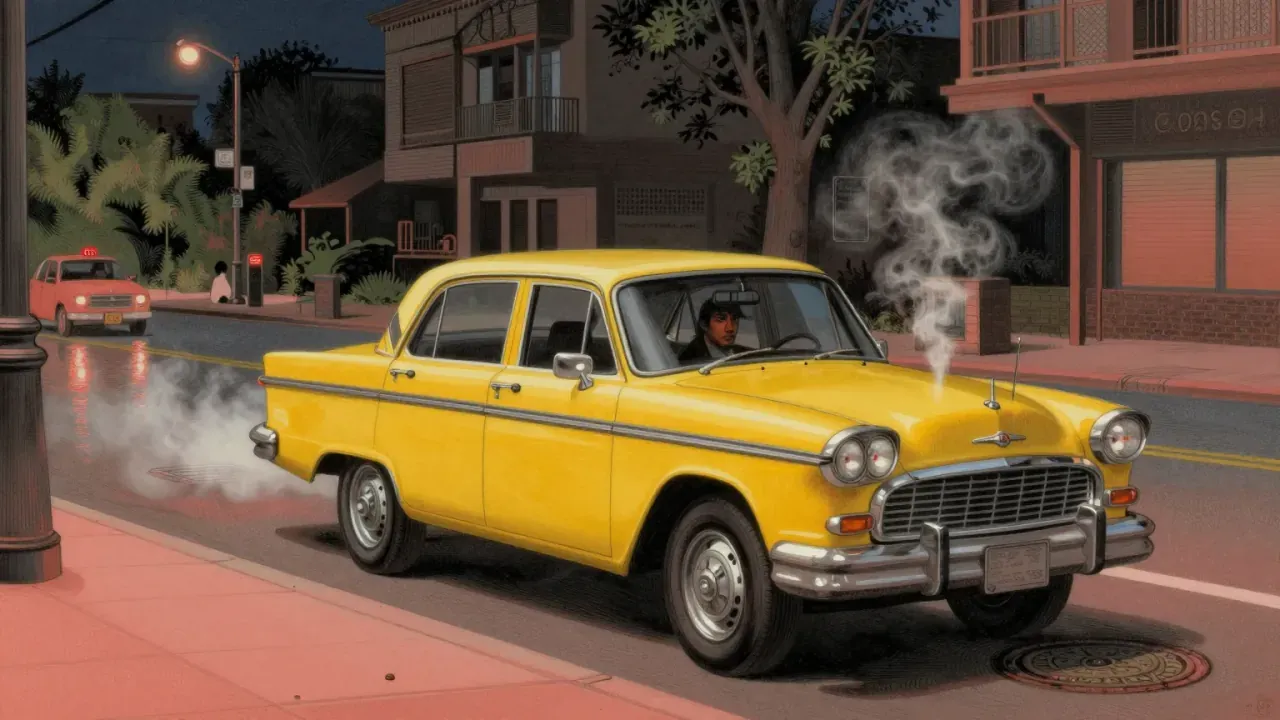
Scorsese shoots much of the film from inside Travis’s cab or apartment, using a restless, drifting camera that lingers on neon-lit streets and steam rising from grates, giving the city an almost hallucinatory quality that matches Travis’s sleep-deprived state. Bernard Herrmann, in what became his final score before his death only hours after finishing it, built a moody, saxophone-led theme that gives Travis’s isolation a strange romantic quality even as his behaviour grows more alarming. Robert De Niro prepared for the role by working actual New York cab shifts, and his performance builds Travis from awkward, hopeful sincerity into a coiled, self-narrating menace almost entirely through voice-over diary entries and small shifts in posture. Jodie Foster, twelve at the time of filming, plays the sex worker Iris with an unsettling mix of childishness and premature toughness.
Herrmann’s last score, finished days before he died
The film’s mirror monologue, in which Travis rehearses a confrontation with an imagined attacker, has become one of the most referenced scenes in American cinema for good reason: De Niro builds an entire psychological portrait out of a man performing toughness to nobody but himself. The extended sequence of Travis assembling and testing his weapons, cutting down a revolver and rigging a spring-loaded sleeve holster, is shot with a craftsman’s patience that makes the violence to come feel inevitable rather than sudden. The climactic shootout, filmed in desaturated colour after censors required the blood tones muted, retains its shock decades later, and the film’s final, deliberately ambiguous coda, in which the press recasts Travis as a hero, leaves the audience with no comfortable place to land.
A gun collection assembled for a purpose not yet named
Travis’s courtship of Betsy, the campaign volunteer, is written to reveal his social isolation through cringing detail, including a disastrous choice of a pornographic cinema for a date, but the character herself remains thin once she exits the story, present mainly to demonstrate Travis’s failure to connect rather than to register as a person in her own right. The film’s political assassination plotline is abandoned rather than resolved, dropped once circumstance intervenes, which serves the story’s point about arbitrary targets but can read as a loose thread on a more plot-focused viewing. At 114 minutes the film moves briskly, but its refusal to offer any framework for understanding Travis’s transformation, beyond his own increasingly unreliable narration, leaves some viewers wanting more grounding than the film is willing to provide.
A rescue that made a hero of a would-be killer
The film treats Travis’s violence as an outgrowth of a loneliness so complete it curdles into a self-appointed moral mission, with masculinity here bound up in a fantasy of being needed, useful and finally seen, whether by a woman, a political figure or a child he has decided requires saving. New York itself functions less as setting than as accusation, a city Travis experiences almost entirely through its filth, its exploitation and its indifference, which the film neither fully endorses nor fully rejects as an accurate reading. The ending’s ironic elevation of Travis into a media hero complicates any easy moral, refusing to separate his violence cleanly from the heroism the outside world chooses to project onto it.
A film that shaped real violence after its release
This suits viewers interested in character studies built around unreliable, disturbing psychology, and in Scorsese’s specific control of camera and sound to place an audience inside a deteriorating mind. It is a difficult watch for anyone sensitive to its violent climax or to the sexualised framing of Foster’s underage character, both of which generated controversy on release and remain uncomfortable by design rather than accident. Viewers wanting a clear verdict on Travis, hero or villain, will not get one, since the film’s ending deliberately refuses to supply it. It is not a film suited to casual or background viewing given how much rests on tone and interiority.
Short, tense, and still uncomfortable to watch
At 114 minutes the film is compact and tense throughout, never padding its runtime despite the slow accumulation of Travis’s isolation, and its return of over sixty times its modest budget reflects how completely it connected with audiences despite its bleak subject. Its later real-world entanglement, cited by John Hinckley Jr. as an influence on his 1981 assassination attempt on President Reagan, added a grim coda to a film already interested in how media and violence feed each other. Worth the evening for its craft and De Niro’s performance, though it demands a willingness to sit with genuine discomfort rather than resolution.