The silence of the doctor
The Testament of Dr. Mabuse is a German crime-thriller made in late 1932 and released in early 1933, conceived as a direct sequel to Lang’s 1922 silent film Dr. Mabuse the Gambler. It attempts to extend the mythos of its titular criminal mastermind not through action or presence but through absence: Mabuse is confined to an asylum, writing feverishly, his plans enacted by others who do not know they obey him. The film tries to dramatise ideological contagion — how a single mind, even when silenced and institutionalised, can generate coordinated violence across a society. Its structure mirrors this: a series of seemingly disconnected crimes cohere only in retrospect, under Inspector Lohmann’s slow, methodical reconstruction. Lang and von Harbou wrote it while Hitler was consolidating power; the script treats organised criminality as a structural analogue to totalitarianism — not allegory, but formal parallel. It does not name politics, but builds its tension from bureaucratic paralysis, media manipulation, and the erosion of legal authority. The film’s ambition is forensic and political at once: to show how systems collapse not from external assault, but from internal replication of a diseased logic. (158 words)
The testament as virus
The story follows Lohmann as he traces a wave of arson, assassination and bank robbery back to the asylum where Mabuse writes in silence. Rudolf Klein-Rogge plays Mabuse with minimal screen time but maximal psychological pressure: his voice is heard only in fragmented dictation, his face appears in distorted, superimposed flashes — a device Lang later disavowed. Otto Wernicke returns as Lohmann, calm and weary, anchoring the film in procedural realism amid expressionist flourishes. Fritz Arno Wagner and Károly Vass shoot interiors with deep shadow and tight framing, keeping corridors narrow and ceilings low, especially in the asylum and police station. Hans Erdmann’s score uses leitmotifs sparingly — a recurring bass figure for Mabuse, silence punctuated by sudden percussion during violent acts. Lothar Wolff edits with deliberate pacing: scenes linger on faces absorbing bad news, on documents being read twice. The French-language version was shot simultaneously on the same sets with different actors, except for bilingual performers like Karl Meixner. Lang directed both versions himself, using the same blocking and lighting — a rare feat of bilingual production discipline. (159 words)
The look of it
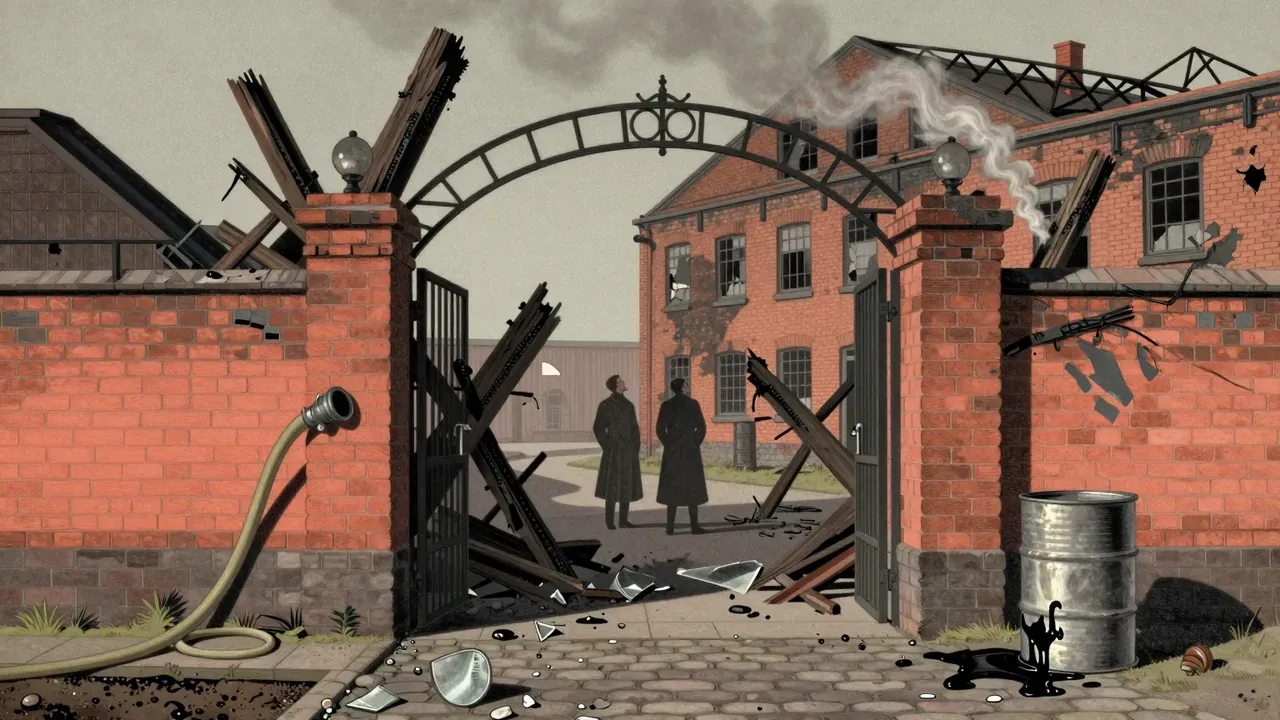
What lands most firmly is the film’s atmosphere of institutional decay. The asylum feels less like a place of care than a node in a hidden network; Professor Baum’s descent into obsession is rendered not through histrionics but through incremental shifts in posture, speech rhythm and eye contact. The factory explosion sequence — filmed on location at night, with real detonations triggered by Lang — carries visceral weight because it is so plainly physical: smoke, heat haze, collapsing timber, no studio gloss. Lohmann’s methodical interviews — with gangster Kent, with Hofmeister, with the increasingly unstable Baum — gain cumulative force through repetition and variation: each conversation reveals another layer of misdirection, another failure of oversight. The film’s sound design works precisely where it is sparse: footsteps echoing in empty halls, typewriter keys clacking over silence, a telephone ringing unanswered. These are not stylistic choices for effect but functional ones — they make surveillance feel plausible, paranoia rational. Even the ghostly Mabuse apparitions, though later regretted by Lang, succeed in their immediate purpose: they visualise the idea that ideology can haunt without embodiment. (157 words)
The weight of the world
What does not land is the romantic subplot between Lilli and Kent, which exists only in the German version and is cut from the French one — a sign of its dispensability. It adds neither thematic weight nor narrative momentum, and its emotional beats feel unearned, inserted to fill time rather than deepen character. The film’s final act also falters structurally: after the careful build-up of clues and converging lines of inquiry, the resolution depends on a sudden, unprepared shift in Baum’s psychology — a breakdown that arrives without sufficient prior signposting in performance or editing. The courtroom scene, meant to deliver moral clarity, instead feels perfunctory, its dialogue exposition-heavy and its staging static. Some of the supporting cast — particularly the minor gangsters — remain indistinct, defined more by function than personality. The supernatural touches, while conceptually interesting, sit uneasily beside the film’s otherwise grounded realism; they suggest a metaphysical dimension the rest of the film refuses to engage with. And though the dual-language production was commercially astute, the French version suffers slightly from thinner vocal performances and less precise timing in key exchanges — a reminder that fluency in language is not identical to fluency in dramatic idiom. (156 words)
The descent of reason
The themes that matter are those of transmission, legitimacy and mimicry. The film treats crime not as individual transgression but as systemic infection — Mabuse’s ‘testament’ functions like a corrupted file, replicating itself across willing and unwilling hosts. Authority figures are shown to be porous: police files are leaked, psychiatrists become acolytes, journalists parrot propaganda without scrutiny. There is no clean line between state and underworld; both operate through surveillance, coercion and the management of perception. The film interrogates what happens when institutions lose the capacity to distinguish between instruction and command, between diagnosis and devotion. It also asks how madness is defined — is Baum insane for believing in Mabuse, or rational for recognising the pattern others ignore? The interwar context is inseparable from this: the Weimar Republic’s fragility is mirrored in the film’s architecture — buildings that look solid but crumble under pressure, laws that exist on paper but dissolve in practice. The theme is not fascism per se, but the conditions that allow it to take root: exhaustion, deference to expertise, and the slow surrender of collective judgement to a single, insistent voice. (159 words)
Two tongues, one will
This film is for viewers who value precision of craft over immediacy of plot, who find tension in stillness and meaning in composition. It rewards attention to editing rhythms, to how light falls across a face in profile, to the weight of a pause before a confession. It suits those familiar with Lang’s earlier work — especially M — or with Weimar cinema’s blend of realism and stylisation. It is not for viewers seeking fast pacing, clear moral binaries or emotionally legible protagonists. Anyone expecting a conventional thriller will find its pacing glacial, its resolutions ambiguous, its villains abstract. Those put off by black-and-white cinematography or German-language dialogue (even with subtitles) may struggle — though the French version offers an alternative entry point. A viewer who dislikes films where atmosphere outweighs action, or who finds philosophical abstraction alienating, would likely disengage. The verdict changes if the film were re-cut to tighten the final third and prune the romantic subplot — but as released, its demands remain specific and uncompromising. (158 words)
The ban that confirmed its truth
Yes, it is worth your evening — provided you approach it as a historical artefact and a formal study, not as entertainment. Its 115 minutes unfold with the gravity of a document: every frame bears the imprint of its moment — made just weeks before Hitler’s appointment as Chancellor, banned within days of Goebbels’s ministry taking shape. To watch it is to witness a filmmaker diagnosing a disease before the public health authorities admit it exists. The craft is exacting, the performances restrained but layered, the ideas urgent and undimmed by time. It is not easy viewing, but it is necessary viewing — for students of film history, of propaganda, of how art registers political crisis before it becomes headline news. Those who prefer accessible narratives or cathartic resolutions may find it withholding. But for anyone willing to sit with its silences and follow its logic step by step, the film repays attention with intellectual rigour and quiet dread. Its value lies not in what it shows, but in how clearly it sees — and how much it dared to say, just before the doors slammed shut. (159 words)