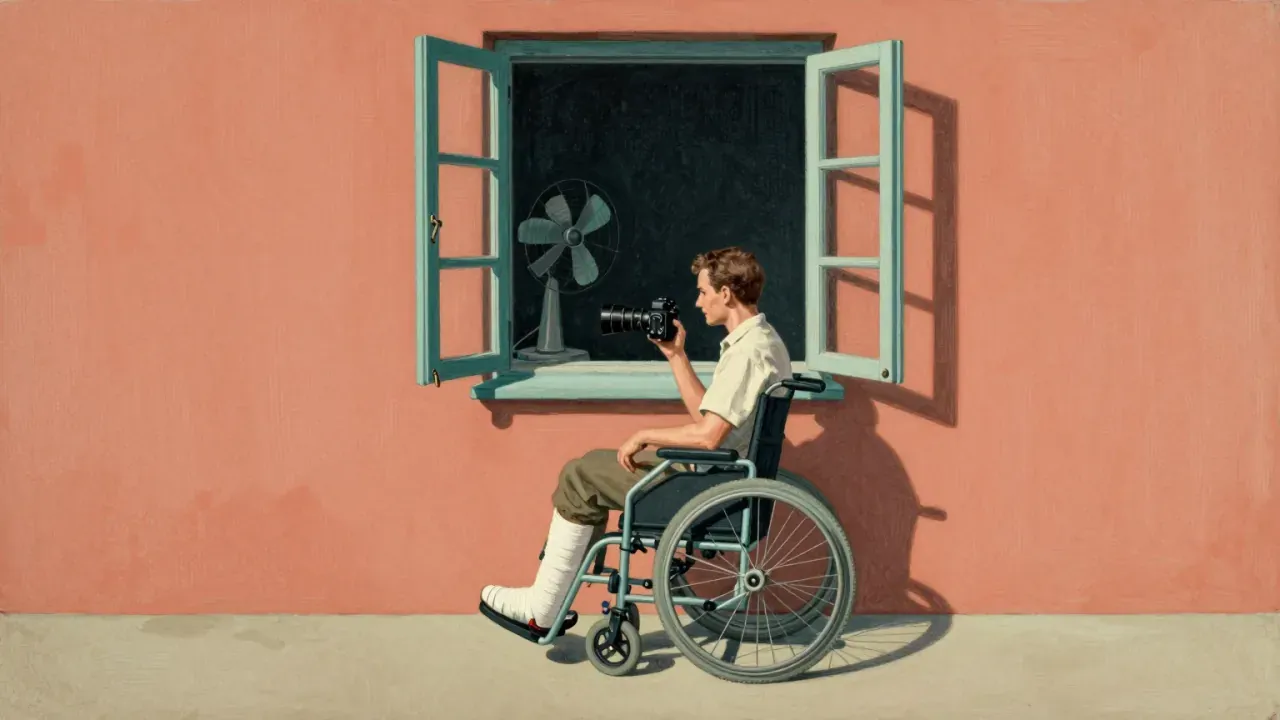
A thriller confined to one apartment
Rear Window is Alfred Hitchcock’s 1954 experiment in confining an entire thriller to what one man can see from an armchair. Adapted by John Michael Hayes from a Cornell Woolrich short story about a bedridden man who suspects a neighbour of murder, it strands photojournalist L. B. Jefferies (James Stewart) in his Greenwich Village apartment with a broken leg and nothing to do but watch his neighbours through the rear window over a heatwave, until watching curdles into surveillance and then into an accusation of murder. The whole picture is shot from inside Jefferies’s apartment and the courtyard beyond it, so the audience is placed exactly where he is, able to see everything except what actually matters.
A courtyard built to be watched
Jefferies watches a newlywed couple, a dancer nicknamed Miss Torso, a blocked songwriter, a lonely woman who mimes dinner dates with imaginary suitors, and travelling salesman Lars Thorwald (Raymond Burr), whose bedridden wife disappears one night after a scream and breaking glass. Girlfriend Lisa Fremont (Grace Kelly) and nurse Stella (Thelma Ritter) are sceptical until the evidence piles up, and it is Lisa, not Jefferies, who eventually climbs into Thorwald’s apartment to search it herself. The entire courtyard, spanning several storeys of separate apartments, was built as a single set on a Paramount soundstage, complete with a drainage system for the rain sequence and four interchangeable lighting rigs for morning, afternoon, evening and night. Robert Burks shot it, Franz Waxman scored it, and George Tomasini cut it, the same editor Hitchcock would use on Psycho six years later.
The opening shot and the crossing of the courtyard
The construction is the film’s real subject: nearly ninety unbroken seconds open the picture, introducing Jefferies, his cast, his camera and his neighbours without a line of dialogue, achieved in ten takes after weeks of rehearsal. Every plot beat arrives as something glimpsed at a distance and interpreted rather than confirmed, which makes Lisa’s decision to cross the courtyard herself the film’s most alarming moment, because for once the audience’s viewpoint and the danger occupy the same room. The soundtrack drifts in from other apartments rather than sitting over the picture, a songwriter’s half-finished tune, a radio, a party, so the courtyard feels lived-in rather than staged, even though every inch of it was built for the camera.
A villain built thin, a heatwave resolved too neatly
Thorwald himself remains a fairly thin presence next to the ingenuity around him; Raymond Burr is required mostly to look ordinary and then guilty, and the film has little interest in him as anything beyond a function of Jefferies’s suspicion. The device of a photojournalist with a coincidentally photogenic courtyard occasionally strains credulity harder than Hitchcock seems to notice, and some of the supporting apartments, Miss Torso and Miss Lonelyhearts among them, resolve into fairly pat endings once the heatwave breaks, tidying away the ambiguity the middle of the film had carefully built up. It is a superbly engineered film that is sometimes more interested in its own mechanism than in the people living inside it.
Watching as a substitute for living
The film keeps returning to looking as a substitute for living: Jefferies photographs the world for a living and, laid up, turns the same professional detachment on his neighbours instead of on his own reluctance to marry Lisa. Every apartment across the courtyard offers a version of the relationship he is avoiding, newlyweds, a lonely spinster, a marriage curdled into violence, and his voyeurism is never presented as harmless. Cities, in this telling, are stacks of unconnected rooms that a camera and a pair of binoculars can briefly wire together for one nosy convalescent. The courtyard is Greenwich Village rebuilt indoors down to its drainage system, and the film treats that artificiality as the point rather than as a compromise it had to make.
Who should sit through a fixed camera
It suits anyone interested in how much tension a director can build from a fixed camera position and a man who cannot leave his chair, and anyone who wants to see Grace Kelly given more to do than look elegant in Edith Head’s costumes, since she is the one who takes the physical risk here, not Stewart. It is less rewarding for viewers wanting momentum or changes of location, because the courtyard is the entire world for nearly two hours and the pace is patient rather than propulsive throughout. Anyone allergic to plots built on convenient coincidence should also be warned that the whole premise depends on one photogenic courtyard doing a great deal of narrative work.
Whether the patience pays off
On a budget of one million dollars that returned many times over at the box office, and a competition slot at the 1954 Venice Film Festival, Rear Window has held up as engineering rather than nostalgia; the single set, the lighting rig, and the unbroken opening shot still work exactly as intended decades later. It is not the fastest two hours in Hitchcock’s filmography, but it is one of the most exactly controlled, and the payoff of Lisa’s late scene inside Thorwald’s apartment justifies the patience the first half asks for. It is worth the evening, particularly on a screen large enough to make the courtyard feel like an actual place rather than a diagram.