The shape of the story
Red Cliff is a two-part Mandarin-language historical war film, released in 2008–09, adapting the Battle of Red Cliffs (208–209 AD) and its political prelude from the end of the Han dynasty. Directed by John Woo and co-written with Zou Jingzhi, it aims not at scholarly fidelity but at emotional resonance—Woo stated the film is only fifty per cent historically grounded, prioritising psychological texture and modern readability over chronicle accuracy. It seeks to reframe a foundational Chinese narrative as a human-scale drama of alliance, sacrifice, and tactical ingenuity, rather than mythic spectacle alone. The production scale is deliberate: shot across reservoirs in Hebei and studios in Beijing, with naval sequences staged on water, it treats landscape and logistics as active elements—not backdrop. Its ambition is structural as much as thematic: the full 288-minute version insists on duration as a condition of immersion, resisting the compression expected of international releases. This is not a primer for newcomers to the Three Kingdoms era, nor a revisionist critique; it is a ceremonial retelling, calibrated for collective memory and cinematic rhythm. (158 words)
The look of it
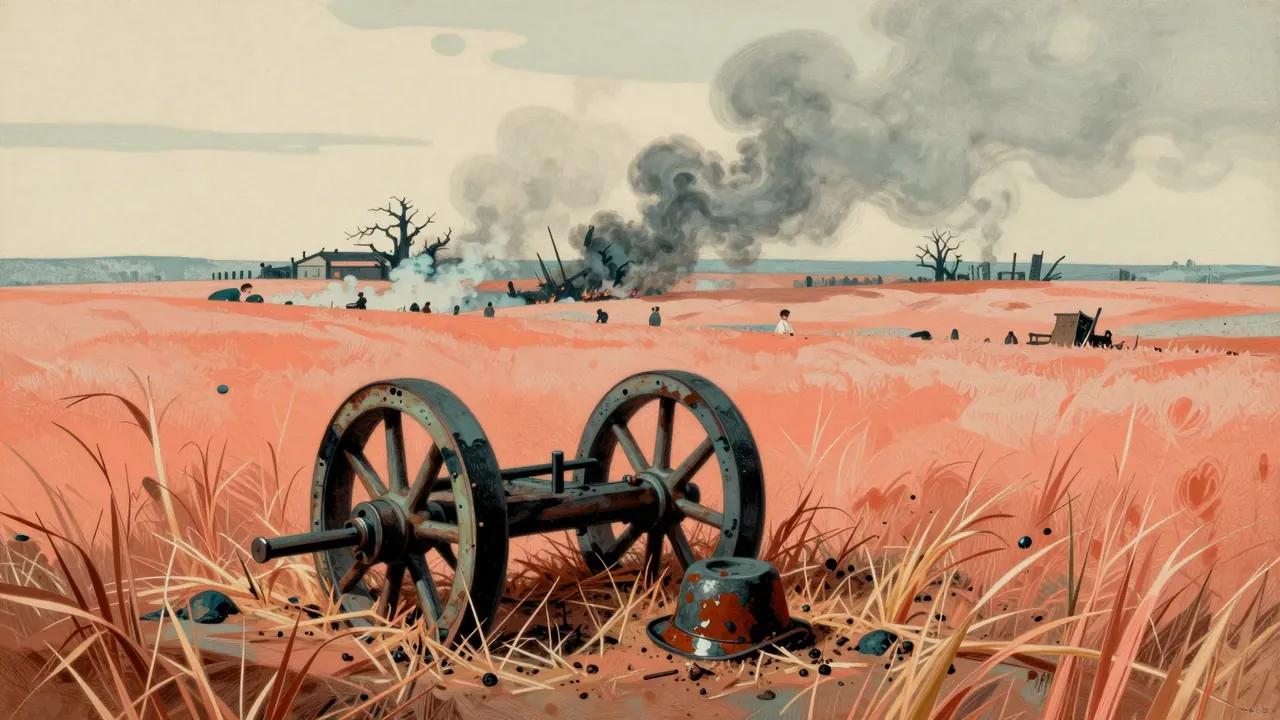
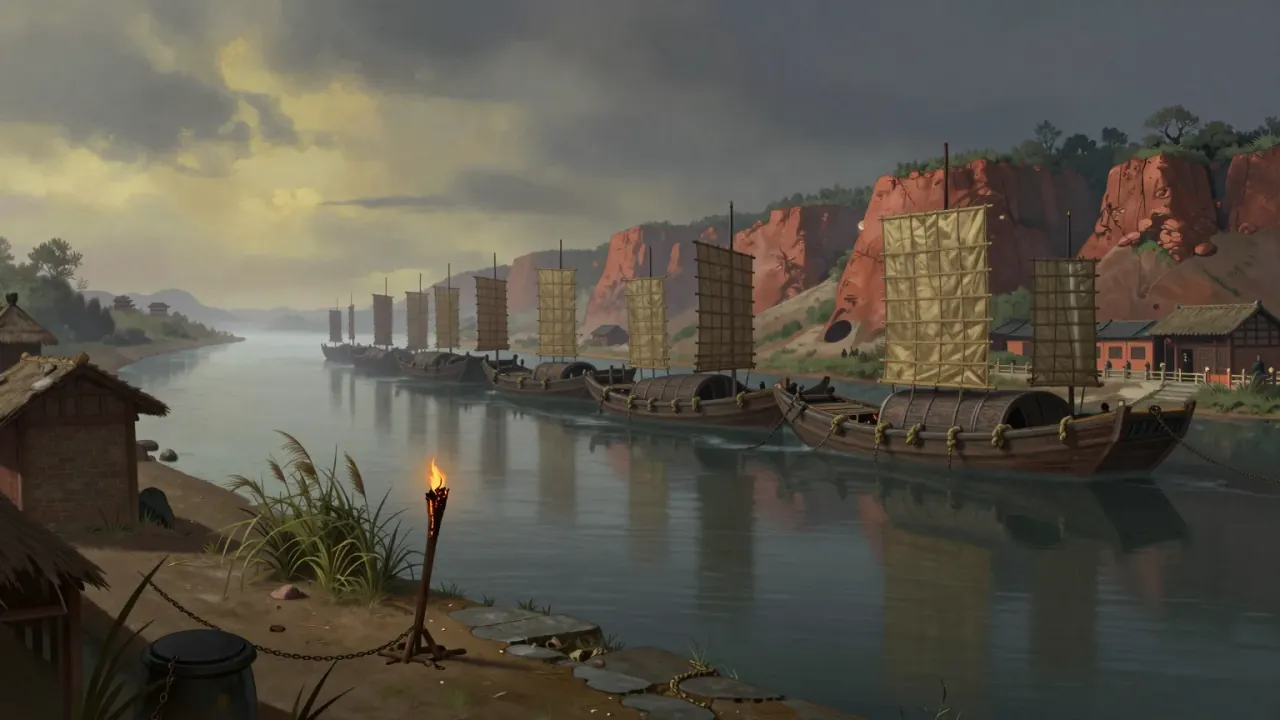
The story unfolds across two self-contained parts, each anchored by converging military and personal stakes: Liu Bei’s retreat, Zhuge Liang’s diplomacy, Sun Quan’s hesitation, and Cao Cao’s overreach. Tony Leung’s Zhou Yu carries quiet authority, while Zhang Fengyi’s Cao Cao balances imperial gravitas with flickers of isolation. Takeshi Kaneshiro’s Zhuge Liang avoids caricature, leaning into wry patience rather than oracle-like certainty. Lin Chi-ling’s Lady Sun moves with physical assurance, though her role remains circumscribed by narrative function. Lü Yue’s cinematography favours wide, steady compositions—water surfaces reflect sky and fire alike; battlefields are shot with spatial clarity, not disorientation. Taro Iwashiro’s score uses strings and percussion to underscore tension without melodrama. The editing sustains tempo across long sequences—banquets, tiger hunts, cuju matches—without rushing consequence. Costume and set design avoid ornamental excess; armour is worn, banners frayed. There is no digital dazzle for its own sake: visual effects serve geography and weather, especially the decisive wind shift that enables the fire attack. (159 words)
What holds weight
What lands is the film’s sense of gravity—not moral, but physical and temporal. The weight of decision-making sits with Sun Quan, not just in council but during his silent tiger hunt, where Zhou Yu’s presence and the forest’s stillness convey more than dialogue could. The interlocking of ships, the plague-ridden rafts drifting downstream, the tangyuan feast before battle: these are concrete, tactile moments that accumulate meaning through repetition and restraint. The fire assault itself is neither chaotic nor spectacularised; it is methodical, lit by torchlight and wind, with sound design emphasising crackle and creak over explosion. Zhao Wei’s Xiaoqiao has one scene—her solitary walk toward Cao Cao’s camp—that lands with understated force, precisely because it is brief and unadorned. Even minor figures register: Hu Jun’s Huang Gai commits to the feigned defection with grim resolve, and Nakamura Shidō II’s Lu Su offers calm counterpoint to Zhou Yu’s intensity. The film trusts its audience to follow cause and effect across extended passages—Zhuge Liang’s straw-boat ruse works because the earlier establishment of Cao Cao’s archery discipline makes the theft plausible. These choices cohere into a world where consequence is earned, not assigned. (157 words)
Where it slips
What does not land is the attempt to soften Cao Cao into tragic ambiguity. Zhang Fengyi delivers the lines with control, but the script gives him little interiority beyond pride and fatigue; his motivations remain strategic, not psychological. The subplot involving Xiaoqiao’s failed peace mission arrives too late and departs too abruptly to resonate—it feels tacked on, not integrated. Similarly, the typhoid plague sequence lacks epidemiological or emotional specificity: soldiers fall, but we see no care, no grief, no medical logic—only its utility as a plot device to fracture the alliance. The international cut’s truncation further undermines this, excising the slow erosion of morale that makes Liu Bei’s departure credible. Some performances suffer from underwritten arcs: Chang Chen’s Sun Quan is capable but muted, his evolution from doubt to command conveyed more through costume shifts than performance. The film also struggles with tonal consistency in domestic scenes—Lady Sun’s banter with soldiers veers into light comedy that clashes with the surrounding gravity. And while the two-part structure serves scale, the second part’s pacing sags in the middle third, where diplomatic manoeuvring and cuju training repeat motifs without deepening them. (159 words)
What it’s really about
The themes that matter are alliance as labour, not destiny; strategy as embodied knowledge, not abstract genius; and leadership as endurance under uncertainty. The Sun–Liu pact is forged not in a single oath but across multiple acts of risk—Zhuge Liang’s journey, Lady Sun’s infiltration, Zhou Yu’s acceptance of shared command. Tactics emerge from observation: the wind direction is noted, tested, then weaponised—not guessed at. Loyalty is shown in action, not declaration: Huang Gai’s self-immolation is preceded by his careful inspection of the enemy fleet, not a soliloquy. The film treats history not as settled record but as contested terrain: Cao Cao’s claim to legitimacy rests on imperial appointment, while Sun Quan’s rests on local consent and ancestral duty—neither is framed as inherently superior. Even the plague functions thematically: disease spreads not through malice but proximity and neglect, mirroring how political fractures widen when trust erodes. There is no triumphalism in victory—only exhaustion, cleanup, and the quiet return of civilians to riverbanks. The film’s deepest concern is not who wins, but what survives the winning: institutions, relationships, memory. (156 words)
Who it’s for
It is for viewers who value duration as a condition of understanding—those accustomed to multi-episode historical dramas or long-form theatre, who accept that character development may unfold across hours, not scenes. It rewards attention to composition, gesture, and silence. It is not for those who require rapid exposition, clear moral binaries, or protagonists whose inner lives dominate the frame. Anyone expecting the kinetic precision of Woo’s Hong Kong work—Hard Boiled, The Killer—will find Red Cliff slower, less stylised, more patient. Those put off by subtitled Mandarin dialogue or unfamiliarity with the Romance of the Three Kingdoms may struggle, though the film does not assume prior knowledge. A viewer who finds the 148-minute international cut coherent may still miss the cumulative weight of the full version—but that is not a flaw in the film, only a limitation of the format. Someone who values historical rigour above all will object to the fifty-per-cent licence Woo claims; they are right to do so, and their objection stands. What would change the verdict? A tighter edit of Part II’s middle section, or deeper integration of Xiaoqiao’s arc. (158 words)
Is it worth your evening?
Yes, it is worth your evening—if you give it the time it asks for. Not the 148-minute cut, but the full two-part version: its length is structural, not indulgent. The film earns its runtime through accumulation—of detail, of consequence, of atmosphere. You will not leave energised, but unsettled in a productive way: aware of how alliances form, how plagues move, how wind decides battles. It is not escapist; it is grounding. Those who dislike slow-burn historical epics, or who need immediate narrative payoff, will find it arduous. But for anyone willing to sit with its rhythms—the lapping water, the clink of cups, the pause before an order is given—the film repays attention with quiet authority. It does not shout its themes; it lets them settle like ash after fire. Its value lies in its refusal to simplify complexity, even at the cost of accessibility. That refusal is deliberate, not accidental—and it is why the film endures beyond its box-office records or aggregate scores. To watch it is to accept history not as verdict, but as process. (159 words)