A cop film, not a crime film
Hard Boiled is a Hong Kong action film conceived as John Woo’s corrective to his own earlier gangster-centred work: it places the police, not criminals, at its moral and narrative centre. Released in 1992, it was intended as a local counterpart to Dirty Harry — a tough, jazz-playing inspector operating within a corrupt system but bound by duty, not code. The film’s stated ambition was to glorify law enforcement without softening its violence or simplifying its dilemmas. It does not disguise its genre scaffolding; it leans into it, using the conventions of heroic bloodshed — double guns, slow-motion dives, sacrificial loyalty — to dramatise institutional integrity under siege. The script, co-written by Woo and Barry Wong before Wong’s death, underwent continuous revision during filming, with major plot elements — including Tony Leung’s undercover role — developed mid-shoot. This iterative process reflects the film’s core orientation: less a fixed statement than an urgent, physical argument about where authority resides when institutions fail.
How it moves
The story follows Inspector Tequila (Chow Yun-fat) as he infiltrates a Triad syndicate, only to find his path entwined with that of Alan (Tony Leung), an undercover officer whose cover has eroded to the point of psychological fracture. Their relationship anchors the film’s emotional architecture, though neither performance relies on interior monologue; Chow conveys resolve through posture and timing, Leung through micro-expressions of exhaustion and doubt. Gordon Willis is not involved; Michael Gibbs scores the film with live jazz arrangements that punctuate rather than soothe. The cinematography — credited to Poon Hang-sang — favours long takes, low angles, and mobile framing, particularly in the hospital sequence, where a five-minute unbroken shot weaves through corridors, elevators, and delivery rooms. Stunt choreography by Philip Kwok treats space as tactical terrain: staircases become slides, teahouse balconies become firing platforms, maternity wards become labyrinths of concealment. Dialogue is sparse and functional; exposition arrives in glances, gun placements, and the rhythm of reloads.
The hospital
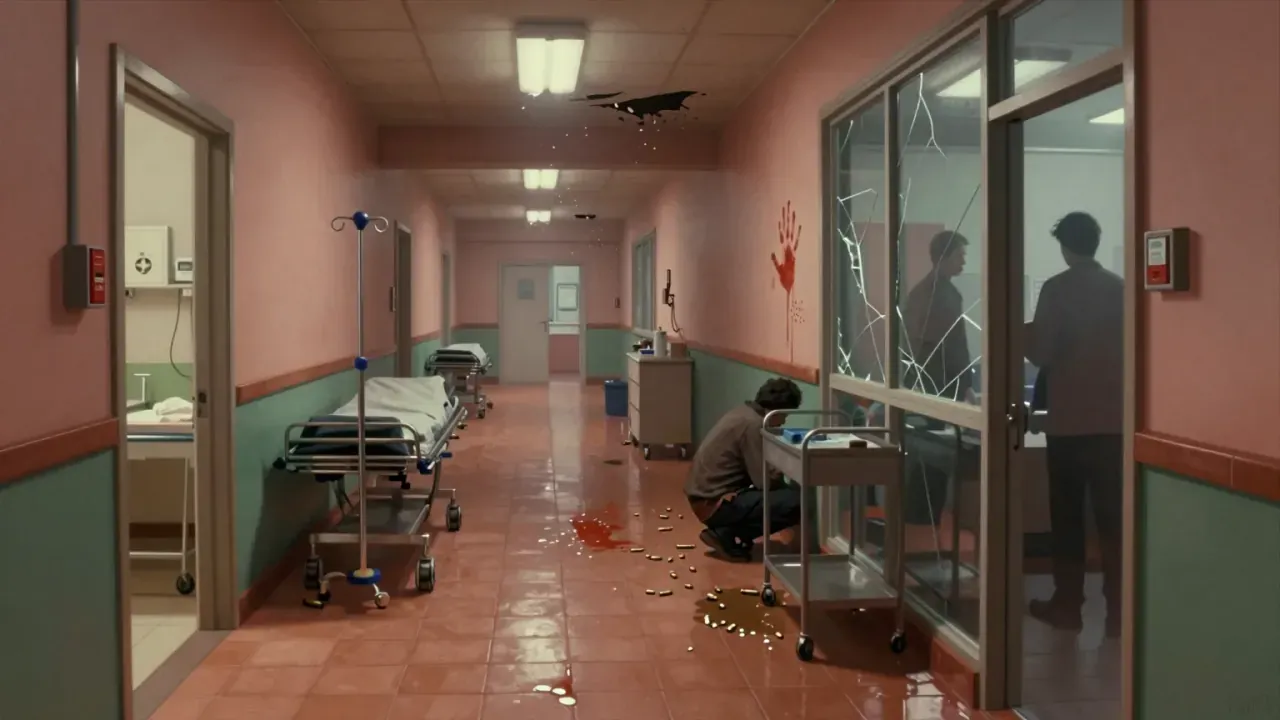
What lands most decisively is the hospital shootout: forty days of shooting condensed into a sustained, spatially coherent set piece that balances chaos with clarity. Its scale feels earned, not inflated — every explosion, every ricochet, every shift from corridor to stairwell serves the logic of pursuit and containment. The film’s kinetic grammar — the way bodies move in relation to doors, windows, and furniture — remains legible even at speed. Chow Yun-fat’s Tequila works because he is neither invulnerable nor infallible; his clarinet playing and quiet grief over fallen colleagues ground him without sentimentalising him. The jazz-inflected score avoids pastiche by refusing to mimic American noir; instead, Gibbs’ brass lines jab and recede like breath held too long. Even minor characters register: Anthony Wong’s villainy is terse and procedural, not theatrical; Teresa Mo’s Teresa Chang carries weight not through dialogue but through duration — her presence across multiple scenes builds quiet narrative gravity without exposition.
Where the wire snaps
What does not land is the film’s attempt at thematic balance between cop-as-hero and cop-as-flawed-institutional-agent. Tequila’s personal life remains underdeveloped — the cuts to his relationship with Teresa Chang leave their bond vague, and the absence of the clarinet-over-grave scene hollows out his mourning. The film gestures toward systemic critique — corruption in the police force, compromised informants, bureaucratic indifference — but never sustains it; these elements surface then vanish, subsumed by the next chase or gunfight. The improvisational production process shows in structural seams: the tea house sequence feels tonally distinct from the rest, its stylisation more self-conscious; the warehouse finale lacks the spatial coherence of the hospital, relying instead on repetition of motifs rather than escalation of stakes. Some performances suffer from dubbing — not technically, but rhythmically — flattening vocal texture and undercutting moments meant to pivot on hesitation or irony.
What endures
The themes that matter are duty as endurance, loyalty as risk, and authority as performance. Tequila does not win through superior firepower but through persistence: he returns to the same locations, re-enters the same rooms, reloads the same gun — each repetition a refusal to cede ground. The film treats police work not as justice delivered but as vigilance maintained, often without reward or recognition. Alan’s undercover identity fractures not from moral compromise but from temporal dislocation — he forgets which name he answers to, which uniform he wears, which side of the door he belongs on. Jazz functions as metaphor: improvisation within structure, discipline enabling freedom, solo lines emerging from ensemble rhythm. The hospital setting reinforces this — a place of birth and crisis, order and emergency, where the line between protector and protected blurs. These ideas do not appear in speeches; they emerge from staging, editing choices, and the physical toll registered on faces after prolonged gunfire.
Who it’s for
This film is for viewers who value choreographed movement as narrative, who follow action not for plot resolution but for spatial intelligence and rhythmic precision. It rewards attention to how a character enters a room, how a camera tracks alongside a falling body, how silence tightens before a burst of gunfire. It is not for those who require psychological exposition, consistent world-building, or moral ambiguity resolved through dialogue. Anyone expecting a procedural or a character study will find the pacing impatient and the motivations opaque. Those put off by stylised violence — particularly the extended use of slow motion during injury — may find the hospital sequence alienating rather than immersive. A viewer who values thematic density over kinetic coherence will likely judge the film as all gesture, no gravity. Change the emphasis from movement to motive — deepen Tequila’s backstory, clarify the chain of command, let the corruption subplot breathe — and the film’s ambitions would align more fully with its execution.
Is it worth your evening
Yes, it is worth your evening — not as a casual watch but as an engaged one, requiring attention to craft over comfort. Its 123 minutes pass with urgency because the film refuses inertia: every frame either advances geography, recalibrates threat, or shifts relational balance. It demands nothing beyond willingness to follow physical logic — where a door opens, who is behind it, what weapon is drawn first — and rewards that attention with sequences few films have matched for sheer logistical audacity. Those who dislike long takes, distrust stylisation, or expect moral clarity will not find satisfaction here. But for anyone interested in how cinema constructs tension through space, time, and repetition — not just spectacle but syntax — Hard Boiled remains a masterclass. Its influence is visible everywhere, yet its originality lies in how little it explains and how much it trusts the eye to comprehend. Worth watching once for the hospital, twice for the teahouse, three times for the way Chow Yun-fat reloads a revolver while walking backward down stairs.