A fable in colour
The Drum is a 1938 British Technicolor adventure film produced by London Films, set on the North-West Frontier during the British Raj. It adapts A. E. W. Mason’s 1937 novel and forms the middle instalment of Zoltan Korda’s imperial trilogy — bracketed by Sanders of the River (1936) and The Four Feathers (1939). Its stated purpose is narrative propulsion within an imperial frame: to dramatise loyalty, legitimacy, and threat through the succession crisis in the fictional kingdom of Tokot. It positions British authority as stabilising, local agency as derivative, and resistance as illegitimate unless channelled through approved figures like Prince Azim. The film does not conceal its alignment; it assumes the moral and administrative primacy of the colonial administration, treats the Durand Line as a natural frontier, and renders all non-British political action either subservient or seditious. Its visual grammar — Technicolor saturation, regimental pageantry, mountain vistas — serves that premise. It is not ambiguous about its hierarchy of competence, virtue or sovereignty. It is a work of state-aligned storytelling, made at a moment when Britain’s imperial confidence was still formally intact but increasingly contested in practice. Word count: 149
The boy and the drum
The story follows Captain Carruthers’ undercover surveillance of arms smuggling, the assassination of Tokot’s king by his brother Ghul, and Prince Azim’s flight and eventual return to sound the warning on the Sacred Drum. Sabu Dastagir carries the emotional core as Azim, his performance grounded in physical presence and quiet resolve rather than exposition. Raymond Massey’s Ghul is tightly coiled, theatrical without caricature; Valerie Hobson and Roger Livesey lend restraint to their British roles. Georges Périnal and Osmond Borradaile’s cinematography alternates between crisp studio interiors and location-shot terrain — Chitral’s ridges, Rhinog Fawr’s granite slopes — lending texture without illusion of documentary realism. The mountain battery sequence, muleback radio, and Gordon Highlanders’ insignia are rendered with procedural fidelity. John D. H. Greenwood’s score avoids quotation but sustains rhythmic urgency, particularly in the drum motifs. Henry Cornelius’ editing maintains forward motion, though some transitions between Peshawar and Tokot feel abrupt, relying on title cards rather than spatial logic. Word count: 152
The pass and the plateau
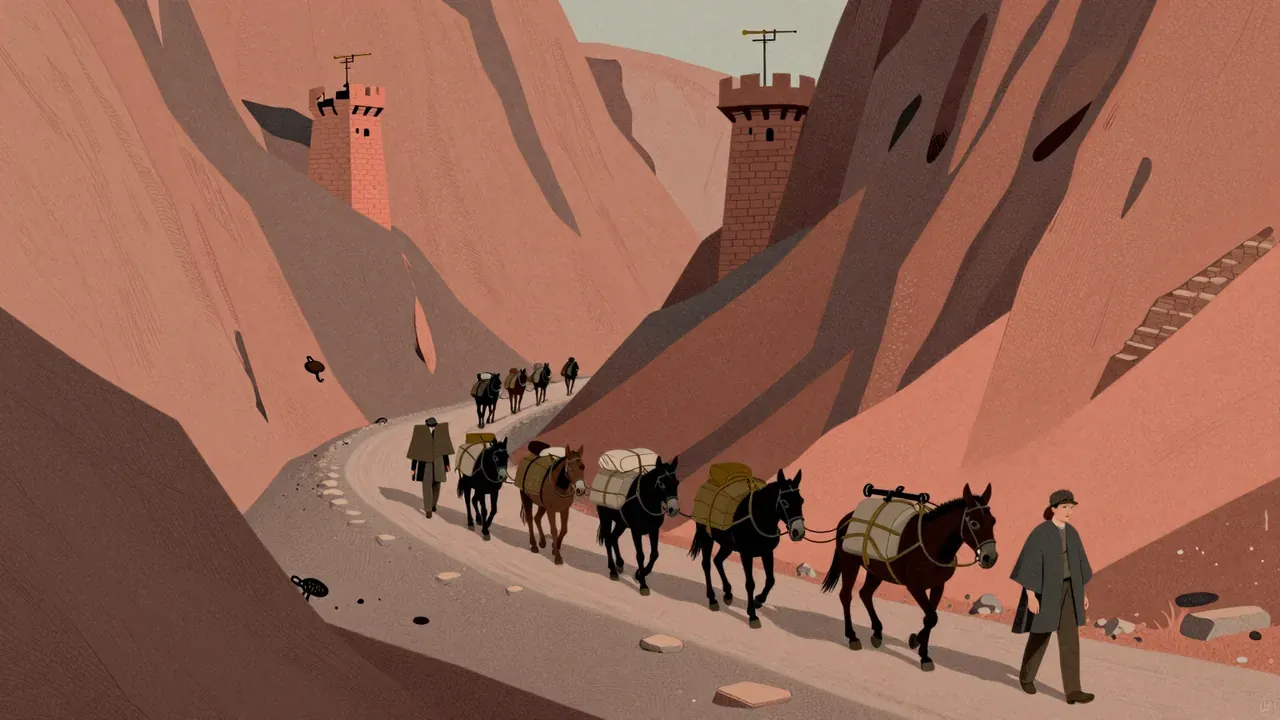
What lands is the film’s sense of place as contested geography. The Khyber Pass is not backdrop but active agent: narrow passes, watchtowers, dust-choked roads all function as narrative pressure points. The drum itself — both instrument and plot device — works because its symbolic weight is earned through repetition: Bill Holder teaches it, Azim learns it, Ghul dismisses it, and finally it carries meaning across language and rank. The military detail feels researched: the unlimbering of the mountain gun, the cut of the Gordon Highlanders’ kilts, the radio’s portability — these are not decorative but structurally integrated. Sabu’s physicality anchors the film’s moral pivot: his refusal of sanctuary in Peshawar is understated but decisive, signalling agency without rhetoric. The climax avoids spectacle for precision — Azim’s run, the drum’s signal, the delayed British response — all land because they follow from established cause and consequence. There is no last-minute cavalry charge; instead, confirmation arrives after the warning, making the rescue procedural, not miraculous. Word count: 154
The usurper’s silence
What does not land is the film’s conception of motive. Ghul’s ambition is presented as personal malice rather than political grievance, and his Gallipoli reference — meant to suggest strategic modernity — remains isolated, unconnected to any critique of empire or war. His courtiers speak in vague proclamations about ‘the old ways’, but the film supplies no counter-narrative to British administration beyond superstition or fanaticism. The Indian characters outside the royal family are near-silent, functioning as scenery or threat rather than individuals. Even the loyal retainers who shelter Azim have no names, no lines, no interiority. The treaty signed with Tokot is treated as inherently benevolent, with no suggestion of coercion, asymmetry or prior history. When protests erupted in Bombay and Madras, they were not misread: the film does frame resistance as irrational, loyalty as innate to ‘good’ natives, and British intervention as self-evidently corrective. That framing now reads less as period piece than as unresolved ideological residue. Word count: 153
How orders travel
The themes that matter are legitimacy, transmission, and the materiality of power. Legitimacy is embodied in regalia — the drum, the crown, the kilt — and tested through succession, not ideology. Transmission operates across three registers: musical (Bill teaching Azim), tactical (Ghul citing Gallipoli), and institutional (the governor signing treaties, Carruthers relaying intelligence). Power is shown not as abstract but as logistical: radio sets carried by mule, guns disassembled for transport, battalions moved along rail and road. The film’s attention to infrastructure — how orders travel, how weapons move, how sound carries across valleys — gives its imperialism a granular, almost bureaucratic texture. It is less about flag-waving than about the daily mechanics of control: timing, routing, verification. That makes its assumptions more durable, and more difficult to dismiss as mere costume drama. The tension is not between good and evil but between order and its breakdown — and the film defines order exclusively through British administrative continuity. Word count: 149
The frame as fact
It is for viewers who want to see how imperial ideology was built into the grammar of 1930s British cinema — not as subtext but as syntax. Historians of colonial representation, students of Technicolor’s early use in location shooting, or those studying the Korda studio’s relationship with the Foreign Office will find it instructive. It is not for those seeking ethical complexity, psychological depth in non-British characters, or narrative distance from its worldview. Anyone expecting critique of empire within the film itself will be disappointed; its value lies in its transparency, not its ambiguity. Those who object to its framing — as audiences in Bombay and Madras did — are not misreading it. A different verdict would require the film to question its own premises, which it does not. Word count: 149
What the drum really says
Yes, it is worth your evening — but only if you watch it as a primary source, not as entertainment. Its 104 minutes unfold with deliberate pacing, its colours remain vivid, its action sequences are tactically coherent, and Sabu’s performance retains its quiet force. It rewards attention to craft: Périnal’s use of shadow in the fort interiors, the way the drum’s rhythm cuts across dialogue, the precise choreography of the mountain battery deployment. What makes it worthwhile is not timelessness but specificity: it shows exactly how a major British studio in 1938 imagined stability on the frontier — down to the cap badge, the radio frequency, the drum’s pitch. To skip it is to miss a calibrated artefact of its moment. Those who demand moral resolution or character interiority will find it hollow. But as evidence of how empire looked, sounded and moved on screen, it holds up. Word count: 149