The scale of it
War and Peace is a four-part Soviet film adaptation of Leo Tolstoy’s 1869 novel, released across 1965 and 1967. Directed by Sergei Bondarchuk, it attempts to render the novel’s scale—not just its historical sweep across the Napoleonic Wars and Russian aristocratic life, but its structural ambition: the interweaving of intimate psychology with massed historical forces. It does not aim for fidelity in every detail—certain subplots are trimmed, philosophical digressions excised—but seeks authoritative embodiment: of period texture, military choreography, and moral gravity. Its method is monumental realism: thousands of soldiers as extras, authentic uniforms and artillery, museum-sourced interiors, horses sourced from army units and police regiments. The production was state-backed, explicitly conceived as a cultural counterweight to King Vidor’s 1959 American-Italian version, and intended to affirm Soviet cinematic capacity on world-historical terms. It treats Tolstoy not as a source to be interpreted, but as terrain to be occupied—physically, logistically, and ideologically. This is adaptation as national undertaking, not personal reading. (142 words)
The look of it
The film works through cumulative physical presence rather than narrative economy. Story is carried less by plot propulsion than by duration and density: battle sequences unfold over minutes without cuts to close-ups; ballroom scenes hold on wide compositions long enough for costume, gesture, and hierarchy to register. Performances are restrained, even muted—Tikhonov’s Andrei carries exhaustion more than anguish, Savelyeva’s Natasha avoids coquetry in favour of unguarded physicality, Bondarchuk’s Pierre is broad-shouldered and slow-speaking, his interiority conveyed through pauses and weight rather than monologue. Cinematography by Petritsky, Chen, and Shelenkov uses Soviet 70mm stock despite its technical flaws, favouring deep focus and low-angle crowd shots that emphasise scale over intimacy. Vyacheslav Ovchinnikov’s score is solemn, sparing, and often silent during key moments—leaving space for hoofbeats, cannon recoil, or silence after a wound. Editing avoids rhythmic patterning; transitions are often functional, even abrupt. The craft serves accumulation, not emphasis: this is cinema built to withstand scrutiny over hours, not reward attention in seconds. (154 words)
The weight of it
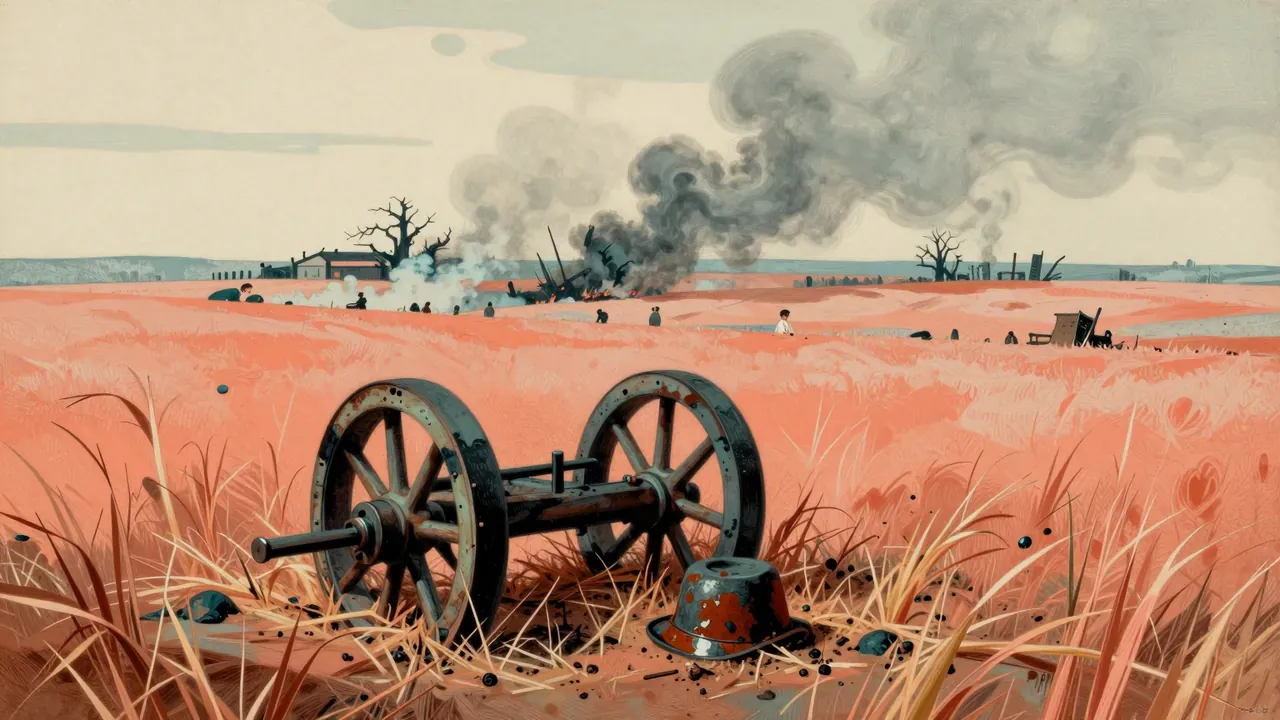
What lands is the sheer fact of its materialisation—the visible proof of collective effort. The Borodino sequence remains unmatched in its depiction of chaotic, unheroic mass combat: no central hero, no clear geography, just smoke, stumbling men, and collapsing formations filmed with hundreds of extras moving under real artillery fire. Interiors feel lived-in, not dressed: chandeliers hang where museums lent them, furniture bears the dents of actual use, uniforms show wear consistent with campaign length. Even minor characters register through posture and costume—Arepina’s Sonya, for instance, is defined by her lowered gaze and tightly bound hair, not exposition. The film’s patience with stillness also pays off: long takes of Natasha dancing alone in a sunlit room, or Pierre walking across snow at dawn, carry emotional weight precisely because they refuse to underline it. These moments do not argue for meaning—they assume it, and trust the viewer to meet them on their own time. The authenticity is procedural, not stylistic: it emerges from logistics, not lighting. That consistency of commitment—across 432 minutes—is what endures. (148 words)
The gaps in it
What does not land is the philosophical scaffolding Tolstoy built into the novel. The film omits or flattens his arguments about historical causality, free will, and the irrelevance of ‘great men’—replacing them with conventional dramatic arcs: Andrei’s redemption, Natasha’s maturation, Pierre’s awakening. Without the textual counterpoint, these arcs feel schematic, especially in the later parts where moral resolution arrives too tidily. Some performances falter under the weight of duration: Tabakov’s Anatole lacks menace, becoming merely petulant; Khmelnitsky’s Dolokhov feels like a caricature sketched in haste. The decision to cast Bondarchuk as Pierre—a choice rooted in physical conception rather than acting range—results in a protagonist whose inner life remains opaque, even when the script demands introspection. The 70mm film stock’s technical instability shows in inconsistent grain and occasional exposure shifts, breaking immersion without adding texture. And while the battle scenes impress as spectacle, they rarely achieve psychological coherence: the camera stays at a remove, observing chaos rather than guiding us through it. What is grand in scale is sometimes thin in insight. (152 words)
The thought in it
The themes that matter are endurance, contingency, and the erosion of individual agency before history’s tide. Not the grand pronouncements on fate, but the quiet evidence: a soldier adjusting his shako before charge, a servant folding a coat after a ball, a horse stumbling mid-gallop and vanishing into smoke. The film insists on the body’s limits—fatigue, injury, hunger—as the true measure of war, not ideology or glory. Class is rendered not through dialogue but through spatial logic: servants move behind pillars, aristocrats occupy centre frame, soldiers fill the margins until they overrun them. Time itself becomes thematic: the pacing refuses acceleration, mirroring Tolstoy’s belief that history unfolds in accumulated instants, not decisive moments. Even love is shown as habit before passion—Natasha and Andrei’s early courtship is all glances and silences, their later reunion weighted with unspoken years. There is no transcendence here, only persistence: the Rostov estate reappears, scarred but intact; Pierre walks on, unchanged in stature but altered in gait. The film’s moral universe is secular, embodied, and stubbornly local. (146 words)
The demand of it
It is for viewers who accept duration as argument, not obstacle—who find value in watching wheat fields sway for two minutes, or in counting uniforms across a battalion. It suits those familiar with Tolstoy’s novel, not for comparison, but for calibration: the film’s omissions clarify what the book insists upon. It repels those needing narrative velocity, psychological exposition, or stylistic flourish—viewers who expect editing to shape meaning, not merely record it. Anyone requiring clear moral binaries or character arcs with closure will leave frustrated. Those who associate ‘epic’ with mythic elevation rather than granular realism may mistake its plainness for dullness. A critic who values concision over accumulation—like David Thomson, who called it ‘cinema as civic duty’—would reject its methods outright. Nothing would change this verdict except shortening it: cutting it to three hours would collapse its central premise, which is that history cannot be summarised. Its audience is narrow but not niche—it is for anyone willing to sit inside time, not just pass through it. (144 words)
The effect of it
Yes, it is worth your evening—if you set aside an evening, not just part of one. Its value lies not in entertainment but in recalibration: after 432 minutes of sustained attention to physical consequence—of wounds, weather, weight, waiting—you perceive ordinary films differently. It rewards patience not with payoff, but with perspective. You emerge not with a story resolved, but with a sense of scale restored: how small decisions accrue, how large forces dissolve individuals, how resilience looks less like triumph and more like continued breathing. Those who dislike it usually object to its refusal to assist—to translate, to highlight, to conclude. But assistance is the opposite of its purpose. To watch it is to submit to its terms: no fast-forward, no skipping, no pausing to check messages. It asks for time as a material, not a resource. If you treat time that way already, it confirms you. If you don’t, it may unsettle you—and that, too, is worth the evening. (143 words)