filmbriefs
Actor · 1933–2021

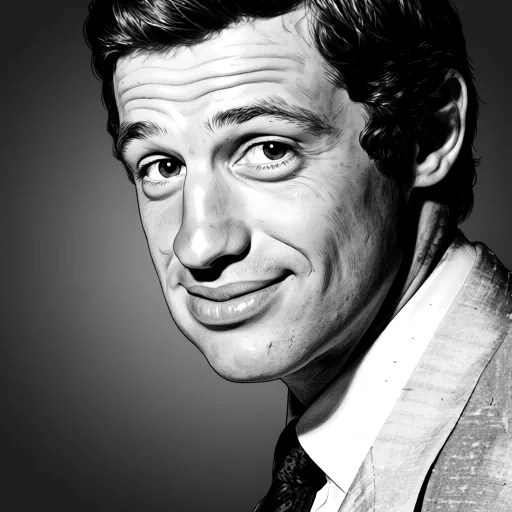
Jean-Paul Belmondo

7
briefs
13:00
average
91 min
in total
On film.briefs7
13:00

A Woman Is a Woman

Jean-Luc Godard · 1961

Jean-Luc Godard’s 1961 colour debut is a self-aware, formally restless romantic comedy starring Anna Karina as Angéla, an exotic dancer determined to have a child. Shot in Paris by Raoul Coutard and scored by Michel Legrand, it uses musical interludes, abrupt edits, and stylised dialogue to interrogate genre conventions, gender roles, and the language of desire — all without relinquishing its wit or warmth.
13:00

Classe tous risques

Claude Sautet · 1960

Claude Sautet’s 1960 crime film follows a fugitive gangster who returns to Paris with his sons, seeking help from former associates now settled into bourgeois comfort. As old loyalties fray and new alliances prove fragile, his attempt to secure a future ends in isolation and inevitability. Shot with restraint by Ghislain Cloquet and scored with quiet melancholy by Georges Delerue, it is a study in moral erosion, not spectacle.

13:00

Le Doulos

Jean-Pierre Melville · 1962

Jean-Pierre Melville’s 1962 crime film Le Doulos follows Maurice Faugel and Silien through a web of murder, deception, and mistaken identity. Adapted from Pierre Lesou’s novel, it uses stark cinematography, elliptical editing, and functional dialogue to construct a closed system of cause and effect — where truth is assigned, not revealed, and loyalty is procedural, not emotional.

13:00

Léon Morin, Priest

Jean-Pierre Melville · 1961

Set in German-occupied France, Léon Morin, Priest follows Barny, a widowed atheist and communist, as she enters a theological dialogue with a young priest. Their conversations—calm, rigorous, unresolved—unfold against a backdrop of scarcity and danger. Directed by Jean-Pierre Melville and adapted from Béatrix Beck’s novel, the film resists melodrama, preferring quiet precision in performance, cinematography, and structure. It is less about conversion than continuity: how people maintain moral shape when the world collapses around them.

13:00

One Hundred and One Nights

Agnès Varda · 1995

Agnès Varda’s One Hundred and One Nights (1995) is a French comedy essay-film set over 101 nights at a château belonging to Simon Cinéma, a centenarian film veteran whose fading memory blurs reality and reel. Starring Michel Piccoli and featuring cameos from Marcello Mastroianni, Anouk Aimée, Alain Delon, and others, it weaves scripted scenes with archival clips and playful allusion to celebrate cinema’s first hundred years — not as chronicle, but as collective, tactile memory.

13:00

Pierrot le Fou

Jean-Luc Godard · 1965

Jean-Luc Godard’s 1965 Pierrot le Fou stars Jean-Paul Belmondo and Anna Karina as a couple fleeing Paris for the Mediterranean, pursued by gangsters and their own unraveling ideals. Shot by Raoul Coutard in vivid primary colours and edited with jarring, associative cuts, it abandons its source novel’s noir framework to become a pop-art-inflected meditation on love, language, and political fatigue. Its power lies in sensation over sense: the weight of a glance, the shock of blue paint, the silence after a firework.

13:00

Breathless

Jean-Luc Godard · 1960

Jean-Luc Godard's 1960 debut sends a car thief who idolises American gangsters, played by Jean-Paul Belmondo, on the run through Paris after he shoots a policeman, hiding out with an American girlfriend played by Jean Seberg who is unsure whether to protect him or turn him in. Shot handheld on repurposed still-camera film stock with almost no lighting, and cut with jump cuts that were reportedly not planned during filming, it became one of the founding statements of the French New Wave.