What it is trying to be
Planet of the Apes is a 2001 studio remake of the 1968 film, itself adapted from Pierre Boulle’s 1963 novel. Directed by Tim Burton and produced by Richard D. Zanuck and Ralph Winter, it attempts to reinvigorate the franchise through visual spectacle, star casting, and a time-loop twist — not as philosophical inquiry but as high-concept action-adventure with mythic scaffolding. It abandons the original’s Cold War allegory and ironic pessimism in favour of physical scale, prosthetic grandeur, and a plot-driven escalation toward spectacle. The film does not seek coherence across its own internal logic so much as momentum: each set piece must outdo the last in texture, contrast, or confrontation. Its ambition lies less in rethinking ape society than in rendering it tactile — fur, armour, architecture, hierarchy — all under Philippe Rousselot’s burnished, amber-heavy cinematography. It is a film built for multiplex impact, not contemplation; its fidelity is to production design and tonal consistency, not narrative rigour or thematic depth. The script, rewritten multiple times before Burton’s involvement, treats the source material as a brand rather than a blueprint — a vessel for Burton’s gothic sensibility and Rick Baker’s makeup artistry, not a framework for sustained ideas. (158 words)
How it holds up
The story follows astronaut Leo Davidson (Mark Wahlberg) as he crash-lands on Ashlar, a planet ruled by apes who enslave humans. His arc — from captive to rebel leader — hinges on alliances with Ari (Helena Bonham Carter), a reformist chimpanzee, and resistance figures like Thade (Tim Roth), a brutal military commander. Roth reshaped his role for greater menace; Giamatti plays the opportunistic orangutan Limbo with W. C. Fields inflection; Duncan’s Attar is physically imposing but narratively inert. Performances are calibrated to genre convention: Wahlberg understated, Bonham Carter earnest, Roth theatrically sharp. Rousselot’s lighting favours chiaroscuro interiors and dusty exteriors; Elfman’s score pulses with percussive urgency and choral unease. Editing by Chris Lebenzon maintains pace but sacrifices spatial clarity in battle sequences. The prosthetics — supervised by Rick Baker — anchor the world: every ape’s face carries individualised wear, age, and authority. Yet the script’s exposition is clunky, character motivations thin, and cause-and-effect often suspended for the sake of a reveal. The craft serves atmosphere over coherence, and the performances serve their roles more than their relationships. (159 words)
What feels true
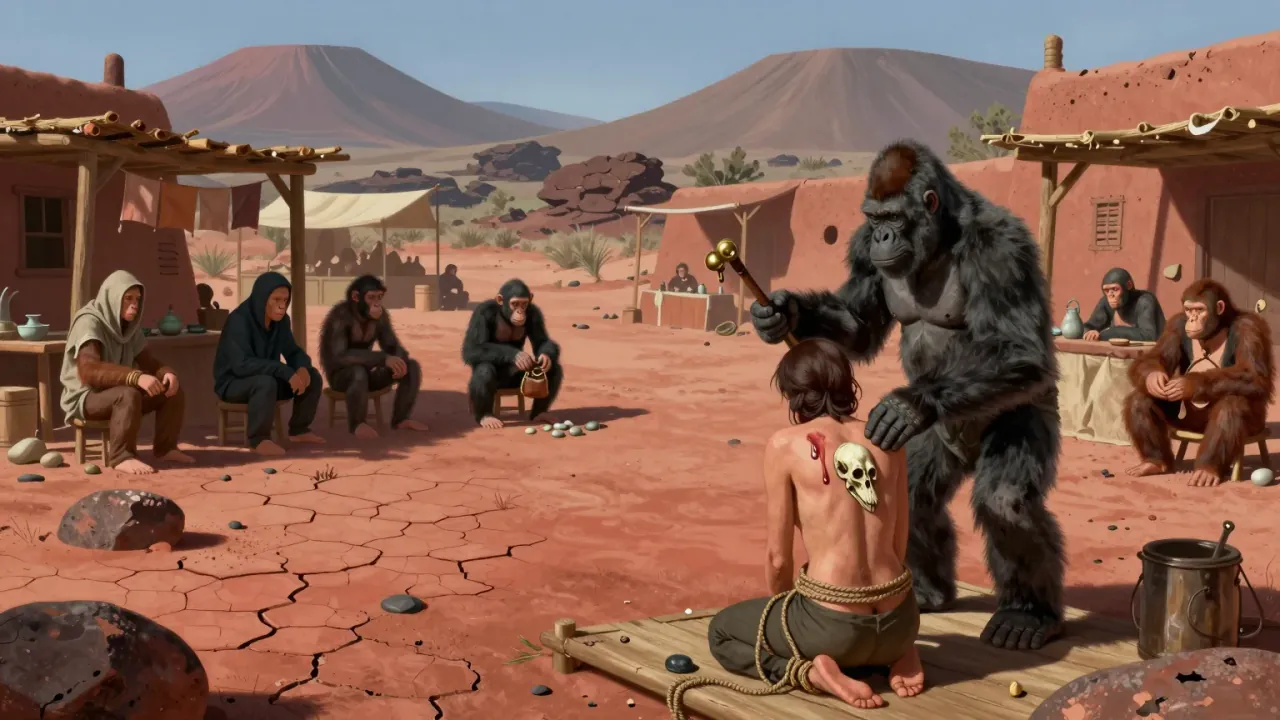
What lands is the sheer physical presence of the apes — their weight, posture, vocal timbre, and social choreography. Rick Baker’s makeup work gives each species distinct biomechanics: gorillas move with grounded heaviness, chimpanzees with nervous precision, orangutans with slow, calculating deliberation. The world feels inhabited, not assembled. Philippe Rousselot’s colour palette — burnt sienna, bruised ochre, deep slate — unifies the film’s tone without flattening its contrasts. Danny Elfman’s score avoids pastiche; its brass motifs echo imperial pageantry while its strings coil with dread. The opening sequence aboard the Oberon establishes routine and intimacy between human and ape before rupture, grounding the later absurdity in something recognisable. The temple reveal — the Oberon’s wreckage reimagined as sacred ruin — works visually and conceptually, a rare moment where design, writing, and revelation align. Even the final image — the Lincoln Memorial recast as Thade’s monument — lands with blunt, satirical force. These moments succeed because they rely on craft, not exposition: what is seen, heard, and felt outweighs what is explained. (157 words)
Where it breaks
What does not land is the screenplay’s structural logic. The time-loop twist depends on inconsistent rules: if Pericles entered the vortex first and arrived millennia earlier, why does his pod remain intact and functional? Why do the apes’ language, technology, and theology evolve identically to Earth’s, yet retain no memory of origin? The rebellion lacks strategic or emotional weight — humans gather, fight briefly, then disperse without consequence. Wahlberg’s Leo has no interiority beyond duty and protectiveness; his bond with Ari remains gestural, never developed. The supporting human cast — Kristofferson, Warren, Avari — are reduced to symbolic functions: father, love interest, resistance token. Dialogue frequently states theme instead of embodying it: ‘They treat us like animals’ is repeated, not interrogated. The satire of ape bureaucracy — senators, generals, traders — is present but shallow, never sharpened into critique. Even Burton’s signature stylisation feels muted: the sets are vast but lack the eccentric detail of his earlier work; the tone veers between grim and camp without resolving the tension. The film’s energy dissipates in the second half, substituting escalation for insight. (159 words)
What it’s really about
The themes that matter are not those announced in dialogue — ‘freedom’, ‘dignity’, ‘evolution’ — but those embedded in structure and image: the fragility of civilisation when stripped of shared memory; the ease with which power ossifies into dogma; the recursive violence of colonial logic, now reversed and mirrored. The apes do not merely rule — they ritualise domination, codify subjugation, and sanctify their own origin myth using human wreckage. Semos is both mutineer and deity, both liberator and tyrant — a figure whose ambiguity the film skirts but never explores. The film’s strongest idea is not about apes or humans, but about how stories become scripture when the archive is lost and the survivors forget who wrote them. That idea flickers in the Oberon’s log entries, in the apes’ misreading of technology as divinity, in the way Thade’s statue replaces Lincoln’s — not as irony, but as inevitability. Yet the script refuses to sit with this. It gestures toward cyclical history, then pivots to chase Pericles’s pod. The theme is present, but unexamined — a motif played once, then abandoned for noise. (156 words)
Who it’s for
This film is for viewers who prioritise immersive world-building over narrative precision, and who respond to Burton’s visual grammar — saturated colour, architectural weight, creaturely tactility. It rewards attention to costume detail, vocal modulation, and compositional rhythm. It is not for those who require psychological realism, causal plausibility, or thematic development: the script’s weaknesses are structural, not incidental. Fans of the 1968 film may find its moral gravity replaced by spectacle; students of adaptation may note how the remake privileges iconography over interrogation. Anyone seeking political allegory will be frustrated by its reluctance to commit — it shows hierarchy but does not dissect it, depicts oppression but does not trace its mechanisms. A viewer who values craft over coherence, or who watches for the pleasure of seeing a well-realised impossible world, will find value here. Those who demand logic, depth, or restraint will not. Nothing in the film changes that divide — not the budget, not the cast, not the prosthetics. It is what it is, and its appeal is categorical, not negotiable. (158 words)
Is it worth your time
It is worth your evening if you watch it as a crafted artefact — a late-studio blockbuster built on artisanal labour, not algorithmic efficiency. Its 120 minutes pass without drag; its images linger; its score resonates. But it is not worth your evening if you expect narrative discipline, thematic follow-through, or emotional investment beyond the immediate scene. It delivers what it promises: apes in armour, humans in chains, ruins as temples, and a twist that lands visually but collapses on reflection. Critics who gave it middling scores did so not because it fails as entertainment, but because it declines to be more than that. A different director — say, Tarkovsky or even the original’s Franklin Schaffner — might have pressed the premise into something enduring. Burton does not. He makes it vivid, coherent enough, and gone. Whether that justifies two hours depends entirely on whether you measure films by what they achieve, or by what they might have been. For most, the former is sufficient. (159 words)