The look of it
Wooden Crosses is a French war film released in January 1932, directed and written by Raymond Bernard. It adapts Roland Dorgelès’s autobiographical novel of the same name, following a squad of French infantrymen from enlistment through trench warfare on the Western Front. Its aim is not to commemorate heroism or national duty but to render war as a sequence of attritional, unheroic losses — a sustained refusal of glorification. Producer Bernard Natan, a decorated veteran, insisted on sonic realism: explosions and gunfire were recorded using Pathé’s new sound department, with detonations staged near the set to reproduce battlefield acoustics. The film was shot on location at Mont Cornillet, where trenches were re-dug over surviving First World War earthworks, and unexploded ordnance was cleared before filming began. Bernard required combat experience from actors; Pierre Blanchar, who plays the protagonist Gilbert Demachy, had been gassed at Verdun. This is not a film about strategy or politics, but about the physical and psychological erosion of men within a system that treats them as expendable units. It is anti-war not by argument but by accumulation: of silences, of interrupted sentences, of crosses placed without ceremony. (158 words)
The shape of the story
The story follows Demachy’s integration into 5th Squad, 3rd Company, 39th Infantry Regiment, and traces its slow disintegration across several engagements. There is no central plot arc, only a series of deployments, watches, patrols, and casualties — each rendered with procedural exactness. Performances are muted, grounded, often underplayed: Charles Vanel’s Caporal Breval speaks with dry authority, Antonin Artaud’s Vieublé appears briefly but with unsettling stillness, and Gabriel Gabrio’s Sulphart carries the squad’s weary humour until his hand is shattered by shrapnel. Gordon Willis is not involved; cinematography is by Léonce-Henri Burel, who keeps the frame tight and the lighting naturalistic — faces half-lost in dugout gloom, artillery flashes illuminating smoke rather than faces. Editing avoids montage; cuts are functional, often held just long enough to register exhaustion or disbelief. Sound design dominates where dialogue recedes: the scrape of boots in mud, the low hum before a shell lands, the ragged breathing inside a collapsing trench. Bernard does not use music to underscore emotion; silence is more frequent than score. The film’s craft lies in its restraint: no close-ups for emphasis, no flashbacks, no voiceover, no moralising intertitles. It trusts the weight of what is shown — a letter opened too late, a cross planted beside a fresh grave — to carry its meaning. (159 words)
What sticks
What lands is the cumulative effect of repetition: the same routines, the same small acts of care, the same sudden erasures. A soldier walks to a well and is shot; another runs out to retrieve him and survives, barely; then another goes out on watch and does not return. These are not dramatic climaxes but quiet terminations, filmed without flourish. The scene where Demachy tears up Vairon’s letter beside a wooden cross works because it is the only time he handles grief directly — and even then, he does so alone, off-centre in the frame, with no music, no reaction shot. The trench sequences feel physically plausible: cramped, damp, lit by flickering candles, the camera level with shoulders rather than elevated for clarity. When the dugout collapses, the sound cuts before the image does — a decision that makes the violence felt in the ear first, the eye second. The casting reinforces this: many actors were veterans, and their physical bearing — the way they hold rifles, adjust helmets, slump against earth walls — reads as lived rather than performed. Even minor characters, like Bouffioux delivering mail or Lemoine speaking of farm life, are given enough screen time to register as individuals before vanishing. The film’s power is not in spectacle but in the fidelity of its details: the weight of a helmet, the texture of a sodden uniform, the pause before a man says his comrade’s name aloud for the last time. (157 words)
Where it holds back
What does not land is the attempt to sustain narrative momentum across 115 minutes without conventional structure. The film lacks a clear through-line beyond attrition, and its episodic rhythm can blur into monotony for viewers expecting escalation or resolution. Some transitions — between rest periods and attacks, between one casualty and the next — feel abrupt not by design but by omission: there is little sense of time passing beyond the calendar dates scrawled on a chalkboard or the gradual wearing of uniforms. The absence of exposition means that viewers unfamiliar with French army organisation may struggle to follow unit movements or command hierarchies. Characters introduced early — like Lieutenant Morache or Sergeant Berthier — fade without clear narrative function, their departures unmarked. The final stretch, where Demachy crawls wounded toward a tree and dies, risks abstraction: the framing is static, the sound sparse, and the emotional release withheld so thoroughly that it may read as indifference rather than intention. Those expecting psychological depth beyond stoicism will find little interiority — Demachy’s thoughts are never voiced, his pre-war life sketched only in two brief exchanges. The film’s rigour becomes a barrier when it denies even the minimal scaffolding of context or reflection. It assumes historical literacy and emotional stamina the viewer may not possess. (156 words)
What it’s really about
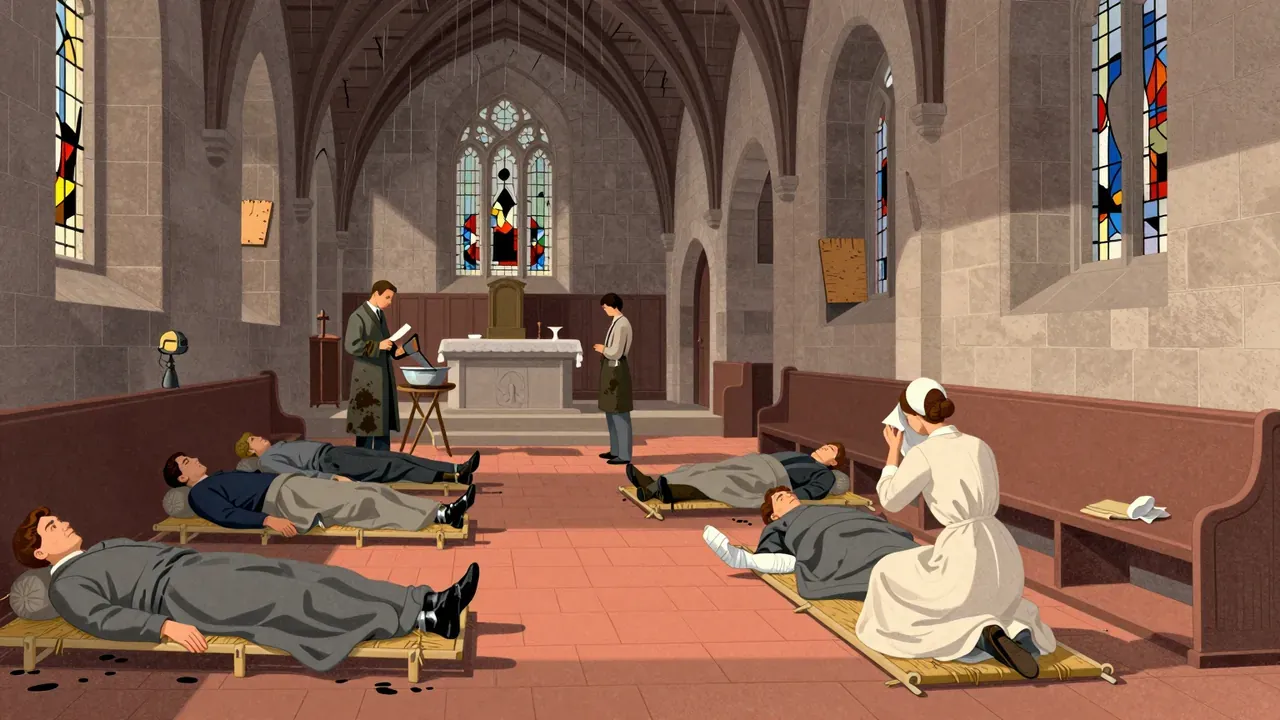
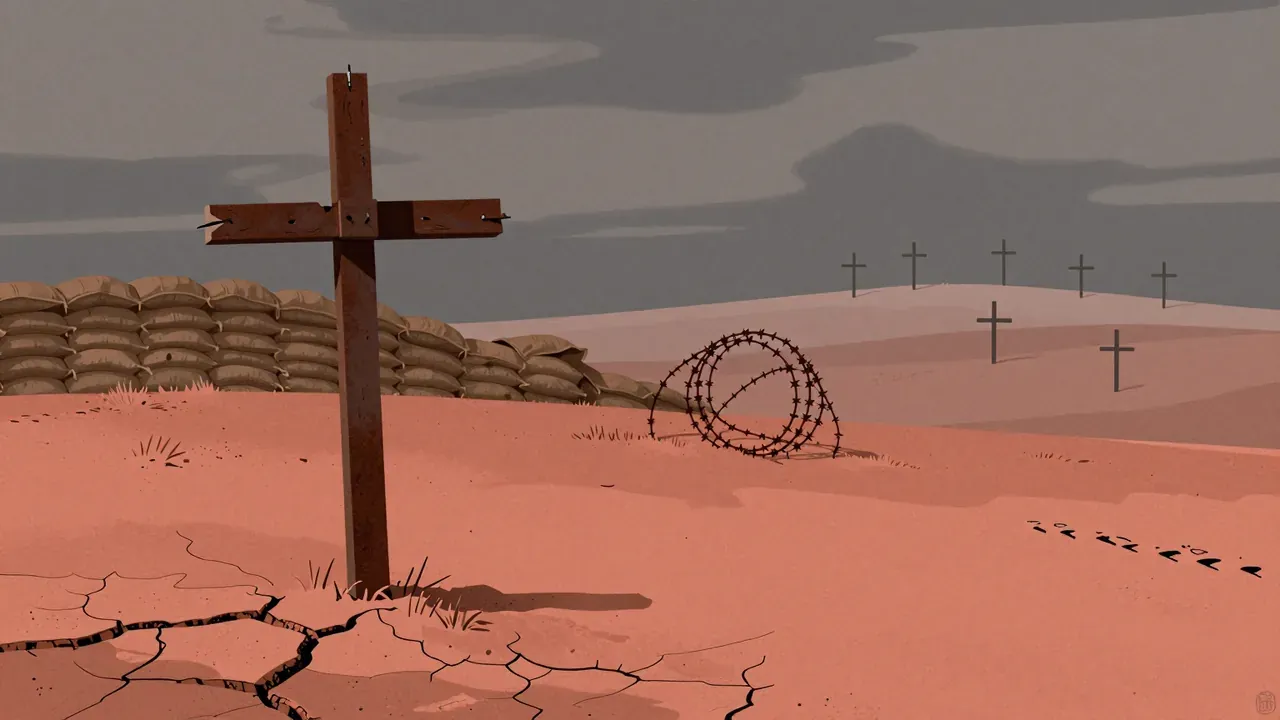
The themes that matter are endurance without purpose, solidarity without ideology, and commemoration without ceremony. The wooden cross of the title is not a symbol of faith or nation but of bureaucratic aftercare — a marker placed where a body was recovered, then left to weather. The film treats death as administrative fact: stretcher-bearers arrive, names are noted, letters are redirected. There is no afterlife, no honour roll, no homecoming — only rotations, reliefs, and replacements. Class is present but unspoken: Demachy is a law student, Sulphart a labourer, Breval a clerk; their differences dissolve in the trench, but reappear in how they speak of leave — one recalls lectures, another recalls wages. Trauma is shown as physiological: trembling hands, insomnia, the inability to drink water without flinching at noise. The film rejects both jingoism and pacifist sermonising; its critique is structural, not moral. It shows how war degrades language — orders become fragmented, letters unreadable, names mispronounced — and how silence accumulates until it becomes the dominant mode of communication. The most resonant motif is the repeated image of men walking past crosses: not pausing, not praying, just stepping aside and saluting, then continuing. That gesture is neither reverence nor resignation, but habit — the only thing left intact after everything else has been worn down. (159 words)
Who it’s for
This film is for viewers who value historical precision over narrative convenience, and who accept that some truths are best conveyed through accumulation rather than climax. It suits those familiar with First World War history, or with French interwar cinema’s tendency toward sober realism — viewers who do not require character arcs or catharsis to feel engaged. It is not for those who rely on exposition, emotional signposting, or tonal variation; the film’s refusal to modulate its gravity may read as austerity rather than intent. Some historians might object to its compression of timelines or its elision of political context — the film mentions no generals, no treaties, no home front — but that omission is deliberate, not negligent. Others may find its pacing incompatible with contemporary attention economies, though the slowness is calibrated, not accidental. To change the verdict, the film would need either a stronger anchoring device — a diary, a recurring image, a clearer temporal spine — or a willingness to break its own discipline, which would compromise its central argument. As it stands, it asks for patience, not sympathy. (158 words)
Is it worth your evening?
Yes, it is worth your evening — if you are prepared to meet it on its terms. It is not entertainment, nor is it instruction; it is an act of sustained witness, built from research, location, and lived experience. Its 115 minutes pass without hurry, but none of them feel wasted: every shot serves the film’s insistence on material reality — the mud, the noise, the weight of equipment, the exhaustion in the eyes. It rewards attention not with payoff but with density: the more closely you watch, the more textures emerge — the way light falls on a helmet rim, the rhythm of breathing in a crowded dugout, the hesitation before a man picks up a letter addressed to someone already dead. Those who dislike films that withhold interpretation may find it cold, but its restraint is ethical, not aesthetic. It refuses to tell you how to feel because it assumes you already know the cost. To skip it is to miss one of the earliest and most uncompromising attempts to translate the sensory and emotional reality of trench warfare into cinematic form — not as memory, but as record. (159 words)