What it is about
La Grande Illusion is a French war drama set during the First World War, centred on French officers held in German prisoner-of-war camps and their attempts to escape. It is not a film about combat or strategy but about the persistence of human connection across national, class, and linguistic lines. Jean Renoir and Charles Spaak built it as a deliberate counterpoint to rising nationalism and militarism in 1930s Europe — not by arguing, but by showing: aristocrats sharing memories over lunch, working-class men singing ‘La Marseillaise’ in unison, a German widow sheltering two French fugitives at Christmas. The film’s title refers to Norman Angell’s thesis that war is economically irrational — but Renoir treats the ‘illusion’ more broadly: the belief that rank, nationality, or ideology can finally sever shared humanity. It does not plead; it observes. Its political weight comes from restraint, not rhetoric. It assumes its audience can read silence, gesture, and what is left unsaid between men who know they are already living in a world whose rules are dissolving. That quiet conviction — that civility precedes citizenship — is the film’s central proposition, and its only agenda.
How it tells its story
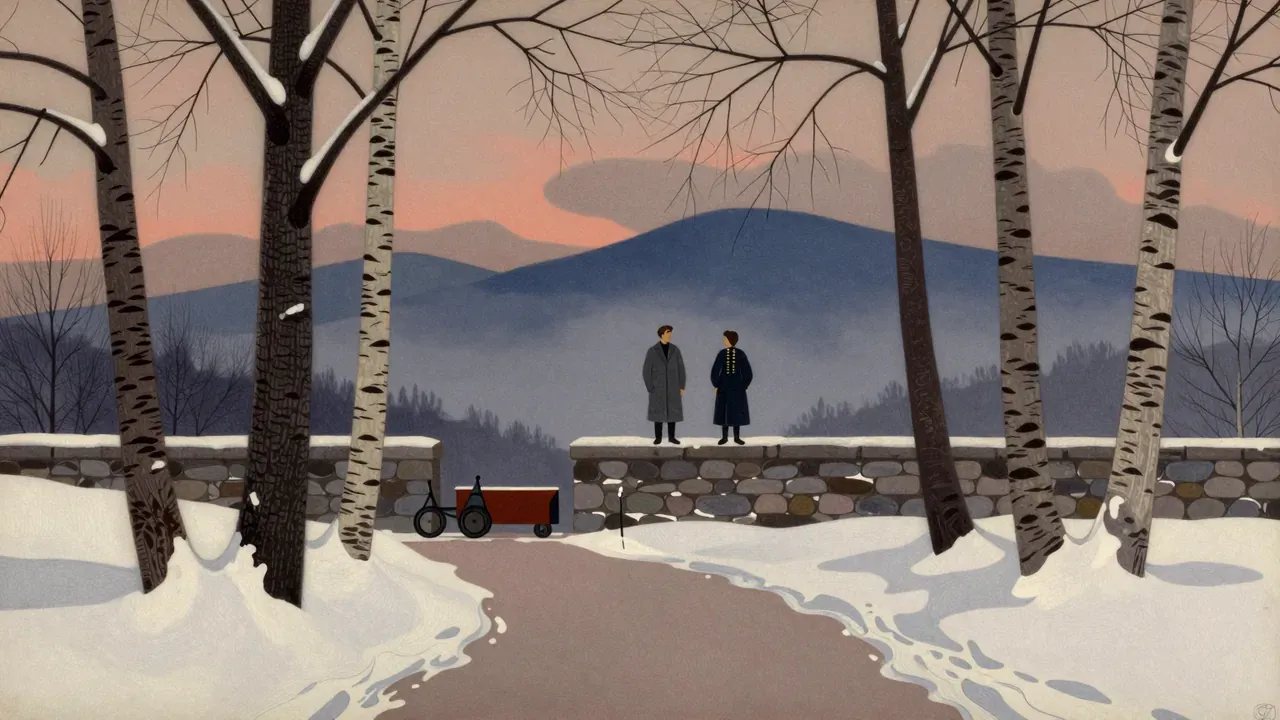
The story unfolds across three linked settings: a temporary German airfield, a crowded POW camp, and the isolated mountain fortress of Wintersborn — each stage tightening the focus on relationships rather than plot mechanics. Christian Matras’s cinematography avoids grandeur: interiors are dim and textured, exteriors stark and wintry, with no heroic framing of landscapes or soldiers. Marguerite Renoir and Renée Lichtig shape the rhythm deliberately — pauses linger, scenes end before resolution, transitions feel unforced. Jean Gabin grounds Maréchal in physical presence and taciturn warmth; Erich von Stroheim, though visibly struggling with his French and German lines, gives Rauffenstein a brittle dignity that never slips into caricature. Pierre Fresnay’s Boëldieu is precise in posture and hesitation alike; Dita Parlo’s Elsa speaks little but conveys grief and resolve through stillness and gaze. Joseph Kosma’s score is sparse, mostly piano and strings, used only where silence would be too heavy. There are no musical stings, no leitmotifs — just accompaniment that recedes when the characters speak, and stays silent when they do not.
Where it holds true
What lands most firmly is the film’s refusal to reduce anyone to type. Rauffenstein is neither villain nor relic, but a man whose code has outlived its context — and whose sorrow feels earned, not theatrical. Boëldieu’s sacrifice carries weight because it is unheroic in delivery: he dances, plays flute, and draws fire not with defiance but with weary grace. The scene where French prisoners erupt into ‘La Marseillaise’ works not as patriotic catharsis but as collective breath — spontaneous, ragged, cut short by punishment. Even minor figures register: Rosenthal’s generosity with food parcels, Modot’s sardonic humour in the camp theatre, Carette’s restless energy during tunnel-digging. The farmhouse interlude with Elsa avoids sentimentality by anchoring emotion in practicality — she mends clothes, shares soup, asks questions she knows will go unanswered. These moments land because they are built on behaviour, not exposition. The film trusts its actors to hold contradiction: loyalty and resentment, duty and despair, solidarity and solitude — all present at once, without emphasis.
Where it asks for trust
What does not land — or lands unevenly — is the structural looseness of the middle act. The camp sequences, while rich in texture, lack forward momentum; the vaudeville performance feels like a detour rather than a pivot, and its interruption by Maréchal’s outburst, though emotionally potent, arrives without sufficient build-up in his character arc. Some transitions between locations rely on title cards rather than visual logic, which can fracture immersion for viewers accustomed to tighter narrative continuity. Erich von Stroheim’s German accent remains inconsistent, and though this may reflect historical reality — he had lived in America since 1909 — it occasionally undermines the illusion of shared fluency between him and Fresnay. The film’s pacing, deliberate by design, risks feeling inert in stretches where dialogue is sparse and action minimal — particularly in the long walk across the German countryside, where landscape dominates psychology. These are not flaws in intent, but consequences of Renoir’s commitment to understatement: some silences ask more patience than modern viewing habits routinely grant.
What it says about the world
The themes that matter are class, obsolescence, and the quiet endurance of empathy. Renoir treats aristocracy not as decadent or noble, but as functionally extinct — its rituals intact but its authority hollowed out by industrial warfare and democratic change. Boëldieu and Rauffenstein converse in English to shield intimacy from subordinates, yet their bond cannot prevent fatal division when duty calls. The film contrasts this with Maréchal and Rosenthal: different backgrounds, different faiths, bound not by shared history but by shared need — and later, by shared vulnerability in Elsa’s kitchen. Nationalism is shown as performative: German officers salute rigidly, French prisoners sing loudly, but both acts dissolve when faced with hunger, cold, or grief. The film’s deepest argument is that identity is situational, not essential — and that the most durable loyalties form not along lines of birth or border, but in the space between one person offering bread and another accepting it. This is not idealism; it is observation, rendered without flourish.
Who it meets halfway
This film is for viewers who value psychological realism over plot propulsion, who find meaning in glances and silences, and who accept that a film can argue without raising its voice. It suits those familiar with interwar European history but does not require it — the dynamics of class and displacement remain legible today. It is less suited to viewers who expect clear moral binaries, rapid pacing, or narrative closure: Maréchal’s final vow to return to Elsa is left open, not resolved; Rauffenstein’s fate is implied, not shown; the war itself continues off-screen. Those who find slow cinema alienating, or who require explicit thematic signposting, may disengage early. A viewer who values craft over convenience — who watches for how light falls on a face, or how a line is paused before delivery — will find it rich. Someone watching for diversion, spectacle, or cathartic release will likely find it withholding. Nothing in the film changes if you watch it alone or with others — but its weight accumulates quietly, and is best absorbed without interruption.
What it leaves behind
Yes, it is worth your evening — not as entertainment, but as calibration. Its 124 minutes do not pass quickly, but they do accumulate: a sustained meditation on how people hold themselves when the ground shifts beneath them. It repays attention not with rewards but with recalibration — of how we read faces, interpret silence, assess motive. It is not demanding in the way of puzzle-box narratives, but in its expectation that you meet it on its terms: unhurried, attentive, willing to sit with ambiguity. Those who find modern films overly insistent — narratively, tonally, morally — may find its restraint bracing. It does not flatter the viewer with clarity, nor insult with obscurity. Its power lies in its refusal to simplify what is complex: hierarchy, enmity, compassion, duty. To call it ‘timeless’ would misrepresent it — it is deeply of its time, and precisely because of that, it remains urgent. You do not need to love war films to value it. You do need to be willing to let it unfold, slowly, without rushing to judgment — or to the next scene.