The premise of it
The Love Parade is a 1929 American musical comedy, Ernst Lubitsch’s first sound film and Jeanette MacDonald’s debut. It attempts to fuse continental operetta wit with Hollywood studio polish, adapting a French stage farce about sovereignty, gendered power, and marital negotiation into a pre-Code talkie. The film sets up a constitutional paradox: Queen Louise rules Sylvania in her own right, yet her marriage to Count Alfred Renard — a charming, scandal-prone diplomat — forces both into roles neither fully controls. Lubitsch and writers Guy Bolton and Ernest Vajda treat monarchy not as history but as a satirical frame for domestic tension, using the trappings of court ritual to expose how authority and obedience are performed, rehearsed, and renegotiated. It is not satire of monarchy per se, but of hierarchy as habit — especially when love and protocol pull in opposite directions. The film assumes its audience recognises the absurdity of ceremonial deference, and trusts that musical numbers can advance character logic as surely as dialogue. It aims for lightness without weightlessness: a confection with calibrated structural irony.
The sound of it
The story moves briskly from diplomatic reprimand to royal courtship to marital crisis, pivoting on Alfred’s reluctant acceptance of consortship and his subsequent rebellion against enforced idleness. Maurice Chevalier delivers dry, physically precise comic timing — his pauses, glances, and vocal inflections anchor the film’s rhythm — while Jeanette MacDonald balances regal composure with quiet vulnerability, particularly in moments where protocol silences her desire. Victor Milner’s cinematography avoids static tableaux; camera movements follow characters through ornate, high-ceilinged interiors, and framing often isolates figures within architectural grandeur to underline their entrapment. Editing by Merrill G. White sustains pace without sacrificing clarity, notably in the dual-set ‘Paris, Stay the Same’ sequence, where cross-cutting between simultaneous performances demonstrates Lubitsch’s early fluency with sound-era logistics. Schertzinger’s score supports narrative function over emotional exposition: songs clarify motive (‘Anything to Please the Queen’), define role (‘The Queen Is Always Right’), or undercut pretension (‘Let’s Be Common’). No performance feels unmoored from the film’s central conceit: that power, even when absolute, is only legible in relation to resistance.
The performances in it
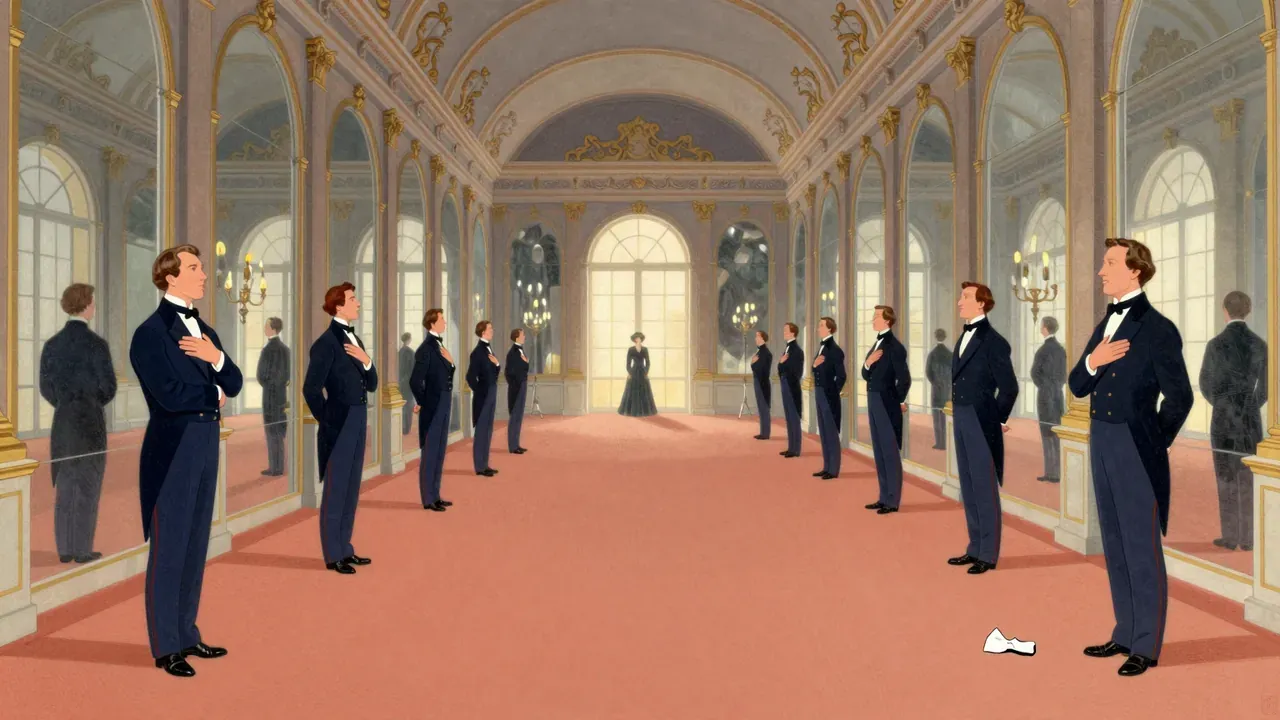
What lands most securely is the film’s tonal consistency: it never mistakes opulence for seriousness, nor frivolity for emptiness. Chevalier’s charisma is inseparable from his character’s self-awareness — he knows he is playing a part, and so does the audience. The court scenes function as choreographed social theatre, where every bow, salute, and hesitation carries ironic weight. Lupino Lane’s Jacques provides calibrated physical relief without breaking tone; Lillian Roth’s Lulu offers grounded counterpoint to royal abstraction. The ‘March of the Grenadiers’ number works because its militaristic pomp is undercut by MacDonald’s deadpan delivery and the chorus’s mechanical precision — it is satire dressed as spectacle. Even the film’s visual design lands: the costumes (by Travis Banton, though uncredited in the sheet) use colour and cut to signal status shifts — Alfred’s transition from diplomat’s uniform to consort’s pastel tunic is a silent plot point. Lubitsch refuses to let the music swell sentimentally; instead, melodies loop, repeat, and interrupt themselves, reinforcing the film’s theme of repetition as both comfort and constraint.
The world of it
What does not land is the film’s treatment of Sylvania as a geopolitical blank. Though named and mapped in intertitles, the country remains a decorative cipher — its language, customs, and institutions exist only to reflect Louise’s authority or Alfred’s discomfort. This flattens the satire: if the monarchy has no cultural texture, its critique loses teeth. Some supporting performances verge on caricature without sufficient grounding — Eugene Pallette’s Minister of War speaks in barks and bluster, but the script gives him no subtext or contradiction. The French-language version, Parade d’amour, is cited but absent from this viewing context, and its existence hints at a dimension of linguistic play and cultural translation the English cut largely omits. The film also struggles with pacing in its second act, where Alfred’s disenchantment risks monotony; his grievances are clear but under-varied, and the resolution — a negotiated return to shared rule — arrives without sufficient dramatic friction. A few songs, particularly ‘Nobody’s Using It Now’, feel like filler rather than function: they advance no character or idea, and rely on Chevalier’s charm alone to hold attention.
The politics of it
The themes that matter are the performativity of power, the gendered asymmetry of partnership, and the quiet violence of enforced leisure. The film treats marriage as a constitutional arrangement — not a private bond, but a public contract with clauses, precedents, and enforcement mechanisms. Alfred’s rebellion is not against Louise, but against the erasure of agency that comes with being designated ‘consort’: he is permitted to look handsome, to smile, to stand beside her, but not to speak on policy, to initiate, or to occupy space with purpose. Louise, meanwhile, must perform both ruler and wife — her authority is constantly undermined by expectation, her autonomy circumscribed by duty. The film’s enduring interest lies in how it frames domestic negotiation as political practice: compromise is not sentimental surrender, but tactical recalibration. It also probes the limits of liberal modernity — the idea that love can dissolve hierarchy — only to show how deeply ritual and institution resist personal feeling. There is no utopia here, only recalibration: power remains, but its distribution becomes negotiable, contingent, and audible in song.
The audience for it
This film is for viewers who value craft over catharsis, irony over immersion, and structure over psychology. It rewards attention to staging, timing, and lyrical economy — those who enjoy dissecting how a joke lands, or why a cut occurs where it does. It is not for viewers who require psychological realism, historical plausibility, or sustained emotional arcs; the characters are archetypes refined by repetition, not individuals revealed by crisis. Those who dislike theatrical artifice, or find musical interruptions disruptive to narrative flow, will likely disengage early. Fans of later Lubitsch films may find this comparatively unsubtle — its wit is broader, its rhythms less elliptical. Someone who values deep character work over formal intelligence would reasonably dissent. A shift toward more interior monologue, or a grounding of Sylvania in tangible cultural detail, would alter the verdict significantly — but the film makes no claim to realism, and judges itself by its own polished, parodic terms.
The worth of it
Yes, it is worth your evening — provided you watch it as a machine built for specific effects: rhythmic precision, tonal control, and structural wit. Its 110 minutes pass without drag because every scene serves the central conceit, and every song advances either plot or position. It does not ask for empathy so much as alignment — with its logic, its tempo, its refusal to mistake grandeur for gravity. Those who expect emotional crescendos or moral ambiguity may leave unsatisfied; this film trades in equilibrium, not upheaval. Its pleasures are cumulative and architectural: the way Chevalier’s posture changes across three costume shifts, the way Milner’s lighting distinguishes state rooms from private chambers, the way Schertzinger’s motifs recur like legal precedent. To dismiss it as ‘dated’ is to miss how deliberately it constructs its own time — one where romance is ratified by statute and love is sung in waltz time. It earns its place not as a relic, but as a working model of studio-era intelligence.