The subject, not the story
Uncle Janco is a 22-minute French documentary film directed and written by Agnès Varda in 1967. It is not a biographical portrait, nor a conventional ethnographic study; it observes a single man — Janco, a Romanian-born sculptor and painter living in Paris — as he moves through his studio, speaks about his work and exile, and handles materials with quiet, tactile attention. The film does not seek to explain Janco’s place in art history or reconstruct his past in detail. Instead, it attempts something narrower and more immediate: to hold time around a person whose gestures, speech rhythms, and physical relationship to clay and metal carry meaning without exposition. There is no voiceover narration, no archival footage, no contextualising titles beyond the opening credit. Varda treats the camera as a respectful, mobile witness — present but unobtrusive — and trusts duration, repetition, and silence to convey what biography alone cannot. The film’s ambition is modest in scale but precise in intent: to let a life register on film not as data or legacy, but as presence.
The look of it
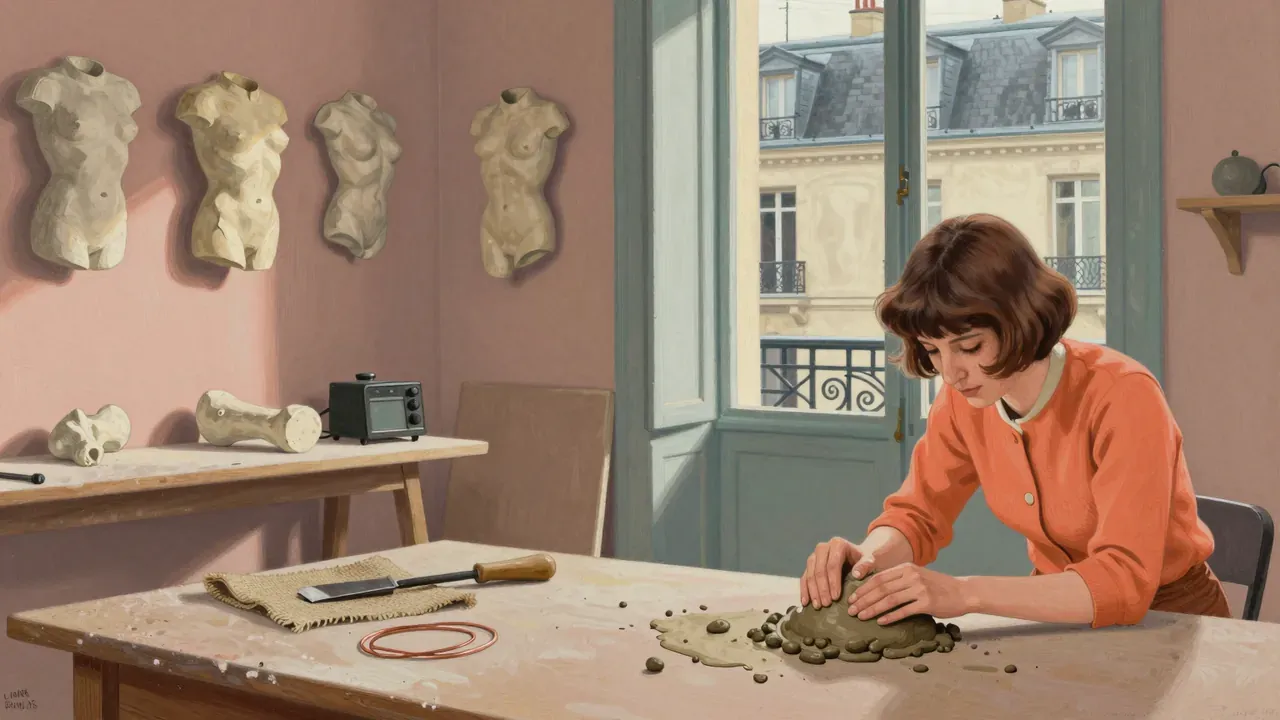
The film works through sustained observation rather than narrative progression. Janco speaks in French with a Romanian accent, his sentences measured, often trailing off or circling back — not because he is inarticulate, but because his thinking is embodied, associative. Varda keeps the camera at medium distance for much of the runtime, favouring steady takes over cuts: a long shot of Janco shaping clay, a fixed frame on his hands as he sands a bronze cast, a slow dolly forward as he stands before a wall of sketches. There are no interviews, no interlocutors, no cutaways to other people or places. The sound recording is dry and close — breath, scrape of tool, rustle of paper — with no added music or score. Editing is sparse and functional: dissolves mark shifts in activity or time of day, but most transitions are straight cuts that preserve continuity of action. The lighting is naturalistic, favouring north-facing window light in the studio; shadows pool where they fall. This is craft in service of restraint: every decision — from lens choice to microphone placement — defers to the subject’s tempo and texture.
What sticks
What lands is the weight of attention. Janco’s hands — knotted, stained, deliberate — become the film’s strongest motif, anchoring abstraction in physical labour. His pauses, his habit of turning away mid-sentence to adjust a wire armature or wipe his brow, read not as evasion but as fidelity to process. The film’s refusal to translate or interpret gives his remarks a gravity they might otherwise lack: when he says he ‘does not make art for museums’, the line carries force precisely because it is not followed by a rebuttal or illustration. The rhythm of the editing — mostly held shots of three to six seconds, with only two takes exceeding twelve — creates a cadence that feels earned, not imposed. Even small details land: the way dust settles on a half-finished sculpture after he steps back, or how he squints slightly when looking at a drawing under changing light. These are not flourishes but observations, and their accumulation builds a portrait less of a man than of a mode of being-in-the-world that resists summary.
What slips away
What does not land is any sense of urgency or stakes beyond the frame. The film makes no claim on history, offers no argument about post-war European art, and avoids even the gentle framing of a ‘portrait of the artist’ tradition. For viewers expecting context — why Janco left Romania, how his work relates to Constructivism or Dada, whether he exhibited widely — there is nothing. The absence of subtitles for non-French speakers (if any exist in the original print) would further isolate those unfamiliar with the language. The pacing, while deliberate, risks monotony if watched outside its intended context — say, as part of a Varda retrospective or alongside her other short documentaries from the same period. Without prior knowledge of Janco’s work or Varda’s method, the film can feel like watching someone else’s private rehearsal: technically assured, emotionally reserved, and resistant to entry. Its austerity is not a flaw, but it is a condition — one that some will read as rigour and others as withholding.
What it thinks about
The themes that matter are exile as lived routine rather than dramatic rupture, and making as a form of memory-work. Janco speaks of Bucharest without nostalgia or bitterness, describing buildings he knew as if measuring them for reconstruction in clay. His studio is neither sanctuary nor prison, but a site of continuous translation: from thought to gesture, from memory to object, from one language to another. Time appears not as linear progression but as sediment — layers of plaster, patina on bronze, pencil marks over older drawings. There is also a quiet insistence on the body’s role in cognition: ideas arrive through touch, hesitation, reworking. The film treats craft not as skill to be admired but as epistemology — a way of knowing the world that precedes articulation. Absence is thematic too: of family photographs, of political commentary, of institutional validation. What remains is the residue of practice — dust, fingerprints, the slight warp of a wooden shelf under decades of weight. These are not metaphors but facts, and the film’s moral centre lies in treating them as sufficient.
Who it’s for
This film is for viewers who value duration over exposition, who find resonance in unmediated gesture, and who approach documentary not as testimony but as encounter. It rewards patience, familiarity with mid-century European avant-garde practice, and comfort with silence as structural element. It is not for those seeking narrative propulsion, biographical clarity, or aesthetic variation — viewers who expect documentary to inform, persuade, or entertain in conventional ways will find it withholding. Those who associate Varda primarily with her later, more discursive films like The Gleaners and I may misread its economy as thinness. A change in context — say, screening it alongside archival material on Janco or with Varda’s contemporaneous interviews about her documentary ethics — would sharpen its impact, but the film itself makes no such provision. Its audience is narrow by design, not oversight.
What it costs
It is worth your evening if you are prepared to meet it on its own terms: as a twenty-two-minute act of sustained looking, not a story to be consumed. Its value lies in its resistance to utility — it does not summarise, explain, or advocate. You will not leave with facts about Janco’s exhibitions or dates of migration, but you may retain the image of his thumb pressing into wet clay, or the sound of a chisel striking bronze at 3.42 p.m. That retention is the film’s measure. It is not for casual viewing, nor for those pressed for time or seeking affirmation. Disagreement would come from viewers who believe documentary must serve pedagogy or advocacy — for them, the film’s reticence feels like failure. But its worth is not diminished by that disagreement; it is confirmed by it. This is a film that asks not whether it is useful, but whether attention, held quietly and without agenda, remains a legitimate end in itself.