The purpose of the walk
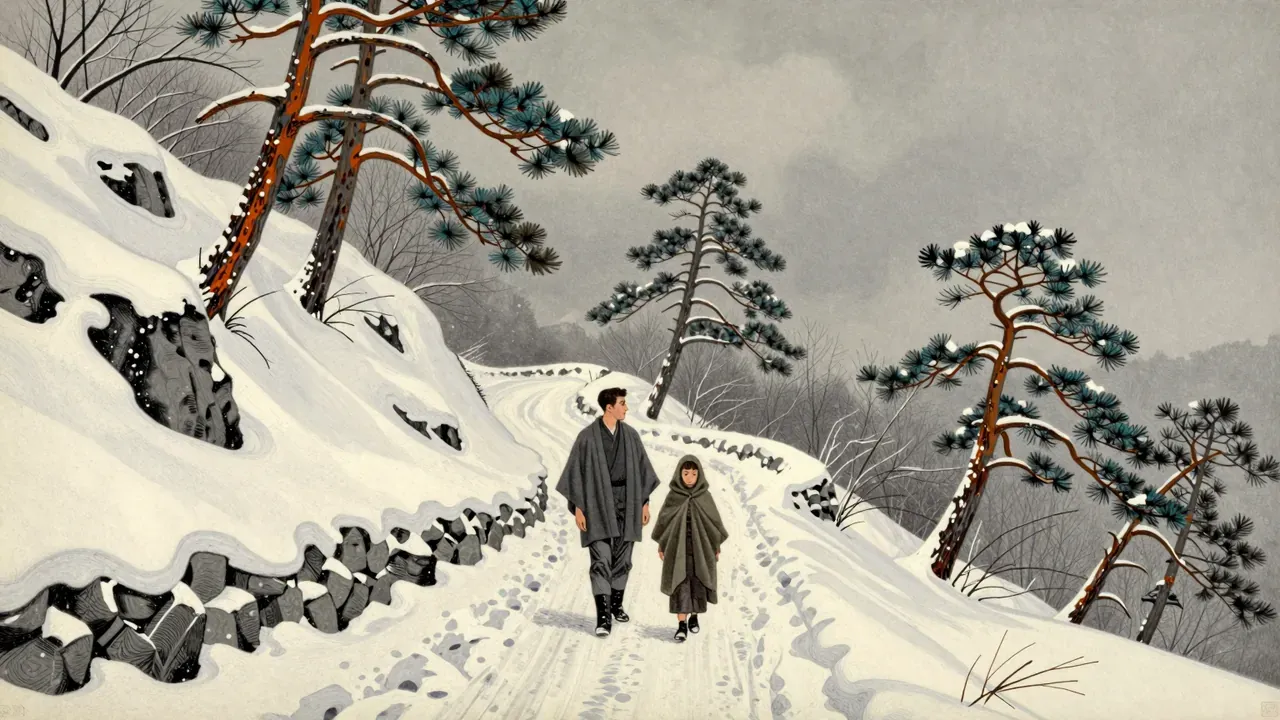
Zatoichi’s Pilgrimage is the fourteenth entry in Daiei’s 26-film Zatoichi series, and it sets itself apart by shifting focus from episodic violence to spiritual itinerary. It follows the blind masseur Zatoichi as he undertakes the Shikoku pilgrimage — eighty-eight temples across a mountainous island — not as a tourist or devotee but as a man seeking quiet reckoning. The film does not treat the pilgrimage as metaphor alone; it grounds the journey in physical detail: ferry crossings, muddy paths, temple gates worn smooth by centuries of sandals. Its ambition is modest but precise: to hold Zatoichi’s moral fatigue alongside his unerring competence, and to ask whether ritual movement can absorb or merely delay the weight of past killing. It makes no claim to doctrinal accuracy in its Buddhism, nor does it offer enlightenment as resolution. Instead, it treats pilgrimage as duration — time measured in steps, not revelations. This is not a film about arrival, but about what persists when the road refuses to end. (148 words)
The rhythm of silence
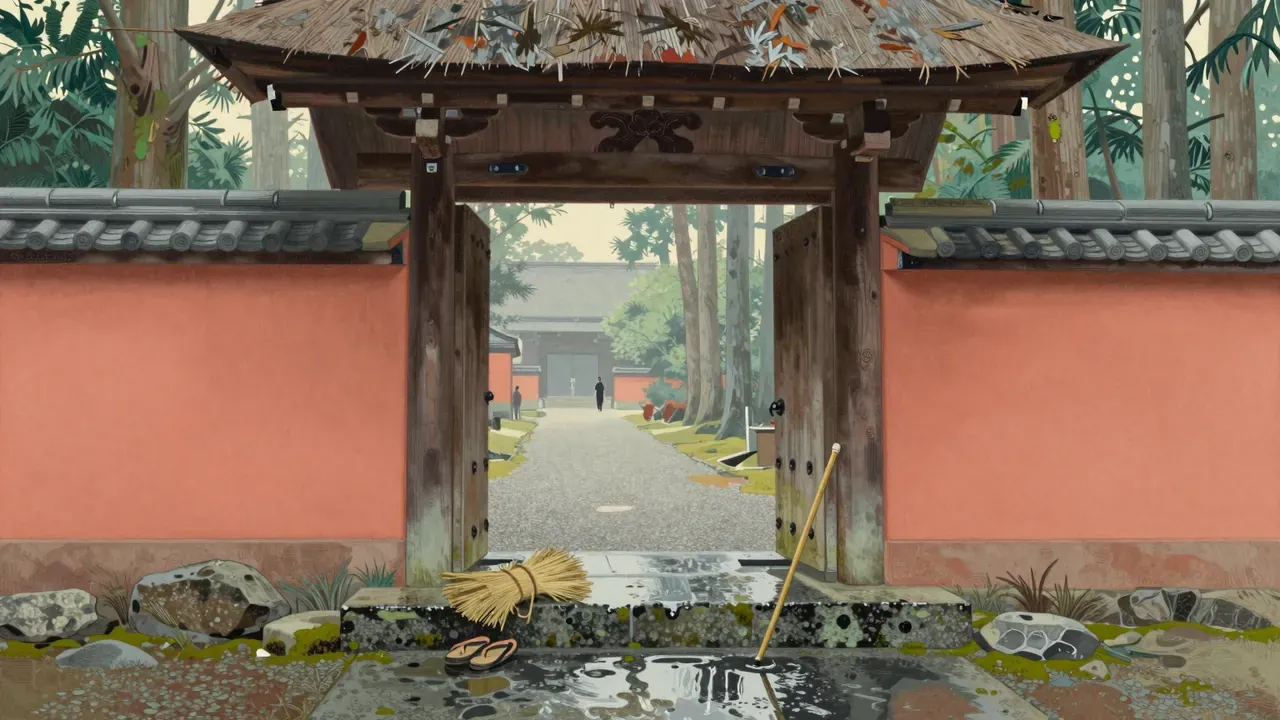
The story moves with deliberate economy: Zatoichi kills a man in self-defence, traces the horse home, and becomes entangled in a local dispute between a corrupt boss and a grieving family. Kaneto Shindō’s script avoids exposition, trusting gesture and silence — a pause before drawing, a hand resting on a sword hilt, the way Zatoichi tilts his head to gauge distance. Shintarō Katsu’s performance remains physically precise: his cane taps with calibrated rhythm, his listening is never passive but active triangulation. Kazuo Ikehiro directs without flourish — long takes on narrow roads, interiors lit by single paper lanterns, compositions that keep Zatoichi slightly off-centre, as if the frame itself hesitates to fix him. Ichirō Saitō’s score uses shamisen sparingly, often cutting mid-phrase. Yoshinobu Nishioka’s art direction gives each temple courtyard its own texture — moss on stone, warped wood grain, the particular grey of rain-wet tatami. There are no set-piece duels; the violence arrives sudden and brief, then recedes into stillness. (152 words)
What stays unspoken
What lands is the cumulative weight of restraint. Zatoichi’s refusal to explain himself, the way Okichi (Michiyo Ōkusu) watches him without asking questions, the quiet persistence of the storyteller (Kunie Tanaka) who appears only to observe — these choices accumulate meaning without stating it. The film’s strongest moments are those where nothing happens: Zatoichi sitting cross-legged on a veranda at dusk, listening to cicadas; a slow pan across empty temple corridors after he has passed through; the way Eigoro’s horse returns alone to the stable, its reins dragging. These are not atmospheric flourishes but structural decisions — the film trusts duration to do the work of exposition. The camera holds on faces longer than expected, not for psychological revelation but to register endurance. Even the fight choreography lands differently: no acrobatics, just two men moving with lethal economy, followed by silence thick enough to hear breath catch. The pilgrimage is never romanticised; its hardship is in the blisters, the damp clothes, the ache in the shoulders — all rendered without commentary. (150 words)
The unresolved subplot
What does not land is the subplot involving Boss Tohachi (Isao Yamagata), which arrives late and resolves too neatly, as if grafted from an earlier script. His menace lacks texture — he gestures broadly but never convinces as a threat Zatoichi needs to overcome rather than sidestep. The film’s attempt to link Eigoro’s death to wider injustice feels underdeveloped: we see the consequences, not the system. There is also a tonal inconsistency in the framing of Okichi’s role — she is introduced with narrative weight, then recedes into symbolic function, her agency flattened by the film’s focus on Zatoichi’s interiority. The ocean voyage of the English title is visually underused: one brief ferry crossing, no sense of scale or peril. And while the cinematography is controlled, it rarely surprises — no bold angles, no disruptive light shifts, no visual risk beyond competent clarity. The film avoids melodrama, but in doing so, it sometimes avoids heat: moments meant to carry moral ambiguity land instead as neutrality. A viewer expecting the series’ sharper irony or sharper violence may find this entry too even-tempered. (154 words)
The weight of repetition
The themes that matter are atonement without absolution, competence without authority, and movement without destination. Zatoichi walks the pilgrimage not to be forgiven but to inhabit time differently — to let ritual structure replace the rhythm of violence. The film treats blindness not as limitation but as a different calibration of presence: Zatoichi hears the grain of a voice before he knows its owner, senses humidity shift before rain falls. His skill with the sword is never questioned, yet he refuses to wield it as power — only as last resort, and always with visible cost. The 88 temples are not milestones but repetitions: same bow, same chant, same stone step, each visit a minor recalibration rather than a breakthrough. There is no conversion, no epiphany, no final temple where everything changes. What matters is the body’s memory of motion, the way habit can become ethics when repeated with attention. The film quietly insists that moral repair is not event-based but temporal — measured in days walked, not deeds undone. (147 words)
Who the film is for
This film is for viewers who value pacing as meaning — those comfortable with long silences, unexplained gestures, and conclusions that settle like dust rather than strike like lightning. It rewards attention to texture: the sound of straw sandals on gravel, the way light falls across a tatami mat, the slight tremor in a hand pouring tea. It is not for those who need narrative propulsion, clear antagonists, or emotional pay-offs timed to the beat of the score. Fans of the earlier Zatoichi films expecting escalating action or wry humour may find this too subdued; newcomers unfamiliar with the character’s history may miss the weight of his weariness. Those who associate Japanese period drama with ornate spectacle or philosophical monologue will find neither here. It assumes familiarity with Zatoichi’s contradictions — his gentleness and lethality, his solitude and deep, unspoken loyalty — and offers no recap. A viewer who values craft over climax, or who finds resonance in repetition, will connect with it. Someone needing catharsis or closure will not. (150 words)
The worth of the walk
Yes, it is worth your evening — provided you watch it without expectation of event. Its value lies in its refusal to rush, to explain, or to resolve. At 82 minutes, it occupies time honestly: no filler, no digression, no false urgency. It repays attention not with plot twists but with accumulated detail — the way Zatoichi’s posture shifts after three days on the road, how the light in a temple changes between morning and afternoon visits. Those who dismiss it as ‘slow’ mistake slowness for emptiness; its pace is structural, not incidental. A viewer who prefers tighter plotting or stronger thematic signposting may leave unsatisfied — Thomas Raven’s praise for its ‘inventive cinematography’, for instance, overstates the visual risk it takes. But its integrity is real: every choice serves the central question — what does it mean to keep walking when forgiveness is not on offer? That question lingers after the credits. (149 words)