The tenth return
Zatoichi’s Revenge is the tenth entry in Daiei Film’s Zatoichi series, a 1965 chambara built around Shintarō Katsu’s blind itinerant masseur and swordsman. It attempts to deepen the character’s moral gravity by returning him to the site of his apprenticeship, where he confronts the consequences of his former teacher’s death and the systemic exploitation of villagers by corrupt officials and merchants. The film does not reinvent the formula — it retains the episodic structure, the calibrated balance of swordplay, quiet observation, and wry interludes — but narrows its focus to a single village and a tightly wound chain of debt, coercion, and filial duty. It treats Zatoichi not as a wandering avenger but as a reluctant catalyst: his presence exposes rot already present, and his interventions are measured, often deferred, never celebratory. The script by Minoru Inuzuka tightens the social stakes without abandoning the genre’s formal discipline — no monologues on justice, no speeches to crowds, just actions that shift power in increments.
The look of it
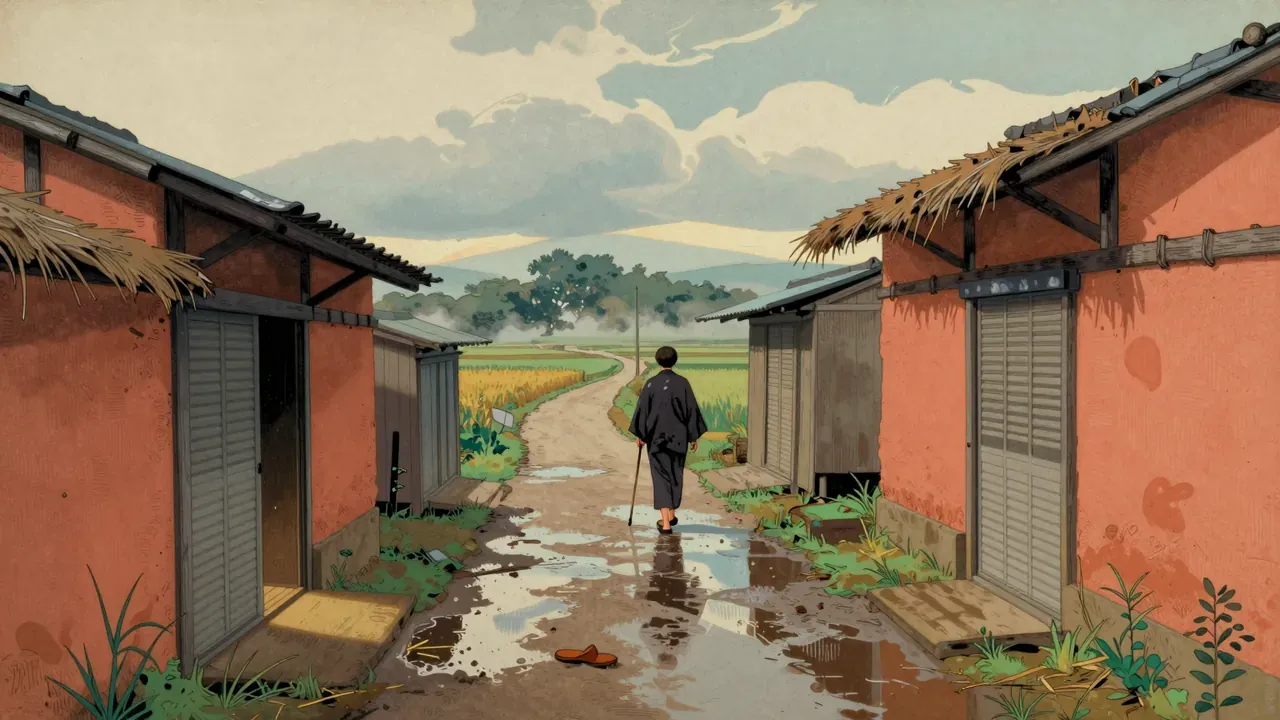
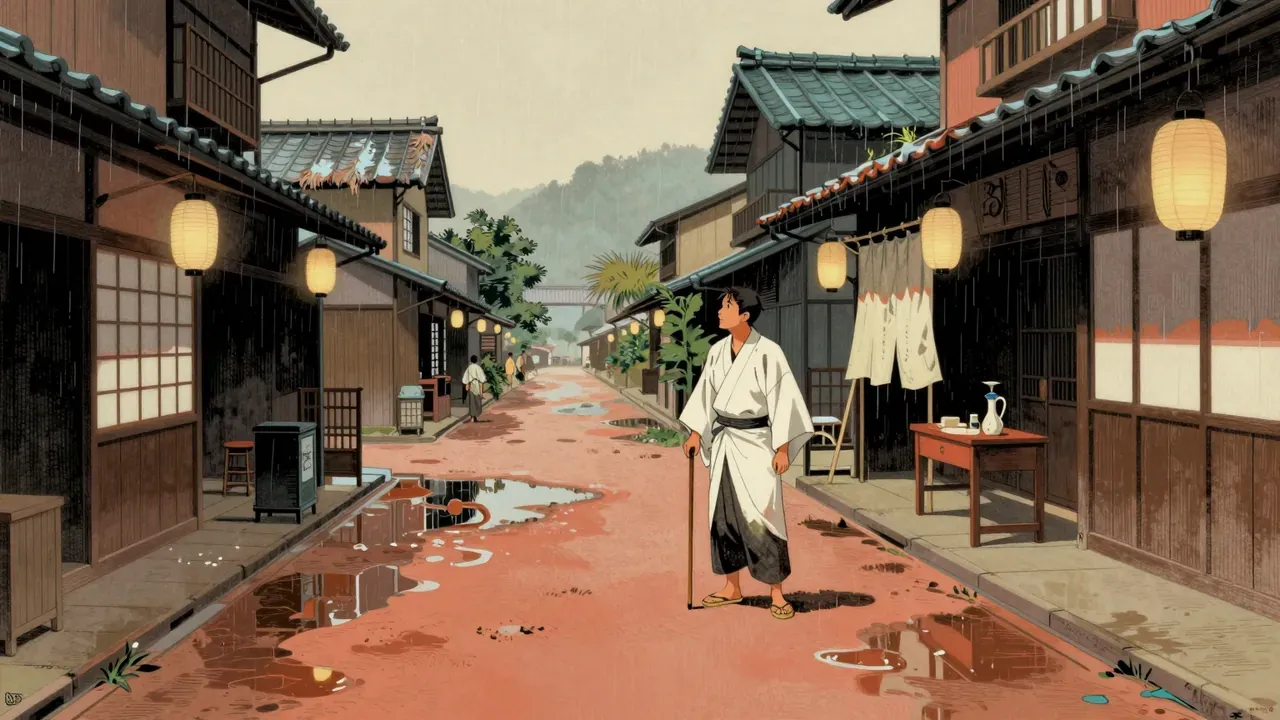
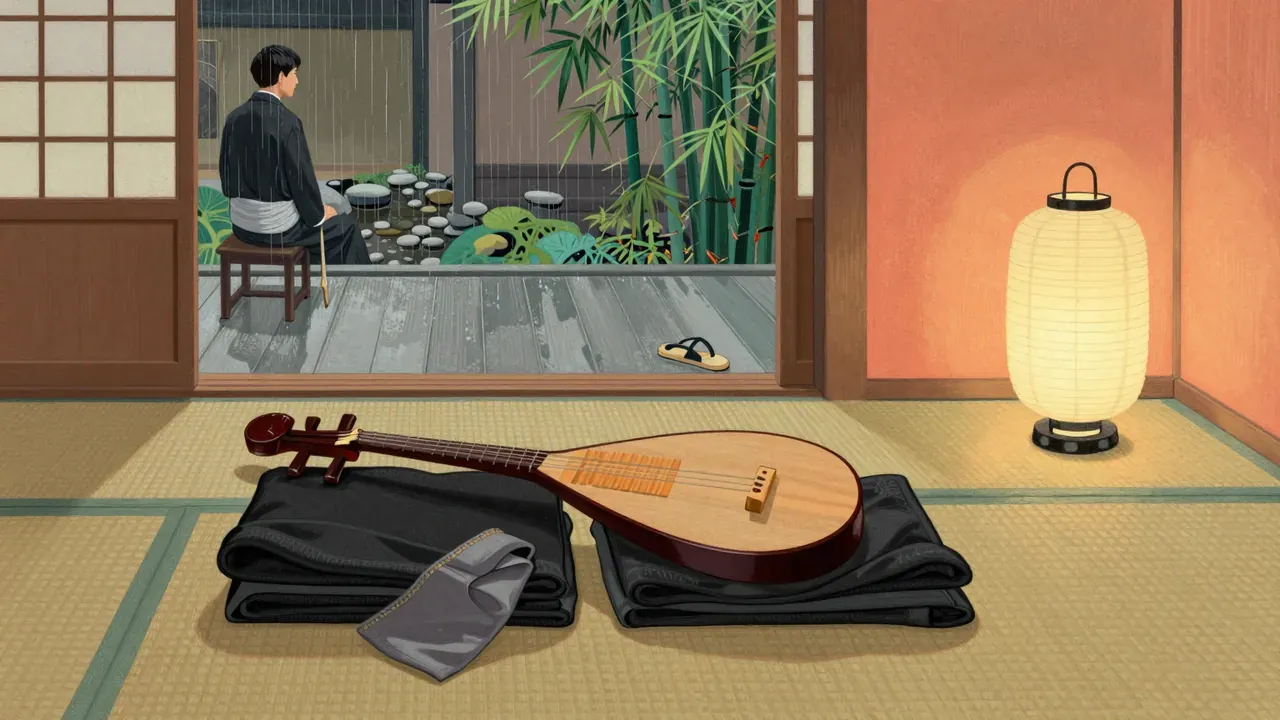
The story moves with deliberate economy: Zatoichi arrives, learns, listens, waits, then acts — twice at the bridge, once at the intendant’s house. Shintarō Katsu’s performance rests on stillness and precision: a tilt of the head, a pause before drawing, the weight of silence after a killing. Fujio Morita’s cinematography avoids flourish; interiors are dim but legible, exteriors lit flatly, compositions favouring mid-shots that hold both Zatoichi and those he observes. Akira Ifukube’s score is sparse — strings and taiko used only to mark transitions or underscore tension, never to emote for the characters. Hiroshi Yamada’s editing sustains rhythm without urgency: fight scenes are clear but not accelerated, cuts timed to breath rather than impact. The art direction by Yoshinobu Nishioka grounds the village in weathered wood and worn tatami — no stylisation, no nostalgia, just functional space where cruelty and kindness occupy the same rooms.
What sticks
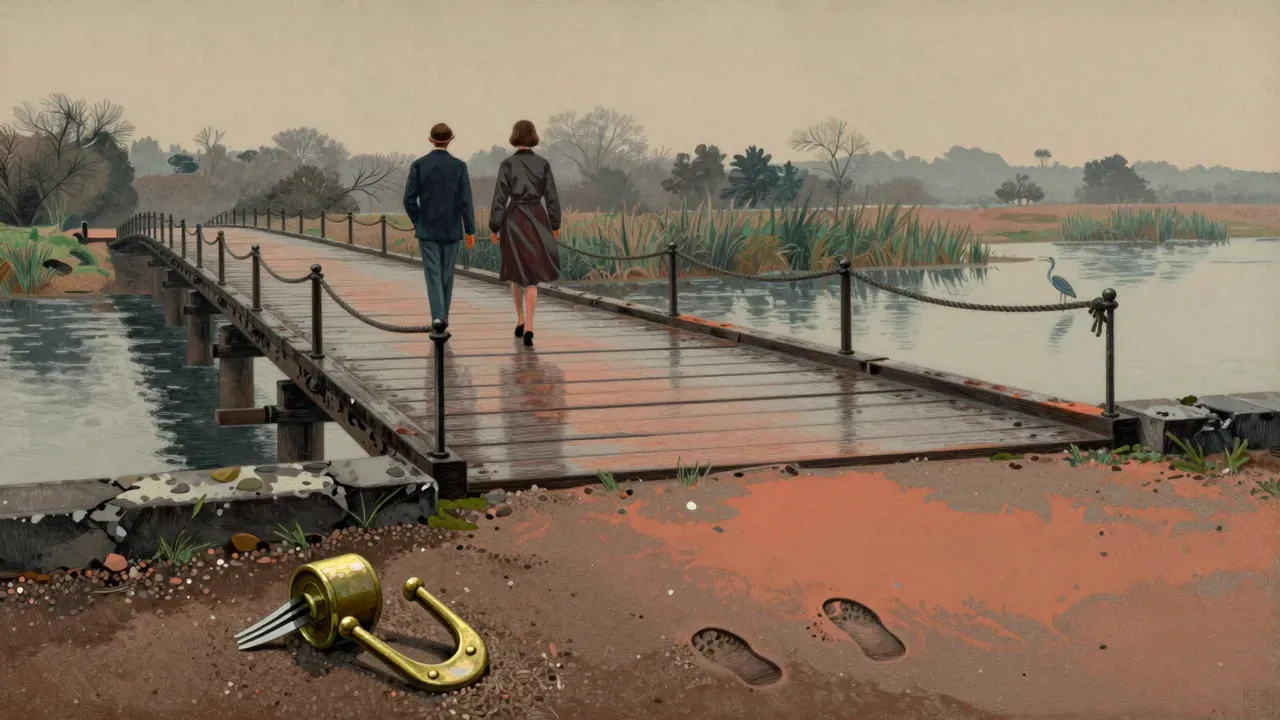
What lands is the cumulative weight of small choices: Denroku’s dice flourish as a gesture of respect, Tsuru stealing the sword not out of malice but mimicry, Zatoichi handing back a single ryō coin to shame a crooked dealer. These moments do not rely on exposition or reaction shots; they register because the film has spent time establishing how people move, speak, and hesitate in this world. The duel at Utsune Bridge works because Kadokura’s arrogance and Zatoichi’s stillness are consistent across earlier scenes — their confrontation feels earned, not imposed. The redistribution of money at the end carries force not because it is grand, but because the bonds destroyed were shown earlier, pinned to a wall in Isoda’s office, each one tied to a named daughter. Even the final image — Zatoichi’s absence at the grave — lands because the film never shows him leaving; his departure is inferred, like all his movements, from what others notice he has done.
Where it holds back
What does not land is the framing of Jingo Odate, the tax inspector. He appears briefly, is waylaid off-screen by Kadokura, and vanishes — his presence raises questions about bureaucratic integrity and institutional oversight that the film neither explores nor resolves. His function is purely plot-mechanical: to panic the villains and justify Kadokura’s escalation. Similarly, the brothel’s role remains symbolic rather than social; we see no women beyond Sayo, no sense of their daily lives or agency beyond victimhood. The film names the system — debt, coercion, official corruption — but stops short of showing how it reproduces itself beyond individual villainy. Tatsugoro and Isoda are types, not studies; their motivations are financial and hierarchical, but their psychology is unexamined. This is not a flaw in the chambara tradition, but it does mean the ‘social commentary’ cited by some critics remains implied, not dramatised.
What it thinks about
The themes that matter are obligation, memory, and the ethics of intervention. Zatoichi’s return is not nostalgic but forensic: he revisits the past not to reclaim it, but to trace how its fractures have widened. His debt to Hikonoichi is not repaid in vengeance but in restitution — freeing Sayo, destroying the bonds, restoring dignity to the village’s economic life. Denroku’s arc mirrors this: his skill with dice is a metaphor for control over chance, yet he must relinquish that control to act honestly. The toggle from the medicine pouch is the film’s central object — not a relic, but evidence, a physical link between cause and consequence. The film treats blindness not as limitation but as a different mode of attention: Zatoichi hears the jingle of the toggle before he sees the killer’s posture; he knows Denroku’s shame before the man speaks it. Justice here is procedural, not cathartic — it requires listening, waiting, and precise timing.
Who it’s for
This film is for viewers who value restraint in action storytelling, who find tension in pauses and moral weight in understatement. It suits those familiar with the series’ rhythms or willing to meet it on its own terms — not as spectacle, but as a study in calibrated response. It is not for viewers expecting escalating set-pieces, psychological exposition, or narrative closure that names every consequence. Those who require explicit moral framing or sustained emotional arcs may find its silences frustrating. A viewer who values Ifukube’s minimal scoring or Morita’s unshowy lighting will respond more readily than one drawn to kinetic editing or expressive camera movement. Its pace assumes patience; its politics assume observation. Change the emphasis from quiet causality to dramatic revelation, and the film would lose its coherence — it is inseparable from its method.
Is it worth your evening
Yes, it is worth your evening — provided you watch it without expectation of novelty or resolution. At 84 minutes, it occupies time like a well-told anecdote: compact, self-contained, resonant in its specifics. It rewards attention to gesture and sound, not just plot turns. Someone watching for Katsu’s physicality or Ifukube’s use of silence will find more than someone scanning for narrative escalation. It is not diminished by being the tenth film in a long series — rather, its strength lies in deepening established patterns, not breaking them. Those who dislike chambara conventions — the ritualised duels, the stoic protagonist, the village-as-microcosm — will not be converted here. But for those open to its discipline, it offers a rare consistency of tone, craft, and purpose across every frame.