What it is trying to do
Zatoichi and the One-Armed Swordsman is a 1971 Japanese–Hong Kong co-production that attempts a formal and cultural crossover: it places Shintarō Katsu’s blind, cane-wielding itinerant masseur Zatoichi — a figure of quiet moral authority rooted in Edo-period Japan — alongside Jimmy Wang Yu’s one-armed, vengeance-driven martial artist Wang Kang, a product of Hong Kong’s wuxia tradition. It is not a merger of styles but a staged encounter: two icons from distinct cinematic lineages, each with established iconography, narrative logic, and ethical grammar, brought into proximity to test whether their heroisms can coexist. The film tries to do this without translation — literal or stylistic — relying instead on gesture, combat rhythm, and shared opposition to corruption. Its ambition is structural: to hold two incompatible worldviews in frame at once, not to reconcile them but to let them collide and clarify one another through friction. It assumes familiarity with both series, and treats genre convention as a language more precise than dialogue.
How it works
The story moves briskly across rural Japan, pivoting on a child under threat and a corrupt priest backed by yakuza — a plot device thin enough to accommodate the real subject: the duelling idioms of swordplay. Katsu performs Zatoichi with his customary economy: minimal movement, lowered centre of gravity, listening before acting. Wang Yu’s Kang is all sharp angles and sudden force, his single arm compensating with whip-like precision and spatial aggression. Their fight choreography reflects this: Zatoichi’s cane work is tactile, grounded, reactive; Kang’s blade work is airborne, anticipatory, theatrical. Isao Tomita’s score leans into contrast — koto and shamisen for Zatoichi’s scenes, percussive gongs and string tremolos for Kang’s — though the mix often flattens texture. Yoshinobu Nishioka’s art direction keeps sets sparse and weathered, avoiding opulence; interiors feel lived-in but never detailed enough to anchor either character’s cultural context. Dialogue remains functional, rarely probing motive beyond duty or honour — a limitation that serves the film’s visual priorities but narrows emotional range.
What lands
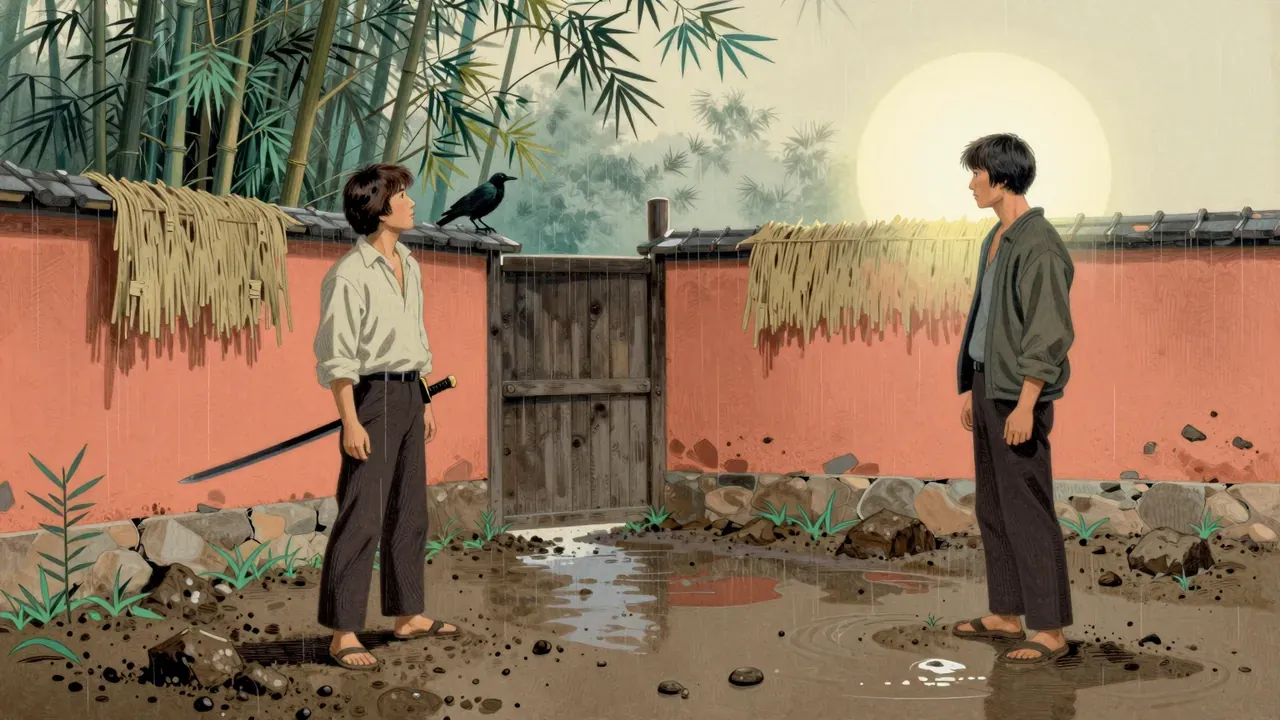
What lands is the physical clarity of the duel sequences — not the final confrontation, which feels rushed and tonally uncertain, but the earlier skirmishes where Zatoichi and Kang misread one another’s intent. A scene where Kang disarms Zatoichi mid-stride, then hesitates upon realising the man is blind, carries weight because it hinges on perception rather than exposition. The film also succeeds in sustaining parallel dignity: neither hero is diminished to elevate the other. Their moral positions remain intact even when they clash — Zatoichi’s non-lethal restraint and Kang’s fierce protectiveness are never made ironic or quaint. The child at the centre is not sentimentalised; her silence and watchfulness lend gravity without speech. Yūko Hama and Michie Terada bring quiet resilience to their supporting roles, grounding the mythic premise in recognisable human concern. And the pacing — at 94 minutes — avoids bloat; every scene serves either setup, miscommunication, or escalation. There is no wasted motion, only calibrated delay.
What does not
What does not land is the attempt to fuse narrative logics. The film treats language barrier as a plot device rather than a structural condition: characters gesture, point, and scowl, but never adapt — no shared sign system emerges, no mutual learning occurs. This makes their eventual alliance feel unearned, less a resolution than a concession to genre expectation. The Hong Kong–Japanese co-production status shows in uneven sound recording — Wang Yu’s lines are often muffled or distant compared to Katsu’s, reinforcing the sense of asymmetry rather than bridging it. The villains lack dimension: Kakuzen the priest is theatrically cruel but psychologically inert; Boss Tōbei’s yakuza operate as interchangeable units, their menace generic. Most damagingly, the film’s central conceit — that these two heroes come from ‘very different worlds’ — is asserted but not dramatised: we see no flashbacks, no cultural markers beyond costume, no ritual or belief system that distinguishes Kang’s worldview from Zatoichi’s beyond weapon choice. The difference remains surface-level, never philosophical.
The themes that matter
The themes that matter are not honour or vengeance — those are givens — but the limits of legibility across systems of meaning. Zatoichi navigates by sound and memory; Kang by sight and speed. Their conflict is epistemological: how do you recognise kinship when your tools for knowing are incompatible? The film quietly questions whether heroism can be translated, or whether it must always be local — bound to place, language, and embodied practice. It also probes the cost of isolation: both men move alone, distrustful of institutions, reliant on personal code — yet their solitude is not romanticised. When Kang shields the child, it is instinctive, not ideological; when Zatoichi intervenes, it is habitual, not heroic. Neither seeks recognition. This understatement matters: the film’s moral weight rests not in grand declarations but in repeated small choices — to pause, to listen, to lower the blade. It suggests that ethics reside in attention, not proclamation — and that attention, like language, can fail across borders.
Who should watch it
This film is for viewers who value craft over exposition, who follow action cinema for its grammar rather than its plot, and who have seen at least three Zatoichi films and two One-Armed Swordsman entries — not for context, but to register what shifts when the conventions meet. It rewards patience with rhythm and tolerance for ambiguity: the ending’s unresolved tension between the two heroes is deliberate, not evasive. Those who should not watch it include viewers seeking coherent cross-cultural synthesis, psychological depth in antagonists, or linguistic or historical specificity — the film offers none. Fans of Hsu Tseng Hung’s Hong Kong work may find Yasuda’s direction too restrained; devotees of Katsu’s later, more reflective Zatoichi entries may find the tone too perfunctory. A viewer expecting a ‘meeting of equals’ as celebration will be disappointed; the film treats equivalence as friction, not harmony — and that refusal is its integrity.
Is it worth your evening
Yes, it is worth your evening — but only if you watch it as a dialectic, not a fusion. Its value lies in the space between the two leads: in how their silences differ, how their stances communicate divergent ideas of balance and threat, how their weapons speak different languages of consequence. It is not a seamless crossover, nor does it aim to be; it is a controlled experiment in collision. Anyone expecting narrative synthesis or thematic resolution will leave unsatisfied — and that dissatisfaction is part of the film’s design. A viewer who watches closely for ten minutes will grasp its method; the rest is variation on that premise. It does not deepen either series, but it clarifies them by contrast — like holding two tuning forks side by side and listening to the beat frequency between them. That resonance is narrow, specific, and entirely intentional.