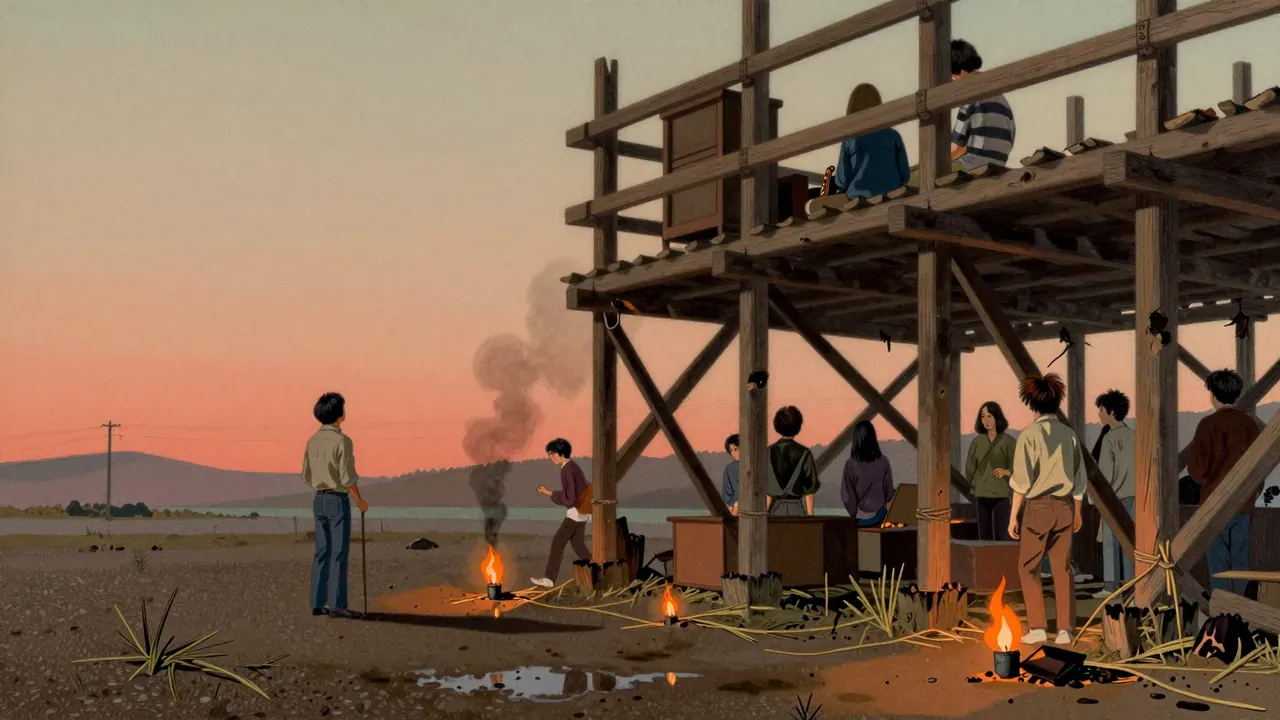
A vow made in an inn
Zatoichi Challenged is the seventeenth film in Daiei’s Zatoichi series, a mid-run entry that attempts to sustain the cycle’s core contract: a blind itinerant masseur who moves through Edo-period Japan as both witness and corrective force, resolving injustice not through authority but through calibrated violence and quiet moral choice. It aims for emotional weight via a child’s journey — a dying mother’s plea, a father held captive, a friendship tested to breaking point — while retaining the series’ formal discipline: tightly composed action, minimal exposition, and Shintarō Katsu’s physical precision as the sole anchor of continuity. The film does not seek novelty in structure or theme; rather, it works within the established grammar of chambara to test how much emotional resonance can be carried by repetition, restraint, and the slow accumulation of gesture. Its ambition lies in deepening character through recurrence — not reinvention, but refinement — trusting that the audience knows Zatoichi well enough to read meaning in the tilt of his head, the pause before a draw, the way he places a hand on a boy’s shoulder without looking down. (158 words)
The road to Maebara
The story follows a clear arc: Zatoichi accepts guardianship of Ryota, travels with him across contested terrain, and confronts Boss Gonzo in Maebara, where the climax hinges on a duel with Akazuka — a friend ordered to kill. Ryōzō Kasahara’s script adheres closely to series conventions, offering little deviation in pacing or tonal variation. Shintarō Katsu performs with economy and specificity: his footwork registers tension before a fight, his stillness signals calculation, his voice remains low and uninflected even in moments of urgency. Kenji Misumi frames interiors with deliberate asymmetry and keeps exterior scenes under-lit, letting snow and shadow absorb noise. Akira Ifukube’s score is sparse, favouring percussive punctuation over melody. Fight choreography avoids flashiness; duels are short, decisive, grounded in spatial awareness. Supporting performances — particularly Jūshirō Konoe as Akazuka and Asao Koike as Gonzo — rely on presence over exposition. There is no psychological excavation, only behavioural consistency: each character acts according to established role logic, never against it. (159 words)
The snow duel
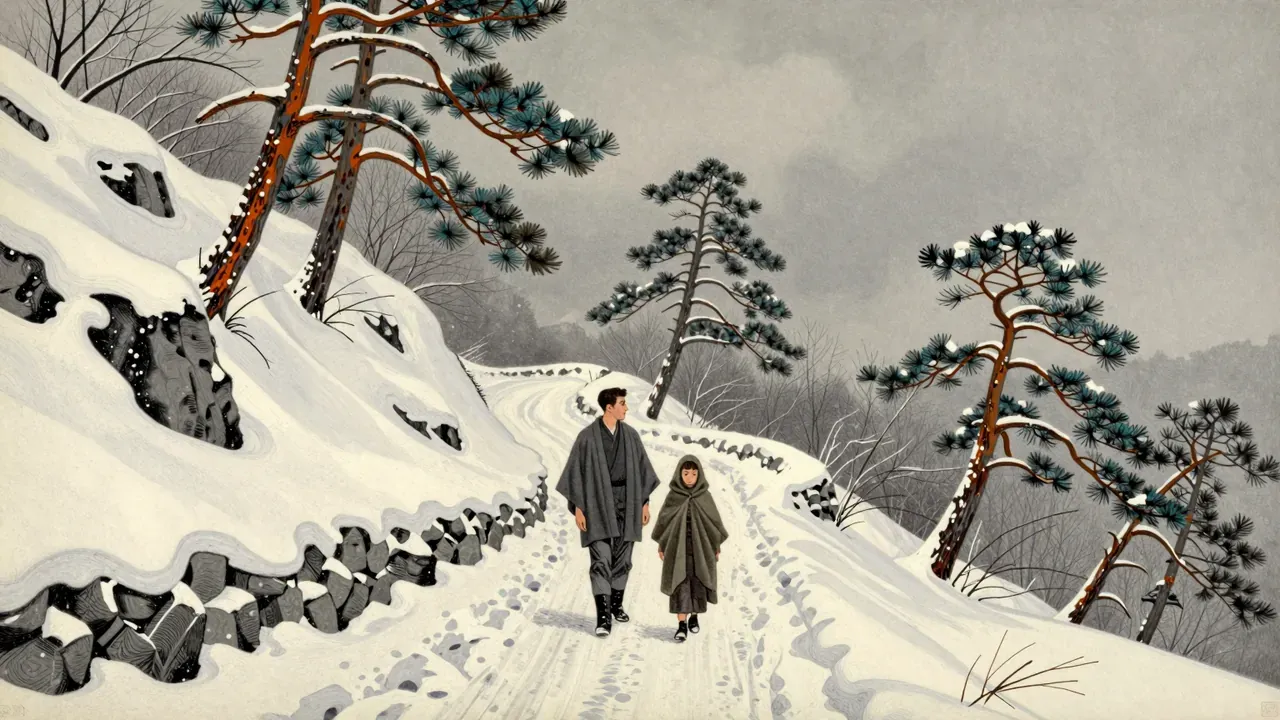
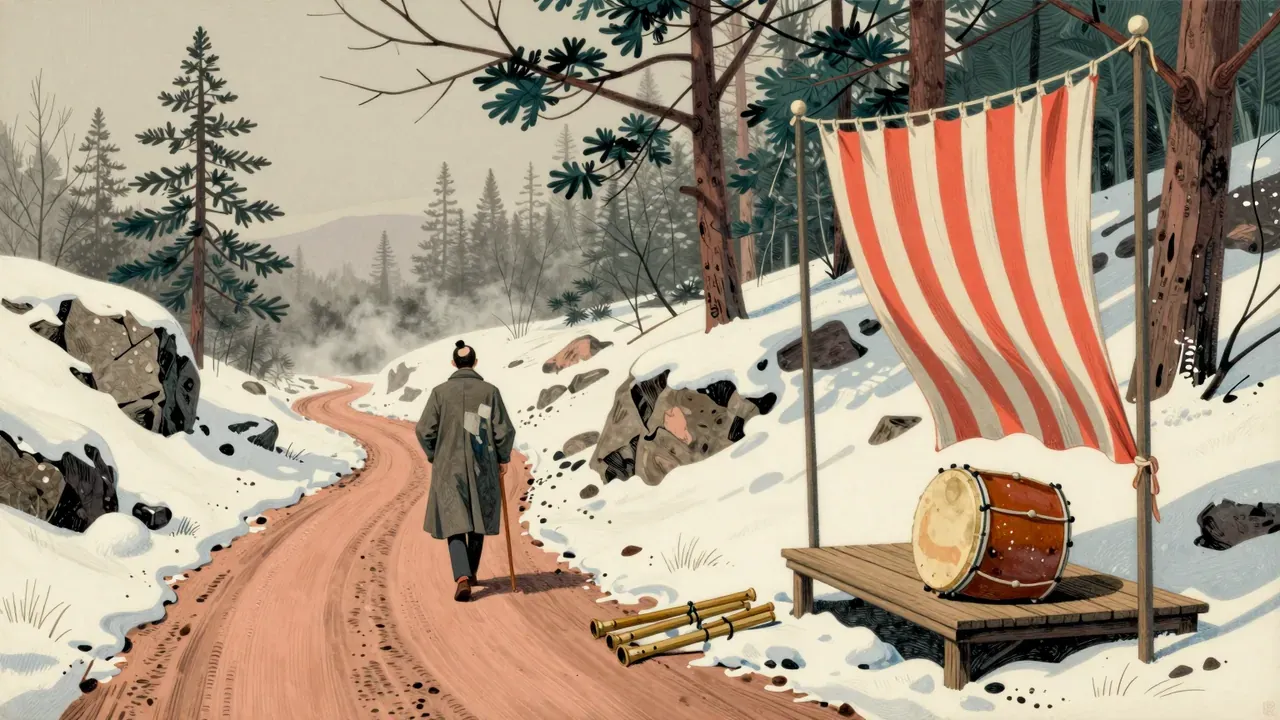
What lands is the cumulative gravity of Zatoichi’s commitment. His decision to throw away his sword — not as a flourish, but as an irreversible act of trust — carries weight because it arrives after eighty minutes of restrained physicality. The snowfall during the final duel is not atmospheric decoration; it slows movement, muffles sound, makes every step deliberate and consequential. Miwa Takada’s Omitsu and Yukiji Asaoka’s Tomoe occupy brief but coherent social positions — innkeeper’s daughter, widow with agency — and their interactions with Zatoichi reinforce his role as mediator, not saviour. The travelling troupe sequence works because its instability mirrors Ryota’s vulnerability: performers shift allegiances, music turns ominous, space contracts. Even the ‘annoying kid factor’ noted elsewhere registers as functional: Ryota’s silence, his habit of watching rather than speaking, his refusal to cry at his mother’s death — these are not flaws in writing but choices that keep the boy legible as a narrative counterweight to Zatoichi’s stoicism. The film earns its pathos not through sentimentality but through withholding it. (157 words)
The weight of repetition
What does not land is the script’s structural fatigue. The plot mechanics repeat beats from earlier entries without recalibrating their stakes: the corrupt official, the coerced artist, the yakuza boss whose menace is signalled more by costume than conduct. Boss Gonzo lacks dimension beyond function; his exploitation of the father feels procedural, not personal. The subplot involving Torikoshi (Eitarō Ozawa) and Osen (Mikiko Tsubouchi) adds little beyond exposition and dissipates without consequence. Dialogue remains transactional, rarely revealing character beyond duty or obligation. There is no irony, no ambiguity in motivation — even Akazuka’s conflict is resolved by wound and withdrawal, not reflection. The film’s middle section drags not from slowness but from redundancy: another inn, another confrontation, another moment where Zatoichi chooses stillness over speech. This is not austerity; it is under-variation. A viewer familiar with the series may register this as diminishing returns; a newcomer may find the pacing opaque, mistaking economy for emptiness. The film assumes fluency in Zatoichi’s language — and when that language repeats without inflection, the silence begins to feel less like restraint and more like absence. (159 words)
Fidelity in snow
The themes that matter are fidelity to promise, the ethics of intervention, and the cost of honour when it cannot be codified. Zatoichi’s vow to the dying woman is not contractual but ontological: to break it would unravel his identity. His journey with Ryota is not paternal but custodial — he does not adopt, instruct, or comfort, but bears witness and removes obstacles. The film treats disability not as limitation but as perceptual recalibration: Zatoichi hears footsteps before sighted men see blades, senses hesitation before it becomes action. His blindness is neither metaphor nor deficit; it is simply the condition of his attention. The snow duel crystallises the central tension: Akazuka obeys orders, Zatoichi disarms himself to protect life — not because he rejects violence, but because he refuses to let it be the only tool. Justice here is not delivered by law or rank but by proximity: Zatoichi stays close enough to intervene, then walks away before the consequences settle. There is no triumph, only completion — and the quiet exhaustion that follows any sustained act of care. (156 words)
For those who know the walk
This film is for viewers who value craft over novelty, who follow the Zatoichi series not for plot twists but for variations in timing, framing, and physical expression. It rewards patience with subtlety: the way Katsu shifts weight before stepping into snow, the rhythm of Ifukube’s taiko in fight pauses, Misumi’s use of doorways as thresholds between safety and threat. It is not for those seeking narrative innovation, psychological depth, or thematic surprise — the film offers none. A viewer expecting the heightened drama of Zatoichi Meets Yojimbo or the lyrical abstraction of Zatoichi and the Fugitives will find this thin. Those who dislike children in action films may resist Ryota’s presence, though his function is structural, not sentimental. Anyone requiring exposition, backstory, or moral ambiguity should look elsewhere. The film assumes investment in Zatoichi as a principle, not a person — and if that assumption does not hold, nothing else compensates. (159 words)
A plateau, not a peak
Yes, it is worth your evening — but only if you watch it as part of the series, not as a standalone. Its value lies in its place: a mid-cycle calibration, where the form is secure enough to carry minimal variation, and the lead performance is so assured that even repetition feels intentional. It is not essential viewing, but it is coherent, controlled, and quietly committed to its own logic. A viewer who watches it cold may find it inert; one who has seen ten or more Zatoichi films will recognise the precision in its repetitions — the slight adjustment in Katsu’s stance, the tighter framing of a corridor, the longer pause before a blade leaves its scabbard. To call it ‘weaker’ presumes a hierarchy of peaks; this film is not a peak but a plateau — stable, weathered, and necessary to the landscape. Without it, the series loses its sense of duration. (159 words)