The premise
Zatoichi Meets Yojimbo is a crossover jidaigeki — the twentieth in Shintarō Katsu’s Zatoichi series and a deliberate, self-aware collision of two dominant figures in Japanese period cinema: the blind wandering masseur-swordsman and the sardonic, masterless rōnin. It does not attempt continuity with either character’s established canon; instead, it stages an encounter between archetypes, using their shared genre grammar to explore contrast in method, motive and moral posture. The film assumes familiarity with both characters’ cultural weight but does not require it: its structure hinges on parallelism and juxtaposition rather than exposition or reverence. Kihachi Okamoto directs with a brisk, unsentimental hand, treating the meeting less as a celebration than as a controlled experiment in friction — one where neither man yields his essence, and neither is diminished by the other’s presence. It is not a merger but a calibration: two fixed points measuring the same world from opposite ends of perception and principle. (124 words)
The pace
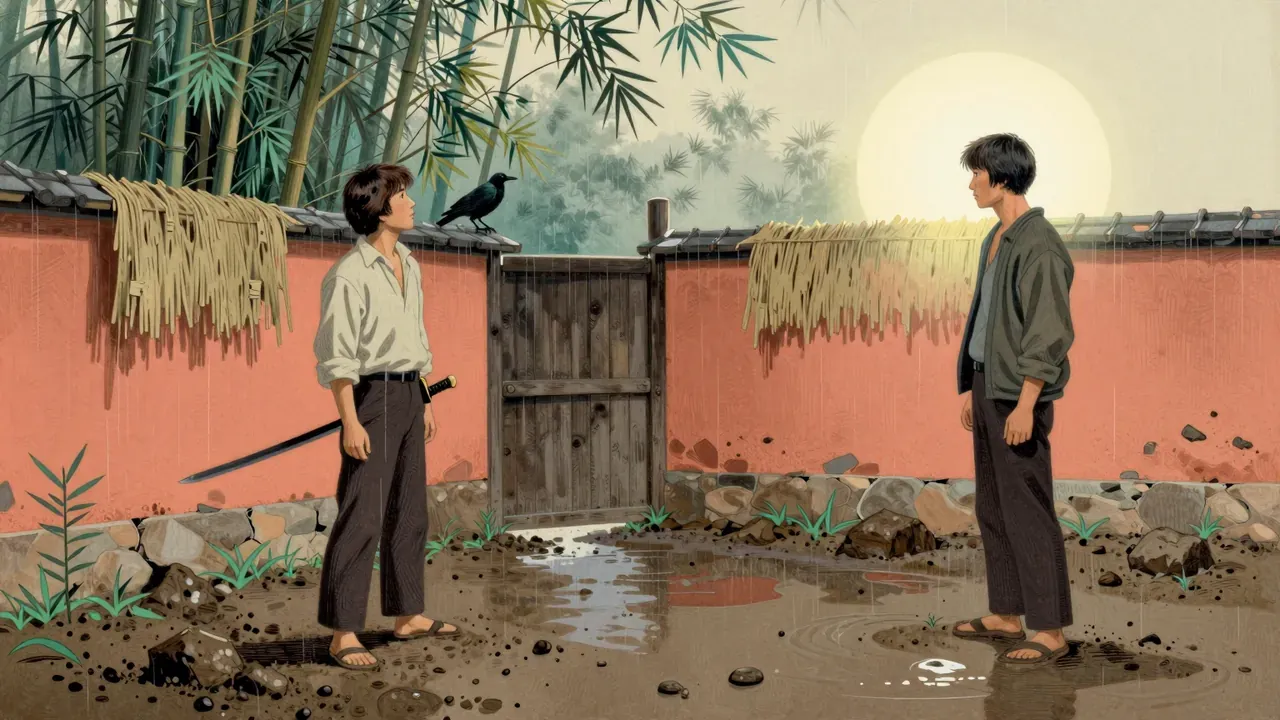
The story moves through rain-slicked streets and teahouse corners with economical precision: Zatoichi arrives weary, hears a murder, stays out of duty rather than design; Yojimbo (Daisaku Sasa) enters later, hired but uncommitted, drinking while waiting for leverage. Shintarō Katsu plays Zatoichi with quiet gravity — no flourish, no self-pity, just tactile awareness and sudden, decisive motion. Toshirō Mifune’s performance is narrower in range but sharper in texture: laconic, physically loose, his eyes never quite settling. Akira Ifukube’s score avoids thematic grandeur, favouring percussive restraint and sparse koto motifs that underscore tension without announcing it. Yoshinobu Nishioka’s art direction keeps sets weathered and interiors dimly lit, avoiding studio polish in favour of lived-in grime. The duel itself lasts under thirty seconds — no music swells, no slow motion — and ends not in resolution but mutual injury, a punctuation mark, not a full stop. Every craft choice serves compression, not ornament. (137 words)
The performances
What lands is the integrity of the two leads’ physical languages: Katsu’s Zatoichi moves with the certainty of someone who navigates by sound and memory, his sword-draw a single unbroken arc; Mifune’s Yojimbo shifts weight like smoke, feinting with his shoulders before his hands move. Their scenes together are charged not by rivalry but by mutual recognition — a glance held too long, a pause after a shared line of dialogue, the way each watches the other’s hands before speaking. The rain-soaked opening murder, heard but not seen, establishes tone without exposition. The town’s fear is conveyed through silence between lines, not speeches about oppression. Even minor roles — Ayako Wakao’s Umeno, Kanjūrō Arashi’s Hyoroku — occupy space with economy and specificity. There is no wasted gesture, no explanatory close-up. The film trusts its actors’ bodies and its audience’s attention span, and that trust is repaid in moments that feel earned, not engineered. (135 words)
The structure
What does not land is the framing device of the university-educated son’s grievance, which lacks psychological grounding and dissolves into generic ambition. His army-building subplot arrives late, feels schematic, and collapses under its own logistical thinness — no recruitment, no training, no visible followers beyond two extras with spears. The pistol-wielding rōnin is introduced solely to be dispatched, serving no function beyond reminding the audience that Zatoichi has a bounty — a fact already established in earlier films and irrelevant here. The final battle sequence, though choreographed with clarity, suffers from spatial confusion: cuts between wide and medium shots fail to anchor geography, so the scale of carnage remains abstract rather than visceral. These are not flaws of execution but of construction — structural gaps where motivation or consequence should sit, left unfilled by script or editing. A viewer expecting narrative cohesion will notice the seams. (138 words)
The weight
The themes that matter are exhaustion, agency, and the limits of intervention. Zatoichi does not seek justice but stumbles into it; Yojimbo does not reject morality but treats it as negotiable currency. Neither man chooses the town — they are drawn in by accident or contract, and neither leaves it improved. The film resists redemptive arcs: the yakuza boss dies, but his sons’ power vacuum is not filled by virtue, only by further violence. Umeno’s quiet resignation — her life unchanged by Zatoichi’s return — underscores the futility of individual action within entrenched systems. Even the duel’s draw is thematic: no triumph, no lesson, only two men marked and moving on. This is not nihilism but realism — a view of the Edo period not as mythic backdrop but as terrain where competence rarely alters structure, and survival is measured in inches, not miles. (126 words)
The audience
This film is for viewers who value craft over exposition, who find pleasure in the weight of a sword hilt in a hand or the rhythm of footsteps on wet stone. It rewards patience with subtlety: a shift in posture, a withheld line, the way rain steams off a blade. It is not for those who need clear stakes, emotional scaffolding, or narrative payoff — anyone expecting catharsis from the Zatoichi-Yojimbo meeting will leave unsatisfied, as the film refuses to resolve their differences or affirm one worldview over the other. Fans of Kurosawa’s Yojimbo may object to Mifune’s looser, more ironic take; Zatoichi devotees might find Katsu’s portrayal unusually detached. A different verdict would follow if the script had anchored its central conflict in character rather than archetype — but it does not, and that is its chosen shape. (130 words)
The duration
Yes, it is worth your evening — not as entertainment in the conventional sense, but as a compact study in contrast, performed at the highest level of Japanese studio craft. Its 115 minutes pass without bloat because nothing is there to pad time: every scene tightens the coil. It demands attention but repays it in precise, unshowy detail — the grain of wood in a teahouse floor, the way light catches the edge of a tanto, the silence after a body hits mud. Those who dislike ambiguity or prefer moral clarity will find it withholding; those who appreciate economy, restraint and the physical grammar of acting will find it rich. It is not a gateway film — it assumes genre literacy — but for those already inside the frame, it is a rare instance of two icons meeting not to merge, but to measure each other, and walk away unchanged. (132 words)