The shape of the series
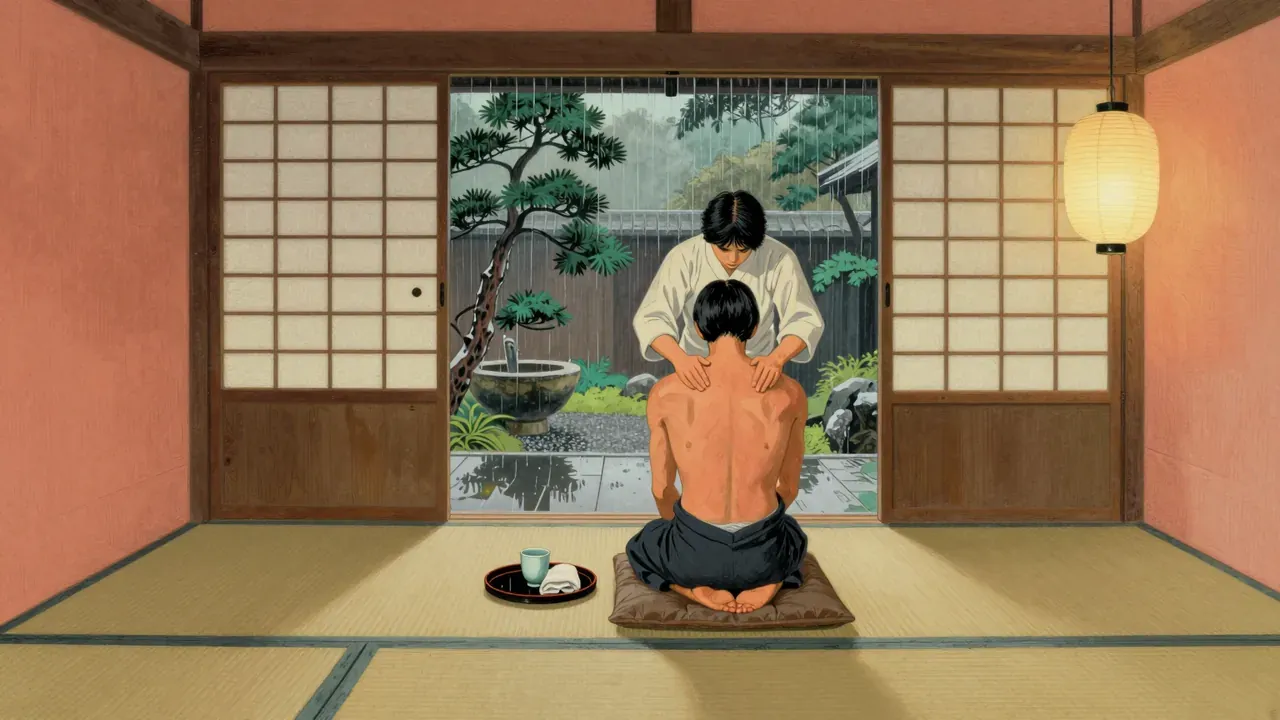
Zatoichi on the Road is the fifth entry in Daiei’s 26-film Zatoichi series, a yakuza film built around the recurring figure of a blind itinerant masseur and swordsman. It does not attempt innovation in form or theme but consolidates the series’ established grammar: episodic travel, moral ambiguity masked by stoic reserve, and swordplay that favours economy over spectacle. The film works within tight commercial constraints — an 88-minute runtime, a familiar cast, and a script by Minoru Inuzuka, who wrote several early instalments. Its aim is functional continuity: to reaffirm Ichi’s paradoxical position as both outsider and arbiter, neither fully aligned with law nor with outlawry, yet repeatedly drawn into conflict by others’ desperation or calculation. There is no effort to deepen his psychology beyond what the series has already settled — his blindness is narrative device, not metaphor; his skill, a given. The film assumes audience familiarity with the character’s code, his reluctance to fight, and the ritualised weight of his blade. It is less a standalone story than a calibrated recurrence — a chapter that sustains rhythm rather than disrupts it. (159 words)
The weight of stillness
The story moves briskly across rural post-Tokugawa Japan, threading Ichi through intersecting schemes: a crime boss’s feint, a lord’s vengeance, and competing yakuza ambitions. Shintarō Katsu’s performance anchors it — his Ichi speaks softly, listens intently, and reacts with minimal inflection, making each physical intervention land with quiet finality. Yasuda directs with unshowy precision: fights are shot in medium, often from slightly low angles, avoiding choreographic flourish in favour of sudden, close-quarters resolution. Akira Ifukube’s score uses koto and taiko sparingly, reserving emphasis for moments of decision — not action. Art director Yoshinobu Nishioka gives the inns, tea houses, and riverbanks a lived-in plainness; there are no ornate sets, only functional spaces where dialogue and gesture carry weight. The editing avoids cross-cutting suspense; instead, it lets scenes breathe just long enough for implication to settle before the next turn. Performances elsewhere are serviceable but unvaried — Fujimura’s Mitsu conveys vulnerability without slipping into fragility, while Reiko Fujiwara’s Hisa holds a steady, watchful resentment. No actor overreaches; none needs to. The craft serves restraint, not revelation. (158 words)
The kerchief moment
What lands is the cumulative weight of Ichi’s solitude — not as tragedy, but as condition. His refusal to name himself at the inn, his dry dismissal of his own legend, the way he charges exorbitantly for a massage not out of greed but to assert control in a situation where he has none: these register because they are understated, repeated, and never explained. The film’s strongest sequence is not the climactic boat raid but the lunch stop where Mitsu says she is happy for her hardships — a line that lands not because it is profound, but because it arrives after sustained silence, and because Katsu’s reaction — a slight tightening of the jaw, then immediate violence — makes clear how little he permits sentiment to interfere with duty. The kerchief moment at the end also lands: its near-return, then withdrawal, communicates more about attachment and discipline than any monologue could. These moments work because they trust the viewer to read absence — the space between what is said and what is done, between what is offered and what is withheld. The film earns its emotional beats not through accumulation but through subtraction. (157 words)
The palanquin service
What does not land is the political scaffolding. The rivalry between Hikozo and Shimozuma lacks texture — their motives are transactional, their men interchangeable, their power bases undefined beyond names and titles. The lord’s assault on Mitsu is stated, not dramatised, so her trauma remains abstract, a plot function rather than a lived reality. Similarly, Jingoro’s villainy feels procedural: he schemes, he lies, he betrays — but his relationship to Hisa or to his employer is never clarified, leaving his actions unmoored from consequence. The film also struggles with tonal drift when shifting between Ichi’s wry detachment and Mitsu’s earnest gratitude; their dynamic risks tipping into sentimentality, especially in the final embrace, which lacks the irony or ambiguity that earlier scenes sustain. The palanquin service subplot introduces Tomegoro as a minor opportunist, but his arc vanishes mid-film, unresolved. These are not flaws of execution but of scope: the film attempts to hold too many minor threads without giving any of them sufficient time to cohere. It is not that they fail, but that they are left hanging — not as mystery, but as omission. (156 words)
Obligation as currency
The themes that matter are obligation and autonomy — how they bind and unbind people in a rigid social order. Ichi accepts payment to meet Hikozo, then refuses to fight until the price rises, treating loyalty as negotiable. Mitsu is hunted not for what she did but for what it implies about power’s limits — her hairpin strike is less rebellion than rupture, exposing the thin line between authority and violation. Hisa’s choices pivot on survival, not ideology: she shifts allegiance not out of conviction but because she reads the balance of force. Even the samurai questioning their orders do so quietly, knowing dissent carries no leverage. The film treats hierarchy not as injustice to be overturned but as atmosphere — thick, inescapable, shaping every gesture. There is no utopian alternative proposed, no critique of the system itself, only precise observation of how individuals navigate its fissures. Compassion appears not as principle but as interruption: Ichi’s protection of Mitsu is not chivalric but situational, born of proximity and a shared understanding of being used. The film’s moral centre is not virtue, but consistency — the quiet insistence on keeping one’s word, even when the word is ‘no’. (159 words)
For those who already know
This film is for viewers who value rhythm over revelation, and who understand that repetition in a long-running series is not stagnation but refinement — like watching a master calligrapher repeat the same character, each time adjusting pressure, speed, and breath. It rewards patience with small, earned satisfactions: the exact angle of a sword draw, the pause before a lie is told, the way light falls across a tatami mat at dusk. It is not for those seeking psychological depth, historical context, or thematic expansion — the film offers none of these. Anyone expecting the philosophical weight of Kurosawa or the visual daring of Suzuki will find it undernourished. Nor is it for newcomers to the series: the shorthand relies on prior knowledge of Ichi’s habits, his reputation, and the world’s rules. A viewer who dislikes slow-burn tension or finds moral ambiguity frustrating will leave restless. But for those who appreciate craft as discipline — the kind that makes restraint feel like strength — this is calibrated, confident work. It assumes its audience knows what it is doing, and asks only that they watch closely. (159 words)
Walking off alone again
Yes, it is worth your evening — provided you approach it as a movement within a larger composition, not as a self-contained statement. Its 88 minutes pass without strain, anchored by Katsu’s unflustered presence and Yasuda’s unhurried pacing. It delivers what the series promises: clean action, quiet wit, and a protagonist whose stillness makes violence meaningful. Those who demand novelty, exposition, or emotional catharsis will find it thin. But viewers attuned to subtlety — who notice how a character’s posture changes when lying, or how silence stretches before a blade is drawn — will find it richly attentive. It is not great cinema in the monumental sense, but it is excellent genre work: precise, unsentimental, and deeply aware of its own limits. To dismiss it as formulaic is to miss how much care goes into sustaining that formula. Someone who prefers the operatic scale of Seven Samurai or the surreal energy of Branded to Kill would reasonably choose otherwise — but that is a difference of appetite, not merit. (159 words)