The premise
Zatoichi at Large is the twenty-third entry in the long-running Japanese chanbara series centred on a blind itinerant masseur and swordsman. It attempts to sustain the formula while shifting distribution from Daiei to Toho, marking a transitional moment in the franchise’s commercial life. The film sets Zatoichi on a mission to deliver an infant to its surviving relatives after its mother dies in childbirth — a narrative pivot toward duty and moral obligation rather than chance confrontation or personal vendetta. This departure from episodic self-containment signals an effort to deepen continuity and emotional stakes within the established rhythm of travel, brief shelter, escalating threat, and decisive swordplay. It does not seek formal innovation or psychological rupture but rather a measured recalibration: tightening cause-and-effect, foregrounding consequence, and testing Zatoichi’s agency against institutional authority. The film’s ambition is modest but deliberate — to reaffirm the character’s ethical gravity without abandoning the genre’s ritualised violence or folk-inflected pacing.
The look of it
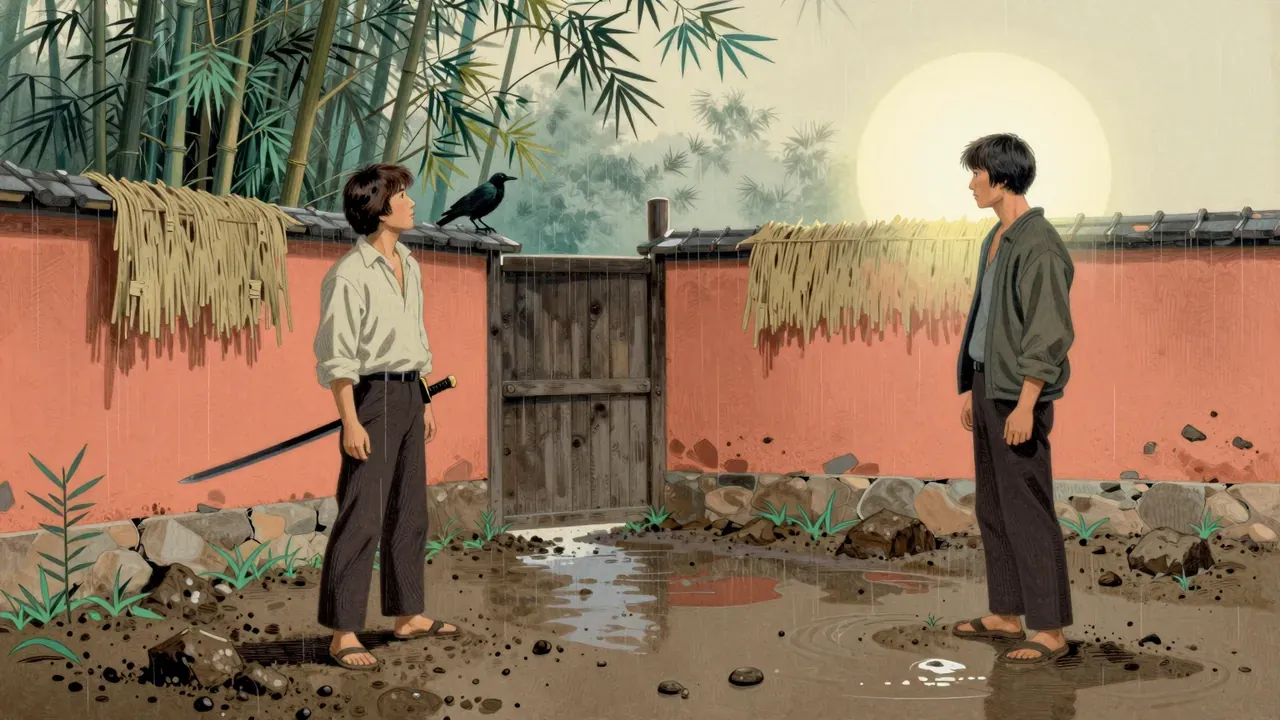
The story follows Zatoichi as he assists a dying woman in childbirth, then carries the newborn across provincial roads under growing suspicion and pursuit. Rentarō Mikuni plays a magistrate whose rigid interpretation of law places him in direct opposition to Zatoichi’s informal justice; Shintarō Katsu’s performance remains grounded, avoiding flamboyance in favour of tactile restraint — his hands, posture, and listening silence carry more weight than any flourish. Kazuo Mori directs with functional clarity: compositions are uncluttered, action staged for legibility over choreographic novelty, and editing avoids rhythmic disruption. The swordplay retains its percussive economy — no lingering close-ups on blades, no slow-motion flourishes — and the score, though uncredited in the fact sheet, adheres to the series’ tradition of sparse shamisen punctuation. Lighting is even, daylight scenes unvarnished, interiors neither oppressive nor atmospheric. There is no stylistic deviation from the series’ established grammar, only a slight compression of exposition and a more insistent through-line binding each encounter to the infant’s fate.
The weight of care
What lands is the quiet accumulation of moral weight. Zatoichi’s care for the child — holding it, adjusting his pace, shielding it from rain — gains resonance precisely because it is shown without commentary or musical emphasis. His refusal to abandon the task, even when cornered and humiliated, reads as conviction rather than heroism. The supporting cast, particularly Mikuni’s magistrate, avoids caricature: his rigidity feels procedural, not cruel, and his final confrontation with Zatoichi carries bureaucratic exhaustion as much as antagonism. The film’s mid-section, where Zatoichi shelters with a family of farmers who accept him without question, works because it rests in duration — shared meals, quiet labour, unspoken trust — rather than exposition. These moments do not advance plot but anchor tone, reinforcing the idea that Zatoichi’s value lies less in what he defeats than in how he moves through the world without erasing those he passes. The film earns its modest emotional payoff not through spectacle but through sustained attention to gesture and consequence.
The forced climax
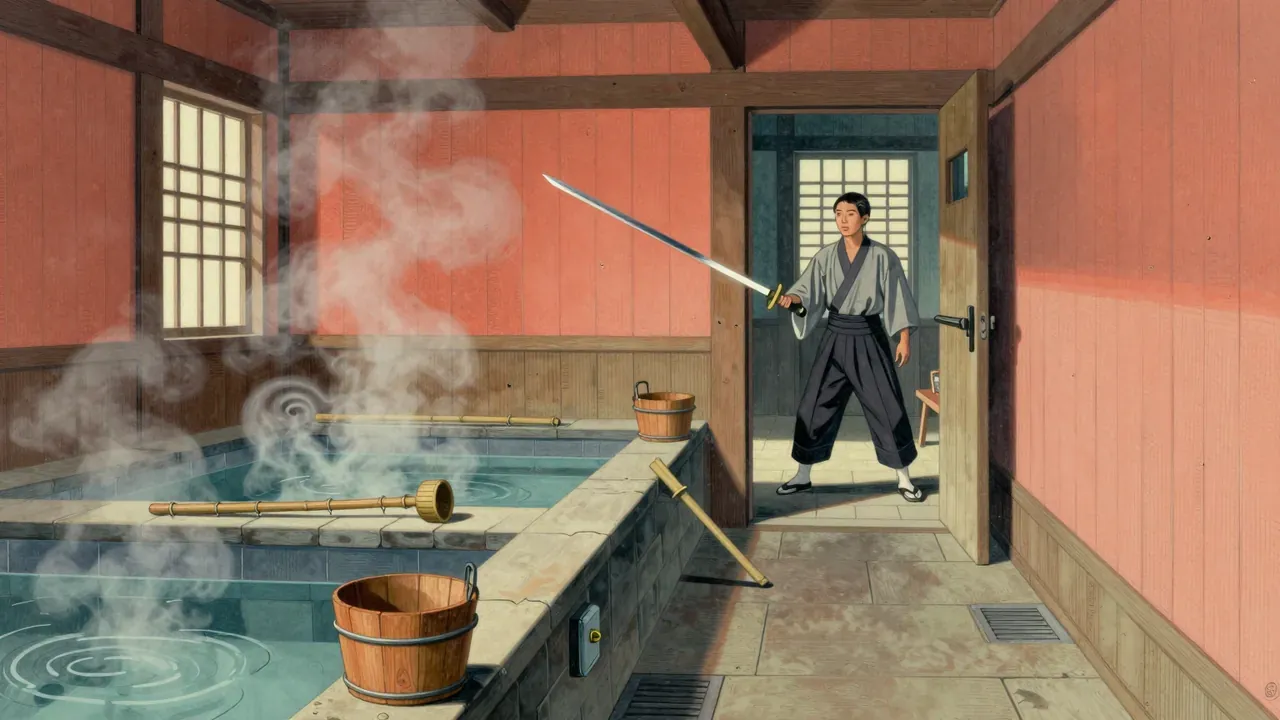
What does not land is the climactic duel, which arrives abruptly and resolves with mechanical inevitability. Its placement feels structural rather than earned — inserted to satisfy genre expectation rather than narrative logic — and its execution lacks the spatial coherence or tension-building of earlier entries. The film’s attempt to layer ‘twists’ in the finale — ambushes, betrayals, enforced capture — dilutes rather than deepens stakes; each complication arrives without sufficient groundwork, making Zatoichi’s humiliation feel procedural, not poignant. The subplot involving the infant’s father, introduced late and resolved off-screen, adds little beyond nominal complication. Nor does the shift to Toho yield any discernible change in production texture: the cinematography, sound design, and set construction remain consistent with prior Daiei entries, so the ‘transition’ registers only in distribution credits, not in craft. The film’s fatigue, noted by later reviewers, is not in energy but in invention — it repeats rhythms without varying their weight or timing, mistaking repetition for resonance.
The measure of duty
The themes that matter are obligation versus jurisdiction, care as resistance, and the quiet persistence of ethics in systems built for control. Zatoichi does not challenge the magistrate’s authority on legal grounds but by fulfilling a duty the law ignores — the infant has no status, no name, no claim; yet Zatoichi treats it as a person with inherent claim on time, risk, and protection. This is not rebellion but counter-administration: a parallel system of responsibility operating outside official channels. The film also sustains the series’ long-standing preoccupation with blindness as perceptual discipline — Zatoichi hears hesitation in voices, detects deception in breath, locates danger by echo and scent — but here, that acuity serves nurture, not combat. His sword remains sheathed for longer than usual, and its use feels like failure, not triumph. The theme is not justice as retribution but justice as continuity: ensuring the child reaches kin, ensuring memory survives institutional erasure, ensuring dignity persists where paperwork ends.
Who it is for
This film is for viewers already familiar with the Zatoichi series who value consistency of tone and incremental variation over reinvention — those who watch not for surprise but for confirmation of character logic and craft reliability. It is also for students of Japanese studio-era chanbara who wish to trace shifts in production context, such as the move from Daiei to Toho, and how such transitions register (or fail to register) on screen. It is not for newcomers seeking an accessible entry point: the film assumes knowledge of Zatoichi’s habits, limitations, and moral shorthand, and offers no exposition to orient the uninitiated. Nor is it for viewers prioritising visual distinction or directorial signature — Kazuo Mori’s hand is steady but unobtrusive, and the film makes no argument for itself beyond continuation. Those who found earlier entries repetitive may find this one’s minor adjustments insufficient to renew engagement, and those expecting thematic expansion will note its fidelity to precedent over development.
The evening’s return
It is worth your evening if you approach it as a chapter rather than a statement — a functional, quietly committed instalment in a long sequence, not a standalone event. Its ninety minutes pass without strain or pretension, anchored by Katsu’s unshowy command and Mikuni’s restrained antagonism. The film earns its time not through revelation but through steadiness: the baby is delivered, the magistrate is checked, the road continues. It would not persuade someone indifferent to the series, nor does it demand reappraisal from devotees — its virtue is maintenance, not transformation. A viewer who values craftsmanship over novelty, or who finds solace in ritualised form, will leave satisfied. Those who require escalation, stylistic rupture, or conceptual framing may find it inert. Its worth depends entirely on whether you see value in persistence — in doing the same thing, well, once more — and whether that persistence feels like integrity or inertia in this particular instance.