The return
The Tale of Zatoichi Continues is the second film in Daiei Film’s Zatoichi series, released in early 1962 and directed by Kazuo Mori. It attempts to deepen the character of Zatōichi — a blind itinerant masseur and swordsman — not through spectacle or exposition, but through repetition, contrast, and quiet accumulation: returning to the same temple, revisiting the same stream, encountering variations of the same emotional wound. It does not restate the premise; it assumes familiarity with the first film and builds on its unresolved tensions — Otane’s unreciprocated affection, the death of Hirate, the loss of Chiyo. The film’s ambition lies in compressing moral ambiguity into tight, ritualised encounters: a lord’s madness, a yakuza’s petty authority, a brother’s vengeful grievance. It works within the constraints of mid-1960s Japanese studio production — 72 minutes, modest sets, no location shooting beyond temple grounds and roadside streams — and treats those limits as structural features, not deficiencies. Its purpose is not expansion but distillation: what remains when you strip away origin, explanation, and resolution?
The look of it
The story moves in short, decisive strokes: Zatōichi arrives, is threatened, observes, declines to explain himself, fights, withdraws, reflects, and acts again. Minoru Inuzuka’s script avoids flashbacks or voiceover, trusting Shintarō Katsu’s physical presence — the tilt of his head, the pause before a draw, the way he folds his hands while listening — to carry memory and motive. Tomisaburō Wakayama, playing the one-armed Yoshirō, delivers restraint where others might choose bluster; his stillness makes his violence more unsettling. Ichirō Saitō’s score leans into strings and shamisen tremolos, heightening mood without dictating it — a contrast to Ifukube’s more declarative themes in the first film. Kazuo Mori keeps framing tight and editing brisk: no lingering on aftermath, no slow pans across landscapes. Fight choreography favours proximity over spectacle — blades meet close, cuts land off-centre, opponents fall without flourish. The camera rarely follows action; it waits for it, then cuts away just after impact. This is not minimalism for its own sake, but a method of holding attention on consequence rather than cause.
The weight of it
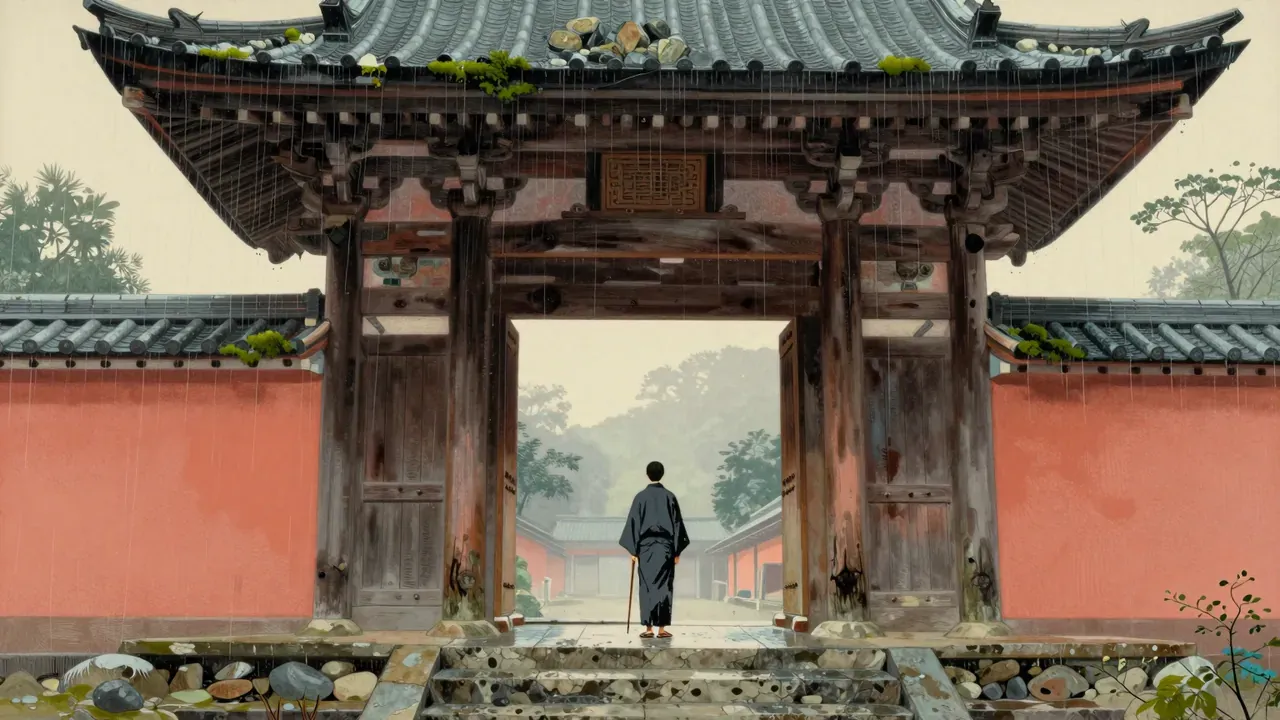
What lands is the weight of recurrence: Zatōichi’s return to Joshoji Temple, his stop at the stream where he fished with Hirate, the reappearance of Chiyo’s name spoken by two men who loved her differently and lost her in ways neither fully understands. These repetitions do not feel like retreads but like stones dropped into still water — each ripple distinct, each echo slightly altered. The restaurant scene, where Setsu invites Zatōichi to stay the night and he accepts without ceremony, lands because it refuses sentimentality: her offer is practical, his acceptance is weary, their morning-after exchange — ‘It is as if we were married’ — carries no irony, only quiet recognition of shared transience. The final confrontation at the temple lands not for its choreography but for its silence: Zatōichi disarmed, then stabbing Yoshirō with the man’s own wakizashi, then carrying him away without triumph. There is no music here, no close-up on a face — just movement, breath, and the sound of rain on stone.
The gaps in it
What does not land is the political scaffolding around the insane lord. His retainers’ decision to kill Zatōichi for witnessing instability feels arbitrary — the film gives no sense of court hierarchy, no stakes beyond personal survival, and no reason why this particular observation should warrant assassination. The yakuza subplot, introduced late and resolved abruptly, serves only to raise the body count without clarifying motive or consequence. Sukegoro’s final confrontation with Zatōichi lacks grounding: we learn he is a gang boss only when he names himself, and his death arrives without preparation or thematic resonance. The film’s tight runtime works against these threads — they are sketched, not shaped. Also unconvincing is the scale of the ‘large-scale battle’ cited by Galloway: the fight involves perhaps a dozen men, shot in tight quarters with minimal coverage, and reads less as a set-piece than as a compressed skirmish. The claim of fifty to sixty opponents appears to be a misreading of either the staging or the source material.
The code of it
The themes that matter are kinship without blood, memory without fidelity, and justice without verdict. Zatōichi and Yoshirō are brothers not by choice but by shared loss — of sight, of limb, of Chiyo — yet neither acknowledges the bond until the end, and even then only to deny it. The film treats blindness not as metaphor but as condition: Zatōichi navigates by sound and scent, corrects others’ misperceptions without correcting their language, and never asks for accommodation. Memory is unreliable but persistent: Zatōichi recalls Hirate’s voice, Otane’s proposal, Chiyo’s departure — all with equal clarity, though none are verifiable. Justice here is not legal or ceremonial but kinetic: Zatōichi kills Sukegoro not for crime but for having made others die in his service — a personal calculus, not a moral one. There is no redemption arc, no lesson drawn, no societal critique. The film holds these ideas in suspension, neither resolving nor condemning them, letting them coexist like stones in a dry riverbed.
The audience for it
This film is for viewers who value economy over exposition, gesture over dialogue, and moral weight over narrative closure — particularly those already familiar with the first Zatoichi film or with mid-century Japanese studio craft. It rewards attention to rhythm: how long Katsu holds a pause, how Mori frames a doorway, how Saitō’s music drops out before a cut. It is not for viewers who require clear antagonists, causal plotting, or psychological explanation — the lord’s madness, Yoshirō’s bitterness, even Zatōichi’s motivations remain partial, implied rather than stated. Those expecting the broader social canvas of later entries (like Zatoichi Meets Yojimbo) or the lyrical pacing of Ozu will find it too lean. A viewer who dislikes ambiguity in motivation or resists films that withhold context will likely judge it underdeveloped. What would change that verdict? A longer runtime allowing the lord’s subplot to acquire texture, or a script that embedded Sukegoro’s authority in visible detail — a ledger, a seal, a subordinate’s deference — rather than naming it in passing.
The worth of it
Yes, it is worth your evening — provided you watch it as a single, self-contained object, not as instalment two of a franchise. Its 72 minutes pass without drag because every scene serves a dual function: advancing plot while deepening character, or revealing motive while withholding judgment. It demands no prior knowledge beyond basic genre literacy — the tropes of the wandering swordsman, the honour-bound feud, the doomed romance — but rewards familiarity with the first film’s emotional architecture. Those who find its pacing too abrupt may prefer the more meditative third or fourth entries, but this one has a rare, unsentimental clarity: Zatōichi is not noble, not tragic, not wise — he is present, precise, and bound by his own unspoken code. To dismiss it as ‘less interesting’ than the first film mistakes continuity for repetition. Its value lies in how it tightens the screws — not on the story, but on the silence between actions.