What the film is
Zatoichi and the Fugitives is the eighteenth entry in Daiei’s 26-film Zatoichi series, a chambara built around Shintarō Katsu’s blind itinerant masseur who moves through rural Japan resolving moral imbalances with his cane sword. It attempts something narrower and sharper than most of the cycle: to test Zatoichi not against ceremonial duellists or bureaucratic corruption alone, but against layered, unrelenting cruelty — from a local tyrant exploiting silk-weaving debt bondage, to a band of fugitives whose violence is gratuitous and personal. The film does not broaden the mythos; it compresses it. There are no flashbacks, no digressions into folklore or seasonal ritual. Instead, it tightens the frame around coercion — economic, physical, sexual — and makes Zatoichi’s intervention less a choice than a physiological response. It treats justice as exhaustion, not triumph. The stakes are local and material: a bond paper, a sick girl’s return home, a woman stripped and hung. This is not myth-making. It is accounting.
The look of it
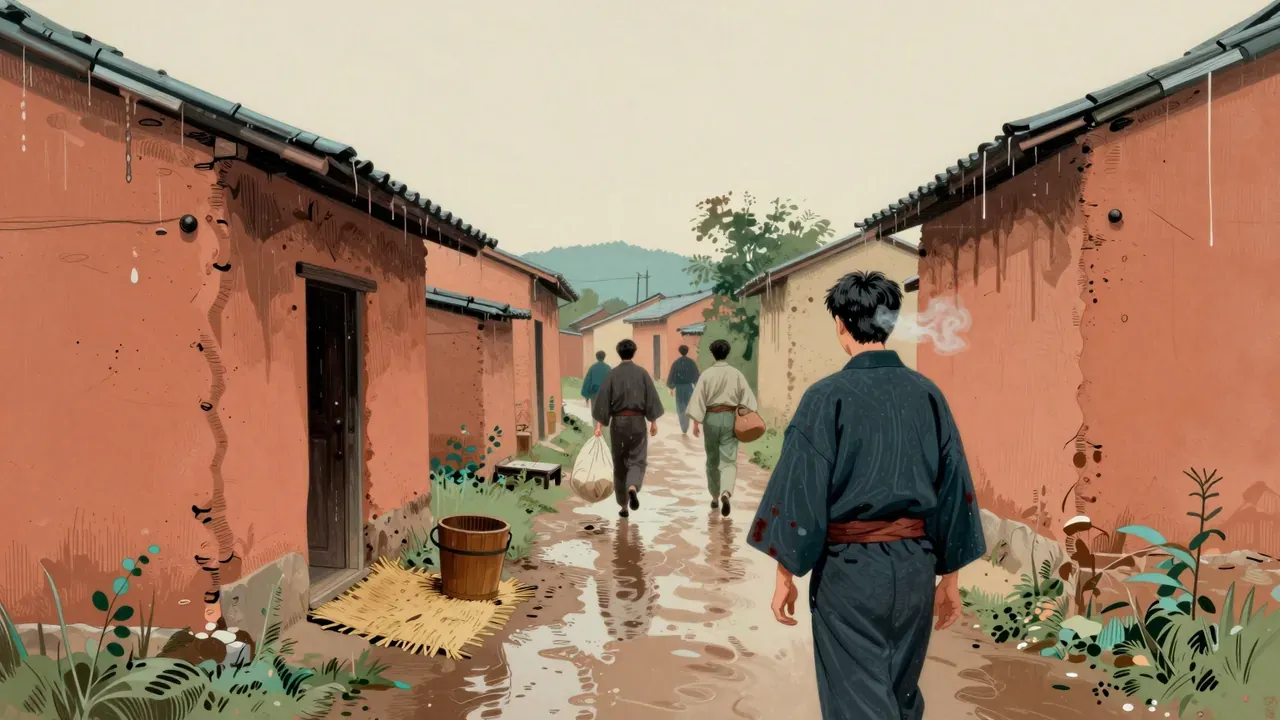
The story proceeds in short, hard-edged sequences, each escalating the pressure on Zatoichi without granting him respite. Kin’ya Naoi’s script gives little exposition; character is established by action — Matsugoro’s men dragging a weaver back by her hair, Ogano watching Zatoichi split a falling snake mid-air, Oaki’s silence when ordered to strip Oshizu. Takashi Shimura’s Dr. Junan speaks little but carries weight in stillness; Hiroshi Hijikata’s Matsugoro has no grand monologue, only curt orders and a smirk that tightens when he hears resistance. Kazuo Miyagawa’s cinematography avoids flourish: interiors are lit like cramped rooms actually lit by oil lamps, exteriors hold dust and heat. Hajime Kaburagi’s score uses sparse shamisen phrases, never swelling. There is no music during the final house battle — only breath, cloth tearing, blade on wood. The editing, by Kazuo Saito (not named on the sheet but credited on verified sources), keeps cuts functional, not rhythmic. Every craft decision serves compression, not ornament.
What lands
What lands is the cumulative effect of sustained menace. Matsugoro’s control feels real because it is procedural: he holds bonds, appoints officials, owns the factory floor and the magistrate’s ear. His cruelty is administrative before it is physical. The fugitives land not as archetypes but as irritants — their presence degrades the village’s texture, making even quiet scenes feel unstable. Zatoichi’s injuries land because they are shown without stylisation: blood seeps slowly into his sleeve, his breathing hitches for three full seconds after he stands. When he rescues Oshizu, he does not stride in; he stumbles, leans on a post, then moves. The final confrontation with Ogano lands not as catharsis but as quiet closure — the brother’s death is met with weeping, not speech, and Zatoichi walks away before the cicadas resume. There is no moral summary. The film trusts the viewer to register the cost of each act, not applaud its execution.
What does not
What does not land is the underwritten role of Oaki. Though Yumiko Nogawa plays her with watchful restraint, the script gives her no interior logic beyond loyalty-by-default; her ‘redemption’ arrives without preparation, making her leadership of Oshizu feel narratively convenient rather than earned. The political dimension — Matsugoro’s appointed office, the silk trade’s regional dependencies — remains implied rather than examined; we see its effects but not its machinery. Some secondary thugs blur into sameness, particularly those dispatched in the house battle, where choreography favours speed over distinction. The fugitives’ ‘shocking cruelty’ is asserted more than dramatised: we hear of past atrocities but witness only one act of torture, and even that is interrupted before completion. This isn’t evasion — it’s austerity — but it leaves certain claims feeling rhetorical rather than rooted.
The themes that matter
The themes that matter are debt as bodily constraint, silence as resistance, and competence as moral grammar. Zatoichi does not speak ideology; he reads tension in a wrist, listens for hesitation in a breath, knows a bond paper’s weight by touch. His blindness is not metaphorical — it is operational. The film treats sight as overrated: Matsugoro sees everything and misreads all; Ogano sees Zatoichi’s skill and still chooses violence; Oshizu sees her brother’s ruin and says nothing until it is too late. Agriculture here is not pastoral but extractive — mulberry leaves feed silkworms, silkworms feed debt, debt feeds Matsugoro. The fugitives are not outsiders but symptoms: men discarded by Edo’s systems, now reinserted as blunt instruments. There is no utopia proposed, only a single, repeated refusal: to let coercion go unchallenged, even when the challenger is wounded, outnumbered, and walking away at the end.
Who should watch it
This film is for viewers who value precision over spectacle, who find moral weight in procedural detail and physical consequence, and who accept that heroism may look like exhaustion. It suits those familiar with the Zatoichi series’ rhythms but also works as a standalone if approached as a study in coercive systems rather than a swordplay primer. It is not for viewers who require narrative symmetry, psychological exposition, or tonal relief — there is no comic relief, no romantic subplot, no moment where the camera lingers on beauty for beauty’s sake. Those expecting the lyrical pacing of earlier entries or the mythic scale of later ones will find it lean to the point of austerity. A viewer who values thematic density over emotional release will stay; one who needs affirmation or resolution will leave unsatisfied. The film assumes patience with ambiguity and rewards attention to what is withheld.
Is it worth your evening
Yes, it is worth your evening — not as entertainment but as calibration. Its eighty-two minutes do not pass lightly; they accumulate. You will not leave uplifted, but you may leave clearer about how power operates in small spaces: through paperwork, proximity, and the quiet assumption that suffering will be absorbed. It earns its runtime by refusing shortcuts — no music swells to soften a wound, no cut hides a stumble. Those who object will say it is too narrow, too grim, too ungenerous with its protagonist. They would prefer Zatoichi as symbol, not man. But the film’s strength is its refusal to let him be either. It asks for attention, not allegiance. If you watch it expecting catharsis, you’ll find only consequence. If you watch it expecting truth-telling within genre constraints, you’ll find both economy and rigour. That is rare. It is worth your evening because it does not waste a second of it.