The span of it
Twenty-Four Eyes is a Japanese drama film released in 1954, directed by Keisuke Kinoshita and adapted from Sakae Tsuboi’s 1952 novel. It traces the life of schoolteacher Hisako Ōishi across two decades — from her arrival on Shōdoshima island in 1928 to the aftermath of Japan’s defeat in 1945 — using her relationship with twelve pupils as a structural and moral anchor. The film does not aim for historical synthesis or political exposition; instead, it seeks to register the cumulative weight of militarisation, poverty, loss and quiet endurance through intimate, repeated human contact. Its method is cumulative rather than argumentative: each classroom scene, each visit home, each departure or return serves as a small deposit in an emotional ledger. Kinoshita and Tsuboi treat the schoolroom not as a site of instruction alone but as a fragile civic space — one that contracts under state pressure, then reopens, tentatively, after war. The film’s ambition is modest in form but expansive in implication: to hold a single ethical stance — care — steady against the tide of national ideology. It asks the viewer to measure history not by treaties or battles but by who stops teaching, who stops singing, who stops coming to class.
The look of it
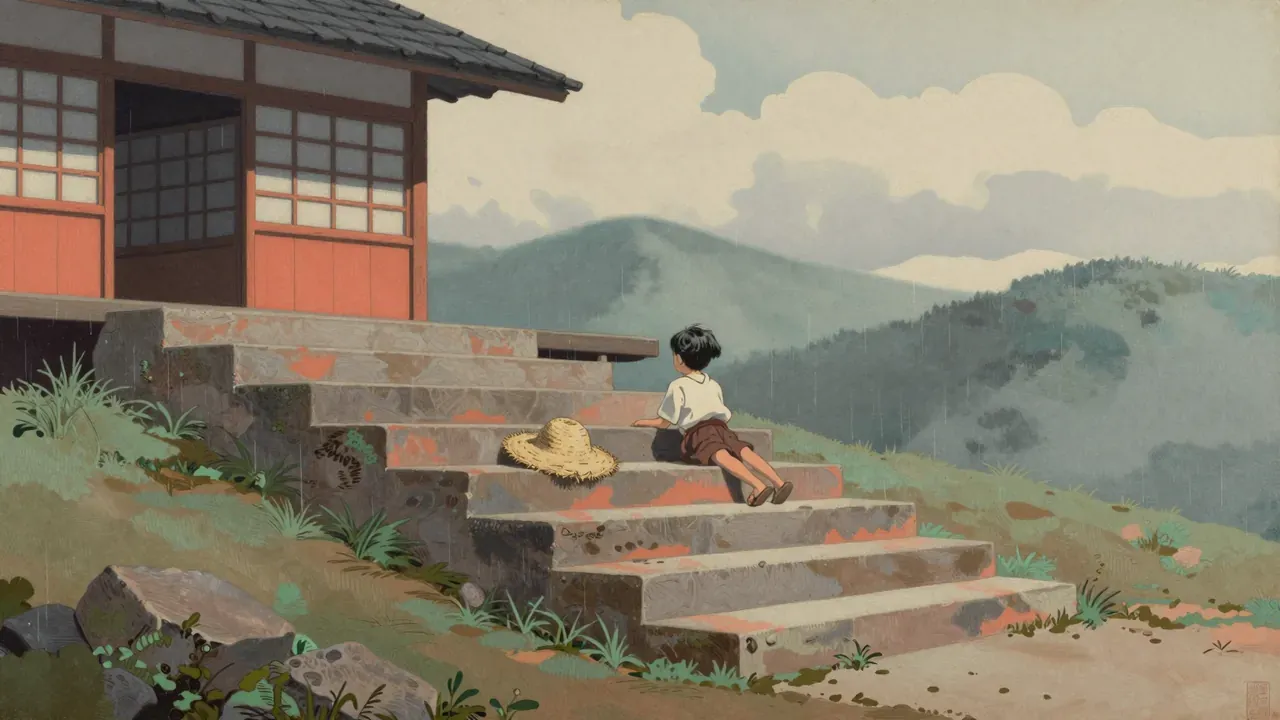
The story unfolds in chronological chapters keyed to academic years and major historical markers, moving from spring 1928 to spring 1946. Hideko Takamine carries the film with unembellished physical presence: her gestures are economical, her voice rarely raised, her authority rooted in consistency rather than command. The child actors — none credited individually beyond the fact sheet — perform without affectation; their reactions feel observed, not staged. Chishū Ryū appears briefly but decisively as the principal, his quiet admonitions carrying institutional weight. Kinoshita’s direction avoids flourish: compositions are frontal and grounded, often framed at eye level with the children. The Shochiku studio’s black-and-white photography renders Shōdoshima with tactile clarity — salt-bleached wood, damp stone steps, the grain of tatami mats — but never lingers on scenery for its own sake. Editing follows rhythm over pace: scenes end when a gesture is complete, not when tension peaks. Music is sparse and diegetic — mostly children’s songs, sung off-key or half-remembered. There is no score to cue emotion; the weight rests in duration, repetition and silence between lines.
What stays
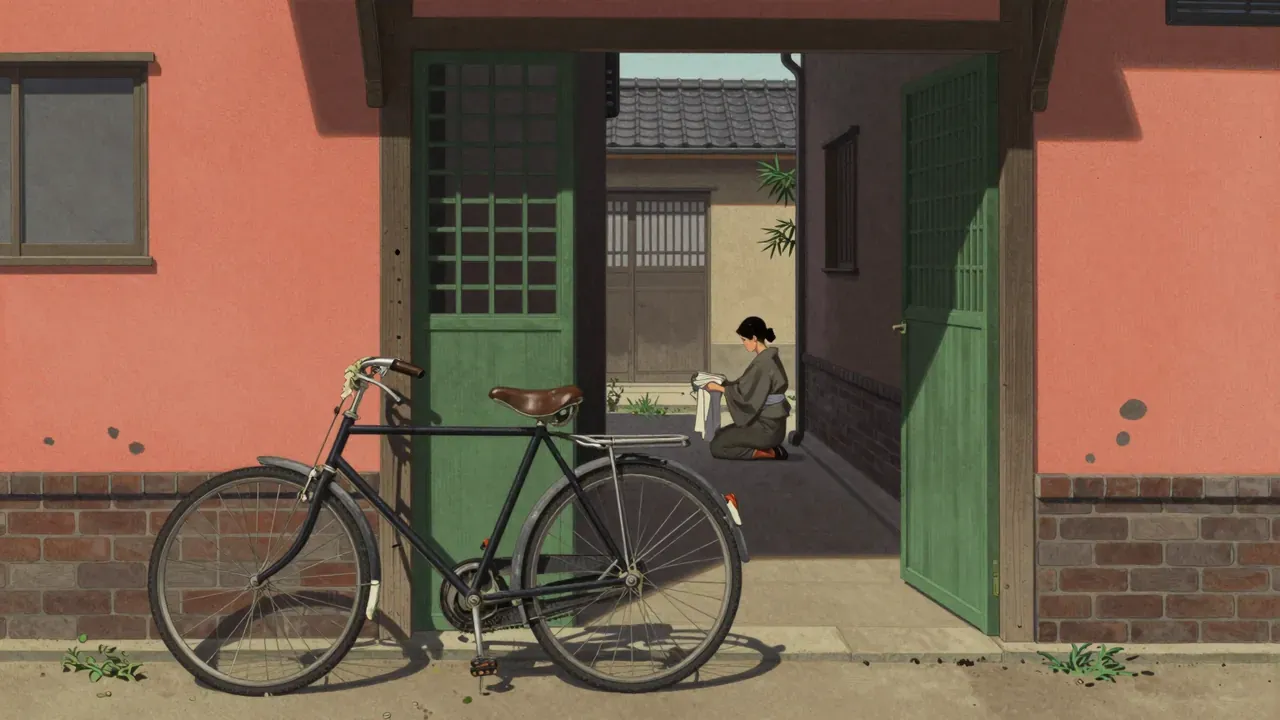
What lands most firmly is the film’s fidelity to time as lived, not measured. The recurrence of April 4th — first as Ōishi’s arrival, then as her return to teaching — functions like a metronome, marking resilience without fanfare. Small details accrue meaning: the bicycle she rides in 1928 becomes a gift from former students in 1946; the anthology she reads aloud vanishes after the principal burns it, then reappears implicitly in the values her pupils carry into adulthood. The classroom scenes land because they are built on behavioural truth — children fidget, interrupt, forget lyrics, stare out windows — not symbolic perfection. Takamine’s performance lands because it refuses catharsis: her grief over lost students is registered in lowered shoulders, not tears; her exhaustion is shown in how she leans against a desk, not in monologues. The film’s anti-war stance lands not through polemic but through subtraction — showing what disappears when nationalism enters the school: questions, laughter, uncertainty, the right to say ‘I don’t know’.
What slips away
What does not land for contemporary viewers is the film’s structural patience, which can read as inertia. The episodic structure — year by year, student by student — risks flattening dramatic shape; there is no central crisis, no turning point that reconfigures the terms of the narrative. Some transitions feel abrupt: Matsue’s departure, Kotoe’s tuberculosis, Ōishi’s resignation — all occur off-screen or in summary, leaving emotional gaps the film does not bridge. The male students’ enlistment is treated as inevitable rather than interrogated, and their deaths arrive as names on a list, not as developed arcs. The film’s refusal to assign individual culpability — noted by Tadao Sato in the fact sheet — means certain moral complexities remain unexamined: how villagers enable militarism, how teachers comply, how economic desperation shapes consent. The tone, while sincere, occasionally tips into reverence: Ōishi’s goodness borders on abstraction, making her less a teacher than a vessel. This limits the film’s capacity to unsettle, even as it moves.
What it says without saying
The themes that matter are education as resistance, memory as continuity, and care as political practice. The film treats pedagogy not as transmission but as mutual recognition: Ōishi learns from her students as much as they learn from her — about hunger, grief, dignity in labour, the weight of silence. Its anti-war stance is rooted in this relational ethics: war is shown not as abstract evil but as the systematic breaking of such bonds — through conscription, censorship, displacement, disease. Class and gender are woven into daily texture: girls leave school to work, boys are steered toward uniforms, poverty dictates who eats and who starves. The film’s quiet feminism lies in its refusal to separate domestic and public spheres — Ōishi’s pregnancy, her mother’s death, her husband’s absence, her financial struggle — are not subplots but conditions of her teaching. And its pacifism is localised: it speaks not of universal peace but of the specific, irreplaceable loss of twenty-four eyes — twelve children, then twelve adults — whose futures were foreclosed by policy, not fate.
Who it meets
This film is for viewers who value slow accumulation over plot mechanics, who find emotional resonance in restraint, and who approach historical drama as social archaeology rather than spectacle. It rewards attention to gesture, silence and recurrence — readers of Yasujiro Ozu or early Mikio Naruse will recognise its grammar. It is not for those who require narrative propulsion, psychological exposition or stylistic intervention; its stillness may register as emptiness without context. Those expecting overt political critique — of imperialism, emperor worship or wartime bureaucracy — will find the film too gentle, its indictment implicit rather than forensic. Its power depends on accepting that some truths are held in a glance, a pause, a shared meal — not in speeches or confrontations. A viewer who needs cause-and-effect clarity, or who finds sentimentality indistinguishable from sincerity, will likely disengage before the final chapter.
How long it lasts
Yes, it is worth your evening — provided you watch it as a chronicle, not a thriller. Its 156 minutes unfold like pages turning in a diary: uneven in emphasis, tender in detail, uninterested in summarising. You do not need prior knowledge of Shōwa-era Japan, but you do need willingness to sit with quietude — to let the weight of a child’s hand on a teacher’s sleeve, or the sound of sandals on stone, register as event. It is not a film to consume but to inhabit, and its reward is cumulative: by the final shot — Ōishi cycling past the same path where she first arrived — the repetition feels earned, not repetitive. Those who prefer tightly wound narratives or visual flamboyance will find it slack. But for anyone willing to meet it on its own terms — patient, humane, unadorned — it offers a rare kind of gravity: the kind that settles in the chest, not the head.