The shape of memory
The Passionate Friends is a 1949 British drama adapting H. G. Wells’s 1913 novel, reframed by David Lean and Eric Ambler as a psychological study of romantic fidelity, self-ownership, and the quiet violence of bourgeois restraint. It does not aim for social critique or narrative propulsion but for sustained interiority: Mary Justin’s voiceover anchors the film less as exposition than as an unreliable, emotionally labile register — her memory edits time, omits motive, and softens consequence. The film tries to hold two contradictory propositions at once: that love is a sovereign choice, and that loyalty is a structural necessity. Its formal ambition lies in sustaining that tension without resolution — not through irony or ambiguity, but through accumulation: repeated gestures (a programme left behind, a suitcase moved between rooms), recurring settings (the terrace, the railway platform), and tonal restraint in performance and image. It is a film about what people do when they cannot say what they mean, and how long they can sustain the silence before it breaks them. It assumes its audience will follow emotional logic over plot logic, and that a glance, a pause, or a withheld breath carries more weight than dialogue.
The look of it
The story unfolds via nested flashbacks anchored by Mary’s narration aboard a plane and at a Swiss hotel, folding nine years into a single morning. Ann Todd carries the film with physical precision: her posture shifts between deference and defiance, her eyes flicker between calculation and surrender. Claude Rains plays Howard with clipped diction and stillness that reads as control until it cracks; Trevor Howard’s Steven is warmer but less certain, his charm undercut by evasiveness. Guy Green’s cinematography avoids flourish: interiors are lit with naturalistic diffusion, shadows fall softly, and compositions favour medium shots that keep characters at a polite distance. Richard Addinsell’s score is restrained — strings swell only where dialogue recedes, never substituting for it. Geoffrey Foot’s editing sustains rhythm without urgency: cuts land on breaths, not beats. The script tightens Wells’s moral inquiry into domestic terms — no grand pronouncements, only private reckonings. Every craft decision serves containment: the film does not dramatise passion so much as its aftermath, its residue, its quiet erosion of self.
What lands
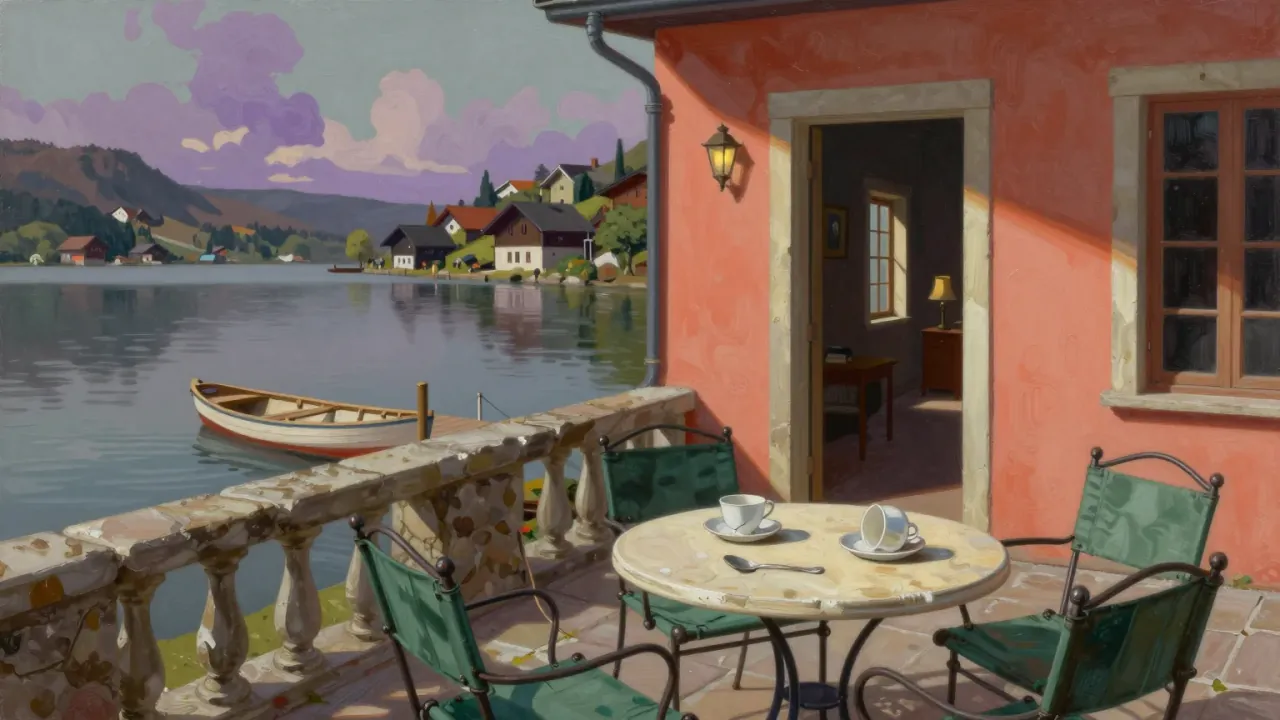
What lands is the cumulative weight of unspoken things. The scene where Howard reads Mary’s theatre programme and then sits alone in the empty seats is more devastating than any confrontation; the porter moving Steven’s suitcase from the adjoining room registers as both trivial and catastrophic; Mary’s final collapse on the Underground platform feels earned because it arrives without fanfare, after minutes of suppressed tremor. The performances land not through revelation but through consistency: Todd never winks at the audience, Rains never lets Howard become a villain, Howard never makes Steven charismatic enough to excuse his carelessness. The film’s restraint pays off in moments of quiet brutality — Howard’s line about ‘the love you’d give a dog’ lands because it is delivered not in rage but in exhausted clarity, and because the camera holds on Mary’s face as she hears it, not as she reacts. The setting — lakeside hotels, London drawing rooms, rain-slicked platforms — functions not as backdrop but as emotional architecture: each space measures the distance between people who know each other too well to lie, yet not well enough to understand.
Where it stumbles
What does not land is the structural framing device. The opening flashback-within-a-flashback — plane, hotel, New Year’s party — delays emotional entry and blurs temporal orientation without yielding compensating insight. The film assumes the viewer will track nine years across three layers of memory, but offers no visual or rhythmic cue to distinguish them beyond Mary’s voiceover, which itself modulates little in tone or pace. Some supporting roles feel underwritten: Isabel Dean’s Pat Stratton has no discernible interior life, and Arthur Howard’s butler exists only to open doors. The modernisation of Wells’s novel flattens some of its philosophical texture — the original’s interrogation of marriage as institution versus contract is muted in favour of individual psychology. The film also misjudges its own pacing: scenes of domestic routine — breakfasts, packing, train arrivals — accumulate without variation in tempo or emphasis, risking monotony rather than gravitas. A tighter chronology and fewer transitional ellipses would sharpen its emotional impact without sacrificing nuance.
What it is really about
The themes that matter are autonomy versus attachment, the gendered asymmetry of consequence, and the illusion of choice within constraint. Mary insists she wants to ‘belong to herself’, yet every decision she makes — refusing Steven’s proposal, continuing the affair, lying to Howard — entangles her further in roles defined by men: wife, lover, suspect, defendant. The film treats class not as backdrop but as grammar: Howard’s wealth affords him legal recourse and social impunity; Steven’s academic status shields him from scandal but not from familial rupture; Mary’s position — educated, affluent, childless — gives her freedom of movement but no authority over narrative. Loyalty is framed not as virtue but as labour: Howard demands it not out of possessiveness but because he has built his life on its assumption, and its withdrawal leaves him structurally unmoored. The film’s quietest theme is time’s distortion: memory edits, regret compresses, and nine years shrink to the length of a cable-car ride. There is no redemption arc, no moral pivot — only the slow realisation that some choices do not end, they settle.
Who it is for
This film is for viewers who value psychological realism over plot momentum, who find tension in silence and meaning in gesture, and who trust actors to convey complexity without exposition. It suits those familiar with Lean’s early work — In Which We Serve, Brief Encounter — and who appreciate mid-century British restraint as aesthetic discipline, not deficiency. It is not for viewers who require clear moral positions, narrative closure, or stylistic punctuation: there are no tracking shots, no dramatic scores, no symbolic weather. Those who expect Wells’s satire or Ambler’s thriller instincts will be disappointed; this is Lean’s film, not theirs. Anyone seeking historical context — post-war Britain, the 1949 social contract — will find none: the film is deliberately ahistorical in setting and reference. A viewer who values thematic clarity over emotional accumulation, or who finds prolonged interiority alienating rather than immersive, should look elsewhere. The film asks for patience, not interpretation — and that patience is its first and most binding condition.
Why it stays with you
Yes, it is worth your evening — but only if you accept its terms: ninety-seven minutes of measured pacing, minimal incident, and emotional weight carried almost entirely by performance and composition. It rewards attention to detail — the way light falls on a staircase, how a hand hesitates before touching a door handle, the precise duration of a pause before a character speaks. It is not entertainment in the conventional sense, nor is it arthouse provocation; it occupies a narrow middle ground of mature, unsentimental human observation. Those who dislike films where nothing ‘happens’ may find it inert; those who mistake stillness for emptiness will miss its rigour. It is worth watching once, attentively, in a quiet room — not for catharsis, but for recognition. Its value lies not in what it resolves, but in how precisely it names what cannot be resolved: the cost of wanting two irreconcilable things, and the quiet exhaustion of choosing neither.