The shape of it
The Private Life of Henry VIII is a biographical film that treats Henry VIII’s marital history as episodic domestic comedy rather than political chronicle. It makes no claim to historical fidelity, omitting Catherine of Aragon outright and sidestepping the Reformation, the break with Rome, and theological conflict entirely. Its aim is not instruction but character portraiture: a study of power refracted through appetite, vanity, and loneliness. Alexander Korda and his writers chose five marriages — Anne Boleyn, Jane Seymour, Anne of Cleves, Katherine Howard, and Catherine Parr — as vignettes to expose the king’s shifting self-regard across time. The framing is deliberately intimate and anachronistic: courtiers speak in clipped modern cadences; diplomacy is reduced to marital negotiation; statecraft dissolves into household management. This is not Tudor history as archive or argument, but as archetype — Henry as enduring figure of authority both absurd and pitiable, shaped less by doctrine than by digestion, desire, and diminishing control. The film’s ambition is tonal: to hold monarchy up to a mirror that reflects not majesty but mortality.
The rhythm of it
The film works through Laughton’s performance, which anchors every scene with physical presence and rhythmic timing — he swallows, sighs, glowers, and grunts like a man whose body has become his first language. Georges Périnal’s cinematography avoids grandeur: interiors are shallow, lit with soft contrast, favouring medium shots that keep the king at centre frame without flattery. Stephen C. Harrison’s editing sustains a brisk, almost vaudevillian pace between episodes, each wife introduced with a title card that names her and pronounces her fate. Kurt Schröder’s score is functional, underscoring transitions without thematic elaboration. Arthur Wimperis and Lajos Bíró’s script gives each wife distinct texture — Anne Boleyn’s sharpness, Anne of Cleves’ wry agency, Katherine Howard’s tragic calculation — while keeping Henry’s voice consistent: weary, possessive, increasingly baffled. Robert Donat appears as Thomas Culpeper with minimal screen time but precise menace; Merle Oberon’s Katherine Howard balances charm and cold calculation. There is no attempt at period verisimilitude in costume or set — the clothes are stylised, the rooms uncluttered, the props few and deliberate.
The comedy of it
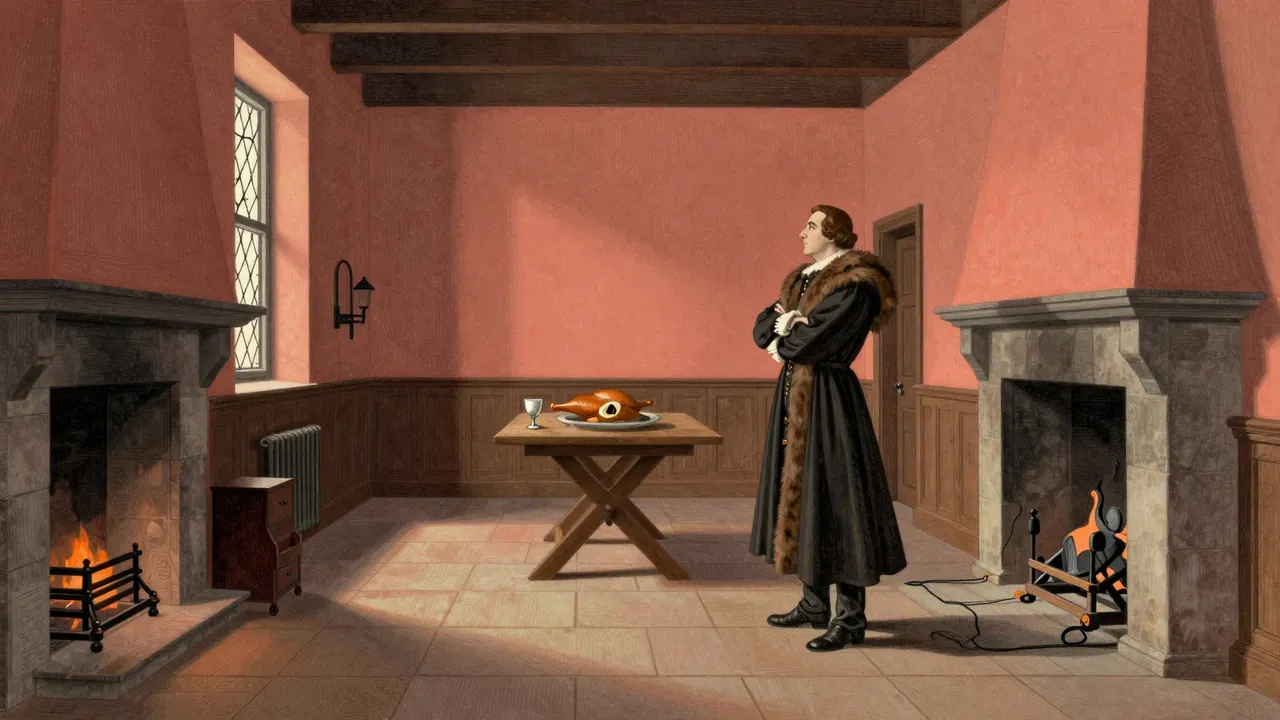
What lands is the cumulative portrait of Henry as a man hollowed out by repetition: each marriage begins with hope or hunger and ends in resignation or rage. Laughton’s delivery of the final line — ‘Six wives, and the best of them’s the worst’ — lands because it is earned by the preceding vignettes, not because it is clever, but because it feels like exhaustion made audible. The film’s comic timing works where it leans into the absurdity of ritual: Henry’s ceremonial eating of a whole capon, the bureaucratic farce of Anne of Cleves’ divorce, the way Katherine Howard’s execution is preceded not by a soliloquy but by a glance exchanged across a corridor. The intertitles — blunt, ironic, occasionally arch — function as narrative punctuation, not exposition. The production design avoids clutter, letting performance and framing do the work: a single goblet on a table, a bare throne, a narrow corridor down which Henry walks alone. These choices create a sense of scale that is psychological, not imperial — the weight of kingship measured in sighs, not statutes.
The politics of it
What does not land is the film’s attempt to treat political context as mere backdrop. The references to German-French enmity and naval spending feel grafted on, not integrated — their contemporary resonance was legible to 1933 audiences but now reads as awkward allegory without dramatic payoff. The omission of Catherine of Aragon weakens the structural logic: her absence leaves no counterpoint to Henry’s self-justification, no moral anchor against which his later choices might be weighed. The portrayal of Katherine Howard as knowingly adulterous, rather than naive and trapped, flattens the tragedy — it invites sympathy for Henry, not horror at the machinery of his justice. Similarly, Catherine Parr’s depiction as domineering ignores her documented intellect and theological engagement, reducing her to a punchline. The film’s refusal to engage with religion or law means its world has no friction: no doctrine to defy, no institution to challenge, no consequence beyond personal disappointment. That simplification serves the comedy but hollows the stakes.
The hunger of it
The themes that matter are appetite and authority — how one feeds the other, and how both decay with time. Henry’s hunger is literal and metaphorical: for food, for wives, for deference, for reassurance. His authority is shown not in decrees but in the silence that follows his frown, in the way courtiers rearrange themselves when he enters, in the speed with which a wife’s status shifts from queen to ‘former’. The film treats succession not as dynastic necessity but as emotional failure — each new marriage is less a political act than a corrective to the last. Class is present but muted: servants move quietly, nobles speak with studied deference, yet there is no sense of economic strain or popular unrest — the Great Depression is nowhere visible, though the film cost five times the average British feature of its year. What persists is the idea of power as performance: Henry must eat, marry, rule, and sigh on cue, and the film watches him do it until the performance becomes indistinguishable from the man.
The watching of it
It is worth watching for anyone interested in how early sound cinema shaped national myth-making, or in Laughton’s craft as a performer who builds character through rhythm and weight rather than psychology. It rewards viewers who can sit with irony that is dry, not cynical — who accept that a historical film may clarify nothing about the past but much about the moment it was made. It is not for those who require narrative continuity, historical coherence, or emotional realism: the vignette structure resists empathy, and the tone refuses gravitas. Historians will find its omissions frustrating; students of propaganda may find its interwar subtext rich. Those expecting costume drama as lush spectacle will be disappointed — this is a film of pauses, not pageantry. Anyone seeking a faithful account of Tudor politics or theology should look elsewhere. Its value lies in what it chooses to leave out, not what it puts in.
The lasting of it
Yes, it is worth your evening — not as entertainment in the modern sense, but as a calibrated artefact: a 97-minute demonstration of how a filmmaker can use restraint, repetition, and performance to turn biography into archetype. It holds up because Laughton’s Henry remains legible across decades — not as a monarch, but as a man whose power cannot insulate him from boredom, betrayal, or bodily decline. It repays attention precisely where it seems slight: in the cut between scenes, the placement of a goblet, the length of a pause before a title card appears. Those who dismiss it as quaint or inaccurate miss its method — it is not pretending to be history, but using history as scaffolding for something older: the comedy of human limitation. To call it ‘dated’ is to mistake its design for a flaw. Its durability lies in its refusal to explain itself.