What the film is
King Kong is a 2005 remake of the 1933 film, directed and co-written by Peter Jackson with Fran Walsh and Philippa Boyens. It sets out to honour the original’s mythic structure while expanding its emotional and thematic scope using contemporary digital tools. The film anchors itself in 1933, following filmmaker Carl Denham’s expedition to Skull Island — a deliberate narrative choice that frames the story as both period adventure and pre-cinematic fable. Its ambition is not revisionist but reverent: to rebuild Kong not as monster or metaphor alone, but as a creature whose intelligence, vulnerability and physical presence are rendered with enough consistency to sustain empathy across three hours. It treats the source material as foundational rather than disposable, preserving the core beats — Ann Darrow’s capture, Kong’s abduction, his display in New York, his escape and fall — while deepening character motivation and world logic. The film attempts continuity between spectacle and sentiment, insisting that awe and grief must share the same frame. It is less an update than a full-scale restoration, using modern resources to recover what the original could only suggest.
How it works
The story unfolds in three distinct movements: the Depression-era New York prologue, the extended Skull Island sequence, and the New York climax. Naomi Watts grounds Ann Darrow in quiet resilience and unforced dignity; Jack Black’s Denham is a volatile, persuasive showman whose moral collapse feels earned rather than cartoonish. Adrien Brody’s Jack Driscoll evolves from cynical playwright to reluctant witness without melodrama. Andy Serkis’s motion-capture performance as Kong remains the film’s central craft achievement: every gesture, glance and grunt carries behavioural specificity. Andrew Lesnie’s cinematography favours deep focus and restrained colour grading — amber interiors, desaturated jungle greens, steel-grey city skies — avoiding the hyper-saturated palette common in early-2000s blockbusters. James Newton Howard’s score avoids leitmotif cliché, favouring texture over quotation. Jamie Selkirk’s editing sustains rhythm across 187 minutes by varying shot duration deliberately: long takes for Kong’s stillness, rapid cuts for chaos, silence where music might overwhelm. The script gives weight to minor characters — Herb the cameraman, Hayes the first mate — without inflating their roles.
What lands
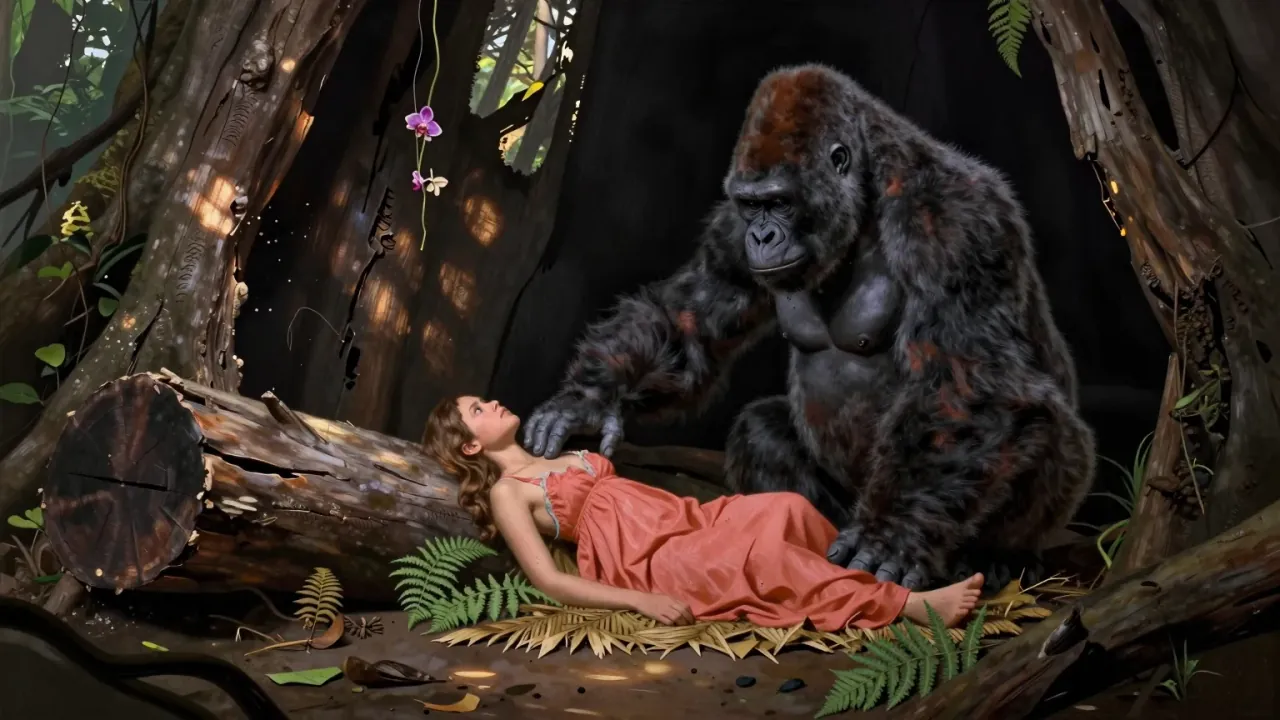
What lands most securely is the Skull Island sequence: its geography feels lived-in, its creatures biologically plausible and ecologically interdependent. The V-Rex fight is neither gratuitous nor abstracted — it has spatial logic, consequence and fatigue. Kong’s relationship with Ann is built through proximity and repetition: shared glances, mirrored gestures, moments of mutual hesitation. The Empire State Building sequence works because it refuses to treat Kong as pure force; his climb is slow, his pauses weighted, his final look at the aeroplanes not rage but dawning comprehension. The sound design — particularly the layered low-end frequencies during Kong’s roars and the abrupt silence after his fall — delivers visceral impact without manipulation. The film’s restraint in New York helps: Denham’s vaudeville-style presentation of Kong, the crowd’s mixture of awe and discomfort, the press photographers’ flashbulbs popping like gunfire — these details root spectacle in social reality. Even the supporting cast’s reactions feel calibrated: no one stares blankly or shouts exposition. The film trusts its audience to read meaning from behaviour, not dialogue.
What does not
The film’s length works against itself in the middle stretch of the Skull Island passage, where pacing slackens during repeated near-misses and narrow escapes. Some character arcs — particularly Colin Hanks’s Preston and Kyle Chandler’s Hayes — remain functional rather than felt, their deaths registering as plot necessity rather than emotional punctuation. The New York section, though visually precise, underdevelops the city’s role beyond backdrop: its architecture, class divisions and media machinery are present but not interrogated. Denham’s transformation from hustler to hollow opportunist lacks a single decisive pivot — his moral erosion happens off-screen, leaving his final courtroom speech unearned. The script also leans too heavily on Ann’s passivity in early scenes, resolving it through action rather than agency: her survival depends on Kong’s protection, not her own choices. A few visual effects shots — especially the ferry sequence and some crowd compositing — date more quickly than others, betraying the strain of rendering 1933 New York at scale. The film’s fidelity to the original occasionally becomes deference: certain lines and beats echo so closely they feel rehearsed rather than reimagined.
The themes that matter
The themes that matter are colonialism as spectacle, the ethics of representation, and the limits of human comprehension. Denham does not merely exploit Kong — he repackages him as entertainment, stripping context and consequence. The film treats the camera as both weapon and witness: Denham films to sell, Jack writes to understand, Ann performs to survive, and Kong himself watches the camera back — a reversal that unsettles the gaze. Skull Island functions as a critique of extractive exploration: the crew arrives armed, assumes dominance, misreads symbiosis as savagery. The natives’ ritual is presented without explanation or condescension, its meaning withheld — a formal refusal to translate. Kong’s death is framed not as tragedy but as inevitability: he cannot exist within systems built to contain, commodify or destroy difference. The film’s strongest idea is that empathy requires time, attention and humility — all things Denham, and by extension the audience, must learn to relinquish. It questions whether wonder can coexist with exploitation, and suggests that the answer lies not in Kong’s size, but in how long we’re willing to watch him breathe.
Who should watch it
This film is for viewers who accept spectacle as a language, not just a delivery system — those who value sustained atmosphere over propulsion, and who trust that emotional payoff need not arrive every fifteen minutes. It suits audiences familiar with Jackson’s work on The Lord of the Rings, particularly his handling of scale and secondary worlds. It is less suited to viewers who require tight narrative economy, irony as a default tone, or protagonists whose agency drives every scene. Those put off by prolonged sequences without dialogue, or by Kong’s relative silence as a character, may find the film withholding. Anyone expecting a lean, modern monster thriller — like Cloverfield or Godzilla (2014) — will be frustrated by its deliberate tempo and classical structure. The film assumes patience as a condition of engagement, and that assumption divides its audience: it rewards attention but does not court distraction. Its ideal viewer is one who watches the rain fall before the storm breaks.
Is it worth your evening
Yes, it is worth your evening — provided you set aside the full 187 minutes without interruption and accept its rhythms as intentional, not indulgent. It is not a film to sample or stream in fragments; its power accumulates in duration, in the weight of Kong’s footsteps, in the silence between his roars. Those who dislike it tend to cite the runtime or Denham’s underwritten arc — fair criticisms, but ones that mistake pacing for inertia. What would change the verdict? A tighter cut — perhaps trimming twenty minutes from Skull Island — would sharpen focus without sacrificing depth. But the film as released asks for commitment, and delivers a rare kind of largeness: not in budget or scale alone, but in its refusal to reduce Kong to symbol, threat or mascot. It treats him as a being whose existence alters the terms of every human interaction around him. That ambition, fully realised in patches and partially in others, makes the evening worthwhile.