The look of it
The Thief of Bagdad is a British Technicolor fantasy film released in 1940, produced by Alexander Korda and directed by Michael Powell, Tim Whelan, Alexander Korda, and Zoltan Korda. It adapts the frame narrative and archetypal figures of Arabian Nights to tell a story of usurpation, exile, magical intervention, and restoration — not as mythic allegory but as a deliberately heightened, visually driven adventure for general audiences. Its ambition is structural and sensory: to sustain wonder through scale, colour, and invention rather than psychological realism or historical fidelity. The film treats its setting as a stage set built from legend, not geography — Basra and Baghdad are names on a map of imagination, not locations in the Middle East. It leans into theatricality: the blind beggar narrator, the genie’s rage and bargaining, the Sultan’s toy obsession, the Silver Maiden’s lethal embrace. This is not escapism as evasion but as affirmation — a world where justice is enacted by prophecy, magic has rules, and rebellion arrives on a magic carpet. The film does not seek ambiguity; it seeks conviction in its own logic, and commits fully to that logic across every department.
The weight of performance
The story follows a clear arc of loss, quest, and return, segmented by magical interventions that reset momentum rather than deepen character. Conrad Veidt’s Jaffar dominates early scenes with physical stillness and vocal control, while Sabu’s Abu carries much of the film’s kinetic energy and moral intuition. John Justin and June Duprez perform their royal roles with formal restraint — less lovers than emblems of rightful order. Miles Malleson, who co-wrote the script, plays the Sultan with comic gravity, his fixation on automata anchoring the film’s preoccupation with artifice versus life. Georges Périnal’s cinematography uses deep-focus composition and saturated Technicolor to render sets as tactile, luminous spaces — the Grand Canyon and Monument Valley backdrops were shot in Hollywood but integrated without irony into the film’s internal geography. Miklós Rózsa’s score blends Middle Eastern motifs with late-Romantic orchestration, avoiding pastiche by treating melody as narrative agent. Charles Crichton’s editing sustains rhythm across shifts in tone, though some transitions between Powell’s English studio work and the Kordas’ American location footage retain a slight seam.
Where the magic holds
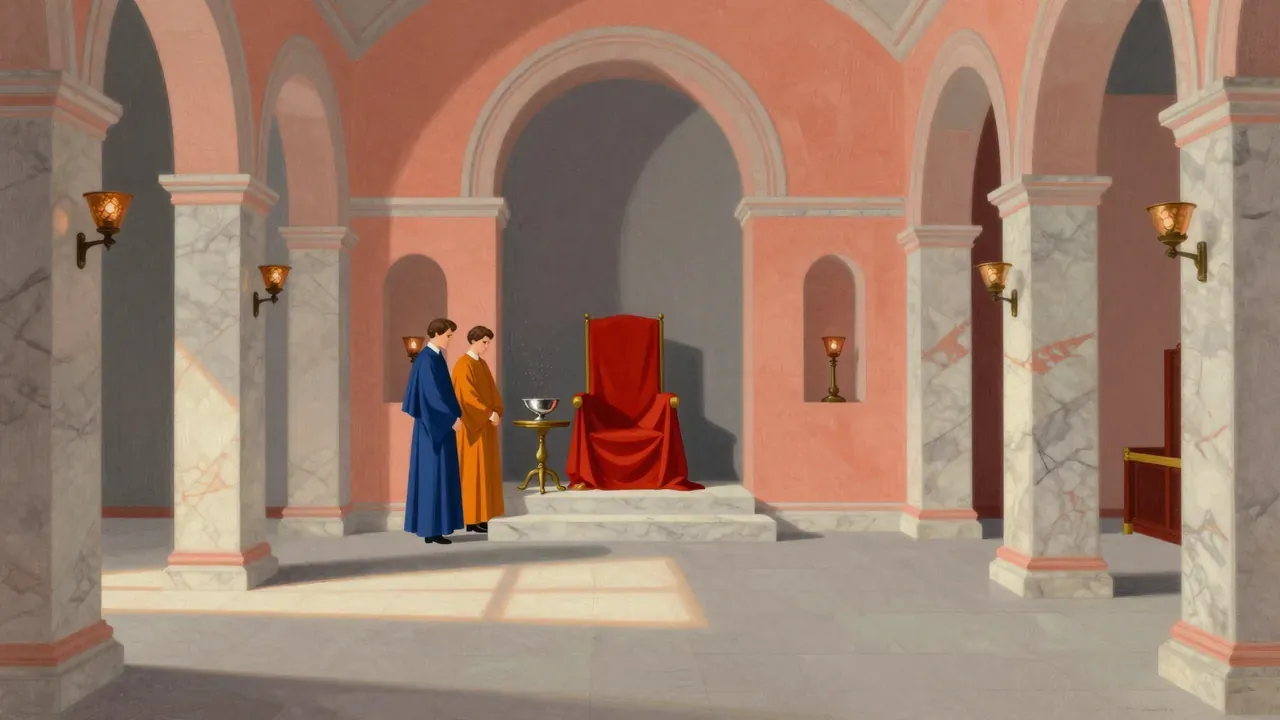
What lands most securely is the film’s visual grammar: the way light pools in the Sultan’s throne room, how the genie’s smoke coalesces into form, the weightless glide of the magic carpet against painted skies. These are not effects for effect’s sake but extensions of storytelling logic — the All-Seeing Eye functions as both plot device and metaphor for perception restored. Sabu’s performance lands because it refuses precocity; his Abu is impulsive, resourceful, and emotionally direct, never cloying or knowing beyond his years. The genie’s bitterness feels earned, not cartoonish, and his submission to Abu hinges on wit rather than force. The mechanical horse and Silver Maiden succeed because they are designed as characters — objects with intention, not props. Even the storm sequence, reliant on rear projection and miniatures, holds attention through compositional clarity and rhythmic cutting. The film’s confidence in its own syntax — that a boy can bargain with a god, that a jewel can show truth, that a crossbow can fulfil prophecy — is never undermined by hesitation or winking irony. That consistency of tone is its strongest achievement.
Where the heart stays cool
What does not land is the central romance. John Justin and June Duprez lack mutual spark; their exchanges are dutiful, their chemistry unconvincing even within the film’s stylised register. Their scenes together feel like pauses between more vivid episodes — the prison break, the genie’s release, the revolt in Baghdad — rather than emotional anchors. The Sultan’s toy obsession, while visually rich, remains underdeveloped as satire: it gestures at folly but stops short of critique, becoming decorative rather than incisive. Some of the exposition — particularly the mechanics of the genie’s wishes and the All-Seeing Eye’s limits — is conveyed through dialogue that strains credulity even by the film’s own rules. The shift from London to Hollywood production left minor inconsistencies in continuity and performance texture: Sabu’s growth mid-shoot is masked by costume and framing, but his voice and bearing change perceptibly between early and late scenes. The film’s refusal to linger on consequence — Ahmad’s blindness is cured, Abu’s dog-form reversed, the Sultan’s death treated as narrative punctuation — leaves little room for emotional residue, trading pathos for pace.
What the story is really about
The themes that matter are sovereignty as stewardship, not possession; knowledge as vulnerability; and craft as moral act. Ahmad loses his throne not through weakness but through misplaced trust in appearances — Jaffar’s calm authority masks malice, just as the Sultan’s playthings mask fatal gullibility. Abu’s thievery is never condemned; it is recast as agency, a skill repurposed for justice. The genie’s imprisonment speaks to the danger of hoarding power, while his release hinges on humility — not obedience, but negotiation. The film treats artifice — automata, illusions, painted backdrops — not as deception but as legitimate tools: the flying horse serves Jaffar’s ambition, the magic carpet serves Abu’s loyalty, the Silver Maiden serves vengeance. Colour itself becomes thematic: the saturated reds and golds of court life contrast with the cooler blues of exile and the stark whites of the Land of Legend. There is no nostalgia for a lost authenticity; instead, the film insists that meaning is made through construction — whether by a set designer, a composer, or a thief who learns to wish wisely.
Who steps inside, and who stands outside
This film is for viewers who value sustained visual invention over psychological nuance, who respond to craftsmanship as expression, and who accept fantasy not as allegory but as grammar. It suits children old enough to follow cause and effect across magical transformations, and adults who appreciate mid-century studio technique — the matte paintings, the bluescreen composites, the orchestral sweep — as artefacts of collective labour. It is less suited to those who require emotional realism, modern pacing, or coherent worldbuilding beyond what serves the immediate sequence. Viewers expecting political or cultural specificity from its Arabian Nights framing will find only surface signifiers — the film makes no claim to authenticity, but some may still find its borrowing superficial. Those put off by formal acting styles or deliberate theatricality will struggle with its rhythms. The verdict would shift for anyone prioritising character depth over spectacle: remove the genie, the carpet, the flying horse, and very little of the human drama remains intact.
Why it still works
Yes, it is worth your evening — provided you watch it as a designed object, not a psychological document. Its 102 minutes unfold with the inevitability of a well-turned mechanism: each scene fulfils a function, each transition serves the next beat, each colour choice reinforces mood. It rewards attention to detail — the texture of a robe, the timing of a genie’s sigh, the way light catches the edge of the All-Seeing Eye — but does not demand interpretation. It is not a film to dissect but to inhabit, briefly, as one might step into a diorama lit from within. Those who dislike studio-era artifice, or who find its moral simplicity reductive, will not warm to it — and that is fair. But its coherence, its generosity of invention, and its unwavering commitment to its own terms make it more than a period curiosity. It is a working model of how fantasy can be both precise and exuberant, technical and tender — and that model still holds up.