A woman who fixes lives instead of living hers
Amélie is Jean-Pierre Jeunet’s 2001 romantic comedy about a Paris waitress who, after a childhood spent isolated by overprotective parents, decides to devote herself to secretly arranging small acts of happiness for strangers and acquaintances rather than pursue anything for herself. The film was written for Emily Watson before Jeunet reworked it for Audrey Tautou when Watson became unavailable, and it went on to become one of the most commercially successful French-language films ever released abroad, earning over $173 million worldwide against a $10 million budget. Its version of Montmartre, filmed on real streets including the still-functioning Café des 2 Moulins, is deliberately heightened rather than documentary, built through digital colour grading into something closer to a storybook.
Tautou, Delbonnel and a Montmartre built in colour grading
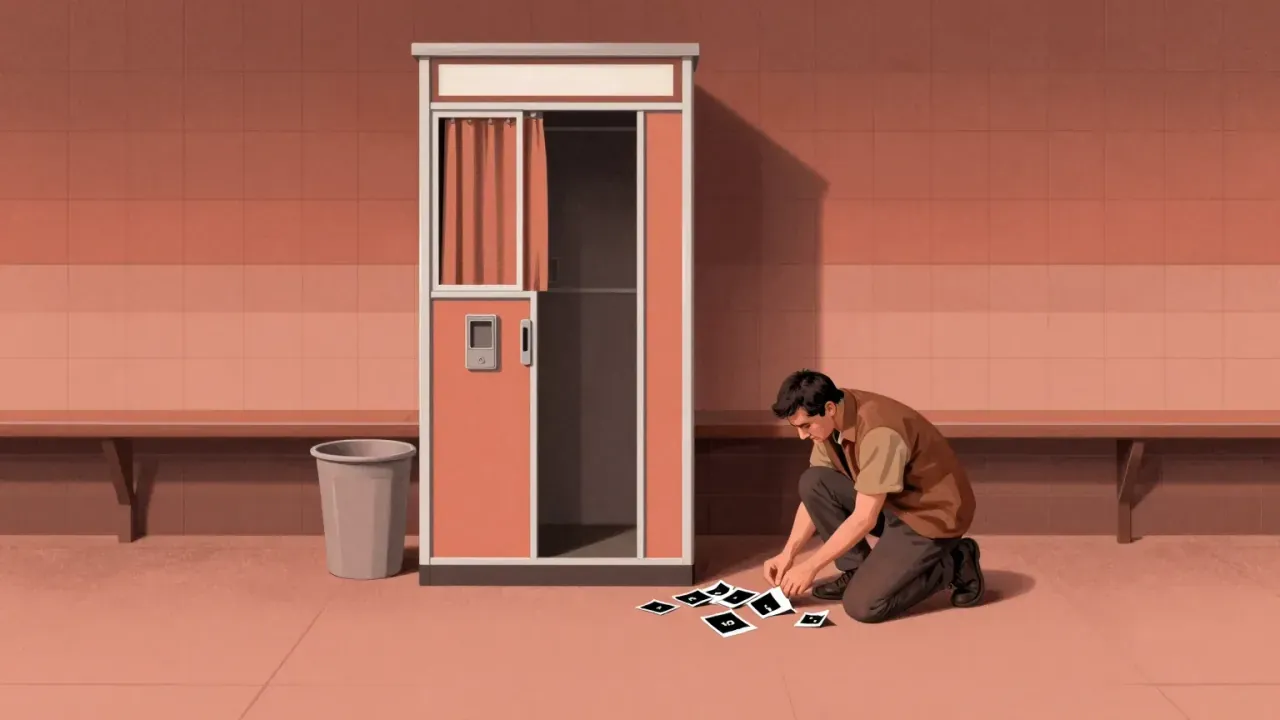
The plot follows Amélie as she discovers a box of a stranger’s childhood keepsakes hidden in her apartment wall, and after anonymously returning it and witnessing the man’s reaction, resolves to spend her life orchestrating similarly engineered moments of happiness for the people around her — her grieving concierge, her hypochondriac coworker, her withdrawn father. Cinematographer Bruno Delbonnel shoots in a heavily saturated green-and-gold palette, composer Yann Tiersen supplies the film’s now-famous accordion-and-piano score, and editor Hervé Schneid keeps the film’s many short vignettes moving briskly. Running parallel to Amélie’s schemes for others is her own halting pursuit of Nino, a man who collects discarded photo-booth pictures, which she manages through anonymous notes rather than direct approach.
The garden gnome and the concierge’s letter
What lands is the sheer density of invention: nearly every scene contains a small structural idea — a garden gnome mailed around the world, a painting studied over years by a man who can’t quite finish it, narration that catalogues characters’ private pleasures and dislikes — and the film sustains this rate of invention across its full length without visibly running out of ideas. Tautou’s performance, largely reactive and interior, keeps Amélie sympathetic even as her methods edge toward the manipulative, and Tiersen’s score does much of the work of keeping the film’s tone light rather than twee.
A romance that has to be tricked into happening
The film’s constant visual and narrative embellishment, effective as it is, leaves less room for Amélie’s own interiority than for the people she is fixing, and her romance with Nino is more a mechanism for closing the story than a relationship explored with the same care given to her secondary interventions. Some of its charm depends on a viewer’s tolerance for a version of Paris and human behaviour that is openly artificial, which a small number of contemporary critics, including the Cannes selector who declined to screen it, found grating rather than enchanting.
Whimsy as a shield against grief
Amélie is ultimately a film about the safety of helping others from a distance, using Amélie’s traumatic isolation as a child to explain why she would rather engineer other people’s joy than risk her own, and it is Dufayel’s late confrontation with her about hiding rather than living that gives the film’s whimsy its one moment of direct self-criticism. It is also, more lightly, a film about noticing — the texture of cracking crème brûlée, skipping stones, small physical pleasures — as its own kind of quiet resistance to loneliness.
Who this suits
It suits viewers who want a warm, visually generous romantic comedy, admirers of Jeunet’s stylised filmmaking looking for his most accessible entry point, and anyone happy to watch a fantastical rather than realistic Paris. It is a poor match for viewers who find manufactured quirk wearing over two hours, or who want psychological realism over stylistic invention. Viewers already familiar with Jeunet’s darker earlier work, such as Delicatessen, may be surprised by how gentle this film is by comparison, which is either its most appealing quality or its chief limitation depending on what drew them to his films in the first place.
An evening’s worth of contrivance
At 122 minutes, the film asks for a fairly substantial evening, and its success depends almost entirely on whether its rate of invention charms or exhausts a given viewer. For the right mood, it remains close to irresistible, and its enduring popularity across markets that rarely take to subtitled cinema is its own kind of evidence that it usually succeeds. Its repeated theatrical re-releases, including a 25th-anniversary run in UK and Irish cinemas, suggest audiences keep returning to it specifically for that feeling, rather than out of mere nostalgia for a film they saw once and half-remember.