The first film
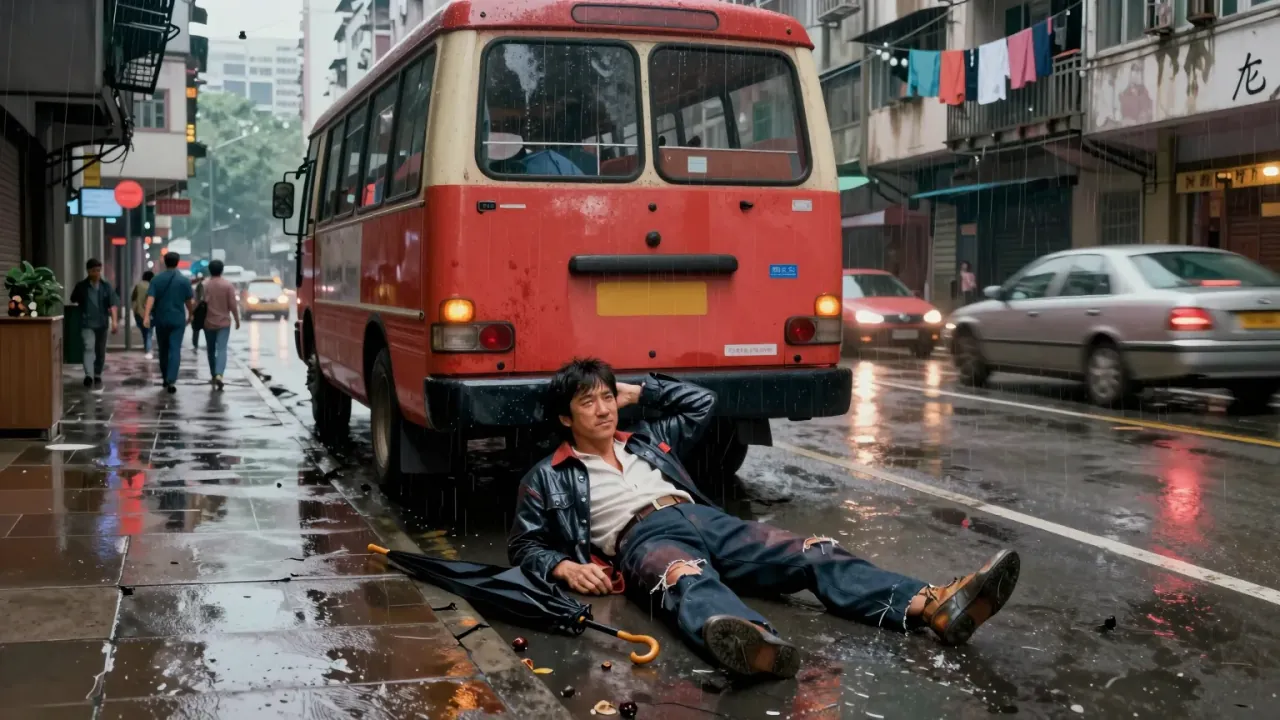
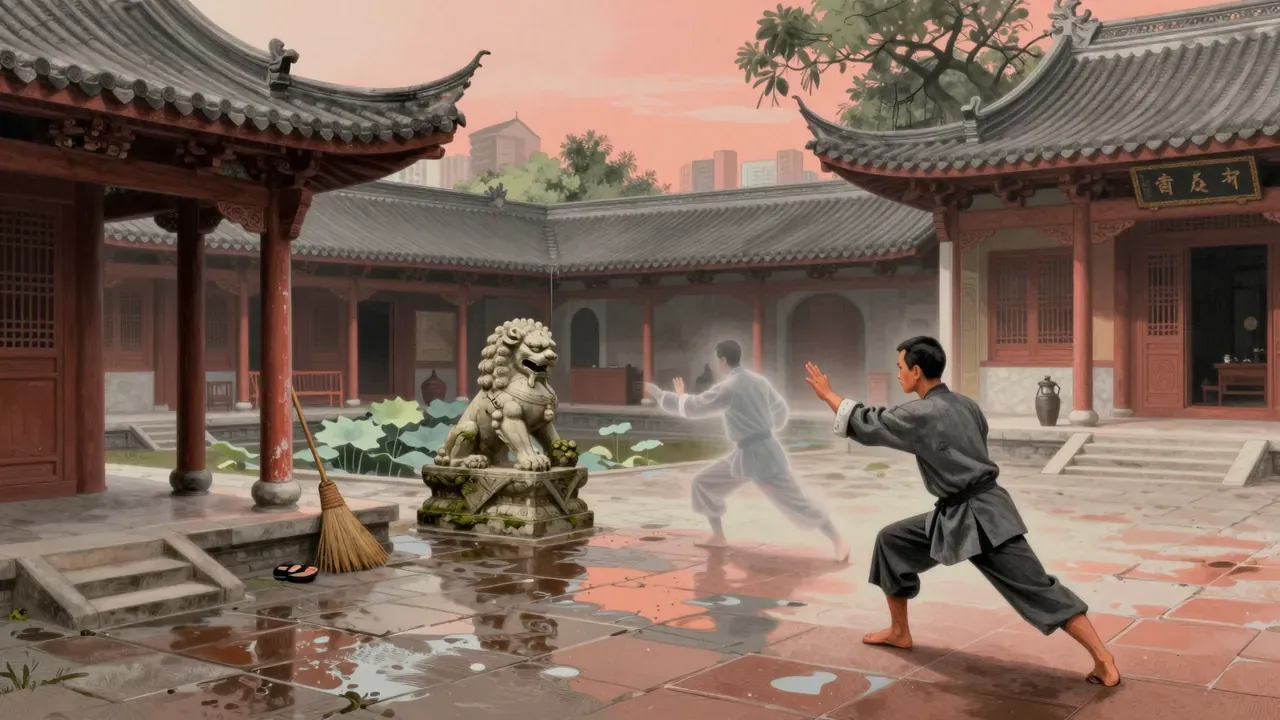
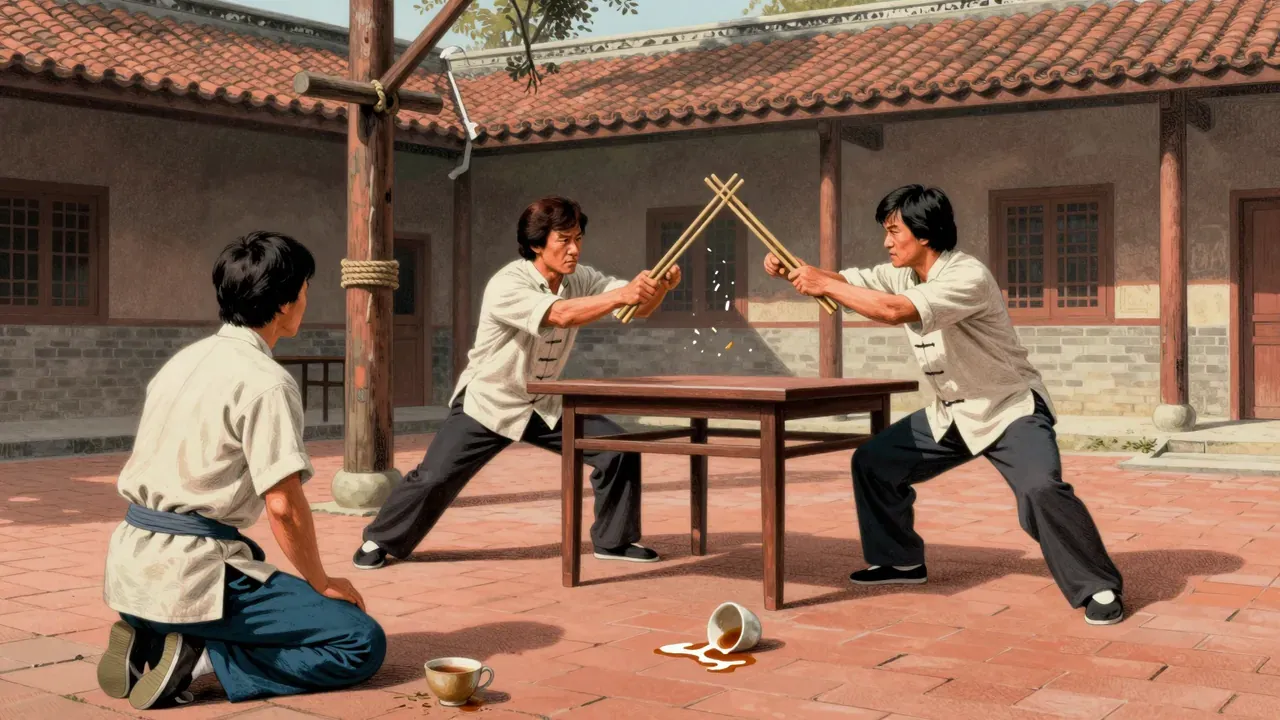
The Fearless Hyena is Jackie Chan’s directorial debut: a Hong Kong action comedy made in 1979, built around his own physical performance, comic timing, and early experiments in integrating slapstick with martial arts choreography. It aims to consolidate Chan’s rising star after his work with Lo Wei, while establishing a new kind of kung fu film — one where the hero’s flaws (impulsiveness, gambling, emotional volatility) are not just backstory but structural engines for both plot and fight design. The film tries to balance genre expectations — lineage, revenge, school rivalry — with deliberate absurdism: cross-dressing, feigned disability, chopsticks as weapons, and ‘Emotional Kung-Fu’ as a literalised metaphor for affective vulnerability. It is not satire in the literary sense, nor parody in the postmodern sense; it is a studio-bound, commercially minded hybrid that treats tradition as malleable material rather than sacred text. Its ambition lies in recalibrating the kung fu hero from stoic paragon to flawed, reactive, often foolish young man whose growth is measured in comedic missteps as much as in combat mastery. The film assumes familiarity with Cantonese theatrical conventions and local humour, but does not require it to function — its physical grammar is broadly legible. (158 words)
The story as trigger
The story follows Ching Hing-lung, a village youth who gambles, disobeys, and accidentally reveals family techniques — traits that drive the plot forward through escalating consequences rather than moral reflection. Jackie Chan’s performance is tightly calibrated: his face registers panic, shame, and glee in rapid succession, and his body absorbs impact with a specificity that feels rehearsed but never mechanical. James Tien plays the grandfather with quiet gravity, anchoring the film’s few solemn moments without undercutting its tone. Jung-Shu Chen’s cinematography keeps framing loose and functional — wide shots for choreography, medium close-ups for reaction — with no attempt at visual flourish. Frankie Chan’s score leans on brassy, circus-like motifs, underscoring farce rather than drama. Vincent Leung Wing-Chan’s editing favours continuity over rhythm: fights are cut for clarity, not pace, and transitions between scenes are blunt, almost perfunctory. The script by Chan and Lo Wei treats exposition as disposable — characters state intentions once and move on — and dialogue serves setup, not character depth. The film’s craft is pragmatic, not expressive: every decision serves the next gag or punch, never the mood or theme. It is technically sound, unshowy, and entirely subservient to the performer’s physical logic. (159 words)
The fusion of slapstick and skill
What lands is the physical comedy — not as ornament, but as narrative method. The chopsticks duel works because it escalates from petty irritation to full-blown absurdity without breaking internal rules; the cross-eyed disguise succeeds because Chan commits to the posture, voice, and slowness of the character he’s impersonating, making the deception plausible within the film’s own logic. The coffin sequence — trapping Dean Shek inside one — lands not for its violence but for its deadpan escalation: the seller’s indignation, Lung’s accidental competence, the sheer weight and finality of the lid slamming shut. Even the ‘Emotional Kung-Fu’ conceit functions because it is treated literally: tears and laughter are shown as destabilising forces, not metaphors, and Chan’s face contorts with real exertion. These moments do not rely on irony or reference; they depend on timing, repetition, and the audience’s willingness to accept that emotion can be weaponised if performed convincingly enough. The film’s best scenes are those where the joke and the fight are the same thing — where Lung’s humiliation becomes his tactical advantage, and his lack of control becomes the source of his unpredictability. That alignment of character, form, and function is rare in early Chan, and it holds here. (157 words)
The hollow centre
What does not land is the revenge structure. Yam Tin-fa’s murder of Lung’s grandfather arrives late, under-motivated, and without tonal preparation — the shift from broad farce to solemn vengeance feels abrupt, not earned. The Unicorn’s training montage is perfunctory: no stakes, no visible effort, no change in Lung’s technique beyond increased speed. The Everything Clan subplot dissolves once it stops serving the gag economy, leaving Tee Cha’s scheming unresolved and unmourned. The film’s supporting cast — Yen Shi-kwan, Lee Kwan, Chen Hui-lou — are given clear archetypes but no interiority; their roles exist only to set up Lung’s reactions. The South Korean and French box office figures suggest international appeal, but the film’s local idioms — gambling culture, coffin-selling taboos, clan naming protocols — are presented without explanation, making them opaque rather than evocative for non-Cantonese viewers. The music, while energetic, lacks thematic development: motifs recur but never evolve, so emotional cues feel arbitrary. Most damagingly, the film’s pacing sags in the middle third, where exposition about rival schools and clan politics is delivered in static two-shots with minimal blocking or variation. It is not dull, but it is inert — a stretch where the film forgets its own strengths and waits for the next stunt. (156 words)
What the body knows
The themes that matter are apprenticeship as failure, reputation as performance, and mastery as delayed consequence. Lung does not become skilled through diligence but through repeated, humiliating exposure — each public mistake forces him to adapt physically before he understands why. His grandfather’s instruction is less about technique than about restraint, yet Lung’s entire arc is defined by breaking that restraint, then learning to weaponise the breach. The film treats reputation not as earned respect but as marketable fiction: Master Tee inflates his school’s standing by hiring Lung to lose spectacularly, then win unexpectedly — a transactional view of honour that prefigures Chan’s later critiques of celebrity. ‘Emotional Kung-Fu’ is not mystical but behavioural: it posits that affect is legible, manipulable, and contagious — a proto-psychological take on combat that treats the opponent’s perception as the real battlefield. There is no meditation on legacy or filial piety beyond the plot device of the grandfather’s death; what matters is how identity is constructed in real time, through costume, gesture, and misdirection. The film’s quietest theme is exhaustion — the fatigue of maintaining a persona, of performing competence when you are still learning, of being constantly watched and misread. That weariness is in Chan’s shoulders, his blink rate, his pauses — not stated, but sustained. (159 words)
Who it is for
This film is for viewers who value physical invention over narrative coherence, who watch action films for the choreographer’s choices rather than the writer’s arcs, and who find pleasure in the gap between intention and outcome. It rewards patience with its rhythms, attention to shifts in posture and timing, and tolerance for tonal inconsistency. It is not for viewers who require psychological consistency in protagonists, who expect villains to be developed beyond function, or who dislike extended sequences where the joke is simply that someone is stuck inside a coffin. Those who approach it as a ‘classic’ or ‘milestone’ may be disappointed by its rough edges and unpolished transitions — it is a first film, not a finished statement. Critics who prioritise thematic density over kinetic intelligence will find it thin. But anyone willing to meet it on its own terms — as a workshop of ideas, not a polished product — will see the foundations of Chan’s mature style: the use of environment as prop, the integration of error into design, the refusal to separate comedy from consequence. Its limitations are not failures, but conditions of its making. (158 words)
Why it endures
Yes, it is worth your evening — provided you watch it as a document of emergence, not as a self-contained work. It is 92 minutes long, and its energy never flags, even when its logic does. The fights are inventive, the gags land with tactile precision, and Chan’s presence is already fully formed: restless, generous, self-deprecating, and technically audacious. You will not mistake it for a masterpiece, but you will recognise the moment when a performer begins to shape a genre around his own body and sensibility. Those who expect tight plotting or thematic resolution will leave frustrated; those who watch for how a kick is set up, how a fall is broken, how a pause before a punch creates suspense — they will find more than enough. It is not essential viewing for casual fans, but it is indispensable for anyone studying how action cinema evolved in the late 1970s. A modern viewer might need subtitles and some contextual patience, but the film’s physical language remains immediate, unmediated, and wholly its own. Its value lies not in completion, but in the clarity of its starting point. (159 words)