The certainty of it
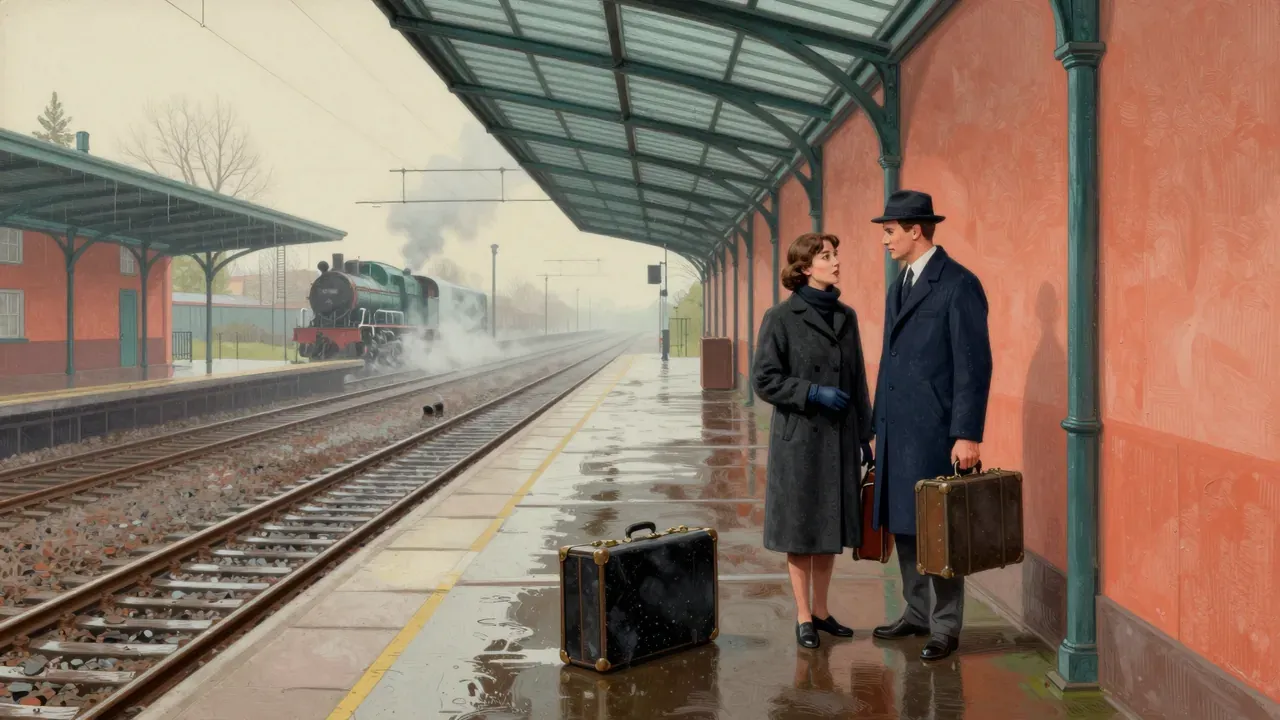
I Know Where I’m Going! is a romantic comedy made in wartime Britain by Michael Powell and Emeric Pressburger as a deliberate pivot from their stalled Technicolor project A Matter of Life and Death. It attempts something precise: to dramatise the quiet undoing of a rigid, self-assured ambition through immersion in place, community and unscripted human warmth. The film’s stated aim — a ‘crusade against materialism’ — is not rhetorical but structural: Joan Webster’s itinerary, her engagement ring, her salary negotiations with Bellinger, even her suitcase labels, are all calibrated to show how thoroughly her sense of self is bound to external validation and control. The Isle of Mull is not backdrop but counterforce — weather, folklore, Gaelic song, communal cèilidh, the physical resistance of sea and stone all work on her, not as metaphors but as lived impediments and invitations. This is not a film about love conquering all, but about a woman’s certainty being worn down by proximity to values she has never had cause to examine. It is tightly plotted, deliberately paced, and wholly committed to its thesis: that knowing where you’re going is only useful until you discover you no longer want to arrive.
The look of it
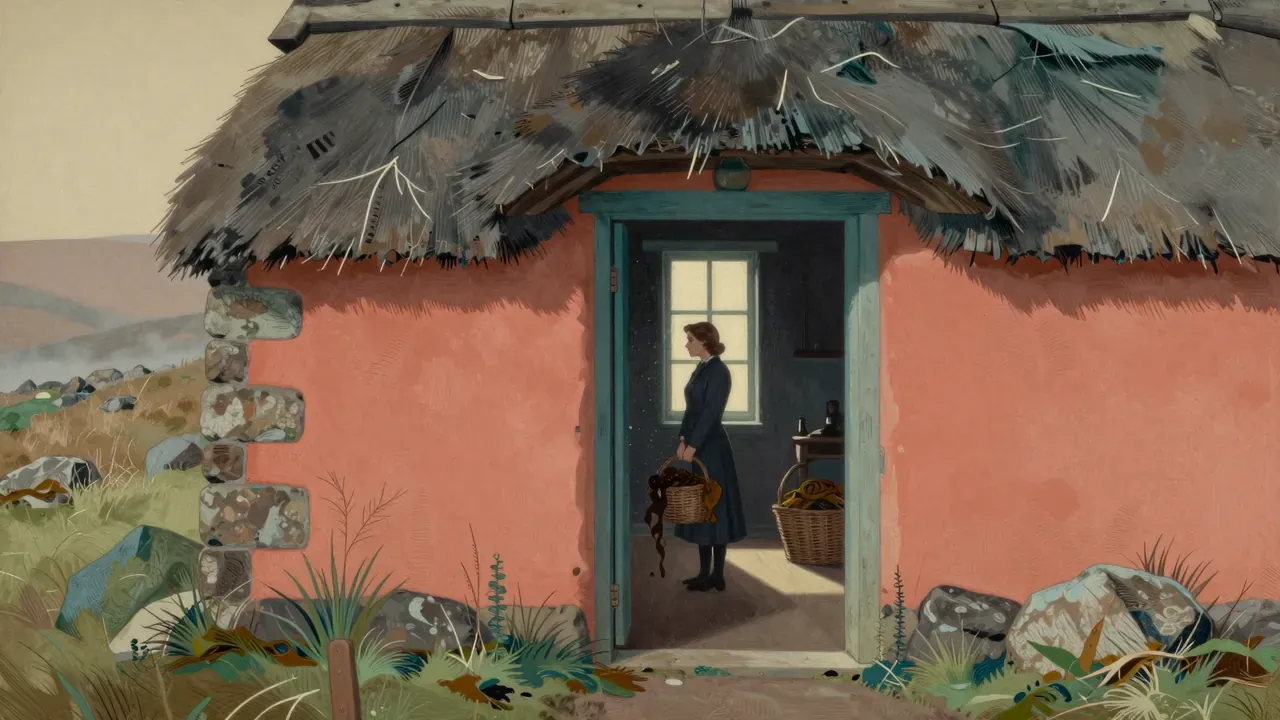
The story moves with quiet inevitability, anchored by Wendy Hiller’s performance as Joan: clipped diction, stiff posture, a gaze that scans rather than sees, all gradually softened without losing precision. Roger Livesey, filmed mostly at Denham Studios while his double stands in for long shots on Mull, carries Torquil with wry patience and unshowy dignity — his restraint makes the final kiss land with real weight. Erwin Hillier’s cinematography avoids picturesque cliché; he keeps the Hebridean light flat and changeable, the interiors of Catriona’s cottage dim and textured, the Corryvreckan sequence built from layered studio and location footage so that danger feels tactile, not spectacular. Allan Gray’s score weaves traditional tunes with original motifs, never underscoring emotion but deepening atmosphere — the bagpipes at Moy Castle are diegetic, ceremonial, not sentimental. John Seabourne’s editing sustains rhythm without hurry: pauses hold, silences register, transitions between studio and location are seamless because they are never asked to be invisible — they are part of the film’s grammar of displacement.
The weight of it
What lands most firmly is the film’s refusal to flatter its heroine or its audience. Joan’s ambition is neither mocked nor moralised against; it is simply shown to be brittle under sustained contact with other ways of living. The cèilidh scene works not because it is charming but because it is choreographed as social fact — the dancing is energetic but unpolished, the singing rough-harmonised, the laughter loud and slightly off-mic. The Corryvreckan crossing lands because its peril is procedural: the engine floods, the boat lists, the water is cold and heavy, and Torquil’s restart is a matter of muscle and timing, not heroics. Even the curse at Moy Castle lands because it is treated as local history, not gothic device — the inscription is read aloud plainly, the well described in terms of space and endurance, not melodrama. Pamela Brown’s Catriona registers as fully realised: her pride is economic, her kindness unperformative, her loyalty to Torquil rooted in shared childhood, not romance. These details accumulate without emphasis, and their cumulative effect is a world that feels inhabited, not illustrated.
The seams in it
What does not land is the film’s occasional over-reliance on exposition to establish character motivation. Joan’s backstory — her Manchester upbringing, her father’s influence, her professional training — is conveyed through dialogue that sometimes strains credulity, particularly in early exchanges with Ruairidh Mhór or Colonel Barnstaple. The script’s four-day genesis shows in places: some secondary characters, like Jean Cadell’s Mrs. MacKenzie, remain functional rather than dimensional, their lines serving plot rather than personality. The decision to cut the final scene of Joan following Torquil into Moy Castle leaves the emotional resolution slightly truncated — we see her kiss him, then he walks away alone into the ruin, but the interior shift implied by that movement is suggested rather than dramatised. There is also a slight tonal friction between the film’s folkloric texture and its upper-middle-class English framing: the Gaelic songs and cèilidh feel authentic, but Joan’s initial disdain reads less as class difference than as narrative necessity, and the film never quite interrogates the asymmetry of her position as an outsider granted full access to intimacy without accountability.
The weather in it
The themes that matter are ambition as habit, not aspiration; place as ethical agent, not setting; and time as relational, not linear. Joan measures time in train schedules and wedding dates; the island measures it in tides, seasons, generations — the curse at Moy Castle spans centuries, the cèilidh celebrates sixty years of marriage, the whirlpool has churned for millennia. The film treats materialism not as greed but as a form of temporal short-sightedness: Bellinger rents Kiloran for the war’s duration, treating land as leasehold rather than legacy. Torquil’s inheritance is not wealth but responsibility — to memory, to geography, to continuity. The ‘crusade’ is thus against instrumental thinking: Joan’s original plan treats people, places and even love as waypoints on a fixed route. Her transformation is not toward spontaneity but toward consent — to stay, to listen, to be unsettled. The film’s quietest theme is linguistic humility: Torquil translates Gaelic song for Joan not to explain it, but to admit he cannot fully render its weight — a gesture that mirrors the film’s own respect for what resists translation: weather, silence, the weight of stone, the pull of water.
The audience for it
This film is for viewers who value craft over velocity, who find pleasure in the accumulation of small, observed truths rather than narrative escalation. It suits those comfortable with British mid-century pacing, with understated performances, and with endings that resolve emotionally but not logistically — Joan does not marry Torquil on screen, nor does she renounce Bellinger formally. It is not for viewers who require clear character arcs measured in decisive actions, or who expect romance to be articulated in declarations rather than glances, gestures, shared silences. Those who dislike studio-shot location doubles may find the seam between Denham and Mull momentarily jarring, though the film’s logic absorbs it. Anyone expecting a wartime morale booster will be disappointed: there are no flags, no speeches, no enemy — only weather, work, and the slow recalibration of desire. Its pleasures are cumulative, not immediate, and its rewards diminish sharply for those unwilling to sit with its stillness.
The time in it
Yes, it is worth your evening — provided you watch it as a film about attention, not about plot. Its ninety-one minutes pass without strain because every shot serves its central question: what happens when certainty meets resistance? The answer is not dramatic reversal but subtle realignment — and that takes time to register. Some will find it too gentle, too rooted in its 1945 moment, too unconcerned with modern psychological exposition. But its craftsmanship holds up: Hillier’s lighting, Gray’s scoring, Seabourne’s cuts all operate with quiet authority. It repays rewatching not for hidden clues but for the way its textures deepen — the way Joan’s coat changes from stiff wool to wind-tousled cloth, the way Torquil’s laugh becomes more frequent but never louder. To dismiss it as ‘quaint’ is to miss its rigour. It is not a relic. It is a calibration tool — for pace, for presence, for the quiet force of place upon person. That remains uncommon, and valuable.