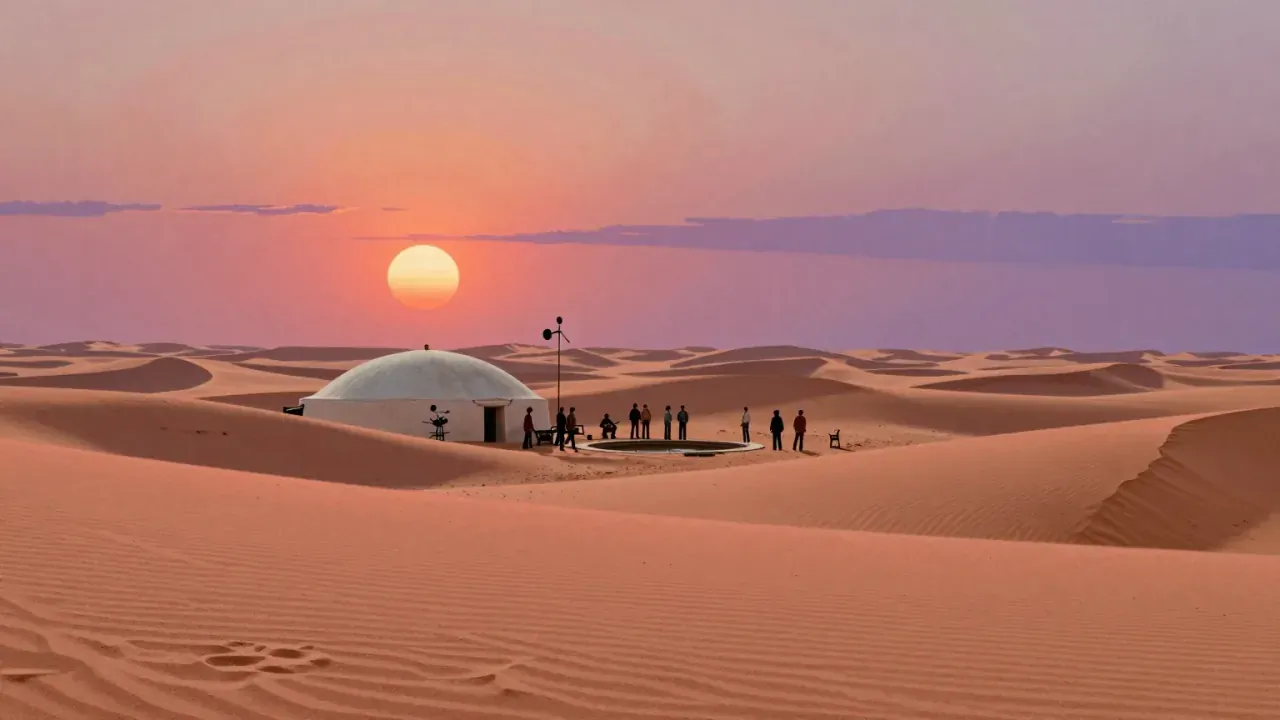
A guide, a writer and a scientist enter the Zone
Stalker follows a professional guide, referred to only by his trade name, who smuggles a writer and a scientist past armed checkpoints into the Zone, a quarantined area said to have been altered by some unexplained event and rumoured to contain a room where a visitor’s deepest wish comes true. Tarkovsky spends almost the entire film on the journey there rather than on what waits inside, letting the three men argue about art, reason and belief as they creep across a landscape that looks, for long stretches, like abandoned industrial land rather than anything overtly fantastical. The film is less interested in whether the room’s power is real than in what each man’s willingness, or refusal, to test it says about what he actually wants from his life.
Danger implied, rarely shown
The Zone is described by Stalker as full of shifting, lethal traps that punish anyone who enters carelessly, yet the film almost never shows a threat directly, building tension instead through the characters’ visible caution, the throwing of small weighted cloths ahead of each step, and unexplained pauses that Stalker insists are necessary for survival. Eduard Artemyev’s electronic score surfaces only occasionally, leaving long stretches of ambient sound, dripping water and wind, to carry scenes that would otherwise run silent. Alexander Kaidanovsky plays Stalker with a nervous, almost religious devotion to the Zone’s rules, in contrast to Anatoly Solonitsyn’s cynical writer and Nikolai Grinko’s more withdrawn scientist, and the three men’s contrasting temperaments do most of the dramatic work in a story otherwise light on incident.
A production that had to be shot twice
The film’s long, slow tracking shots through the Zone’s overgrown, rusted machinery and flooded rooms create a genuinely hypnotic sense of a place operating by rules the men can sense but not articulate, an effect achieved with almost no special effects beyond careful location choice and unhurried camera movement. The scene in which the three finally reach the threshold of the room, and each finds a reason not to cross it, is the film’s strongest piece of writing, since it turns a fantastical premise into a plain, recognisable statement about people who would rather not learn what they actually want most. Kaidanovsky’s late breakdown, mourning that no one values faith or wonder anymore, gives the ending a raw, exhausted quality that the film’s dialogue-heavy midsection does not otherwise reach.
Long takes that refuse to hurry the walk
At 163 minutes, with sequences that hold on a single unbroken shot for several minutes at a time, the film demands sustained patience that a plot this simple, three men walk to a room and decide not to enter it, will strain for viewers wanting incident or clearer stakes along the way. The extended philosophical exchanges between the writer and the scientist occasionally repeat similar ground about faith versus reason without advancing much beyond restating each man’s position more emphatically. Because the Zone’s dangers are almost entirely implied rather than shown, viewers wanting a tangible sense of jeopardy from what is nominally a science-fiction premise may find the film’s restraint closer to inertia than tension.
A room nobody is brave enough to enter
The film treats the Zone, and the promise of a wish granted, as a test of self-knowledge rather than a reward, since each man’s refusal to enter the room ultimately reveals a fear of finding out what he truly wants beneath the want he claims to have. Mortality and faith run through Stalker’s own devotion to the Zone, which he treats as the one place offering meaning in a grey, exhausted world outside it, even though the film gives no confirmation that the Zone’s powers are anything more than rumour. Made under Soviet-era production constraints, including the loss and reshoot of an entire earlier version of the film, its themes of institutional control and forbidden, regulated space carry an added weight from the conditions of its own making.
Demands stillness from its audience
This suits viewers drawn to slow, meditative science fiction concerned with ideas over spectacle, and to Tarkovsky’s specific method of building meaning through duration and landscape rather than event. It is a poor fit for anyone wanting the genre trappings of science fiction, since there are no visible aliens, technology or effects beyond an unsettling, decaying landscape. Viewers who need clear resolution or explanation of the Zone’s nature will be frustrated, since the film treats that ambiguity as central rather than as a mystery to be solved. Considerable patience with long philosophical dialogue is close to a requirement here.
A long, deliberate journey to nowhere definite
At 163 minutes, and following a production history that required an entire earlier version of the film to be junked and reshot after processing errors ruined the footage, this is a demanding film in every sense, on its makers as much as on its audience. Its reputation, including a full Rotten Tomatoes critical score, rests on how completely it commits to its own slow, unresolved method rather than on any conventional payoff. Worth an evening for anyone prepared to sit with a film that treats ambiguity as its actual subject, and a difficult recommendation for anyone wanting even a modest amount of narrative closure at the end.