The point of view
The General is a silent romantic comedy set during the American Civil War, co-directed by Buster Keaton and Clyde Bruckman, released in December 1926. It adapts the real 1862 Great Locomotive Chase — but shifts perspective from Union to Confederate protagonists, casting Keaton’s Johnnie Gray as a Southern railroad engineer whose devotion to his locomotive and his sweetheart drives him into an improvised war effort. The film attempts something rare for its time: a large-scale historical action-comedy built on precise physical logic, sustained narrative momentum, and deadpan emotional restraint. It treats wartime chaos not as backdrop but as terrain for choreographed movement — trains, bridges, cannon fire, and human bodies all obeying consistent mechanical rules. Its ambition lies in merging spectacle with economy: every stunt, cut, and composition serves both story and rhythm. It does not seek pathos through dialogue or psychology but through timing, scale, and the quiet dignity of persistence. At its core, it is a film about competence — how clarity of purpose, technical skill, and unflinching attention turn absurdity into coherence. Word count: 148
The logic of motion
The story follows Johnnie Gray’s exclusion from military service, his pursuit of Annabelle Lee, and his accidental capture of a Union raiding party aboard his stolen engine, The General. Performance hinges on Keaton’s stillness: his face rarely registers more than mild concern, yet his body speaks volumes — leaning into wind resistance, bracing against inertia, calculating angles mid-leap. Marion Mack matches him in physical precision, her reactions calibrated to the same clockwork tempo. Devereux Jennings and Bert Haines’ cinematography keeps the frame wide and stable, letting action unfold in long takes across real Oregon landscapes; no trick shots obscure geography. Editing by Keaton and Sherman Kell sustains momentum without cutting away from consequence — when a bridge collapses, the wreckage stays in frame, and the train lands where physics says it must. The score by Carl Davis (added later) supports but does not dictate mood. There are no intertitles for exposition beyond bare essentials; meaning emerges from motion, not explanation. Word count: 152
The chase
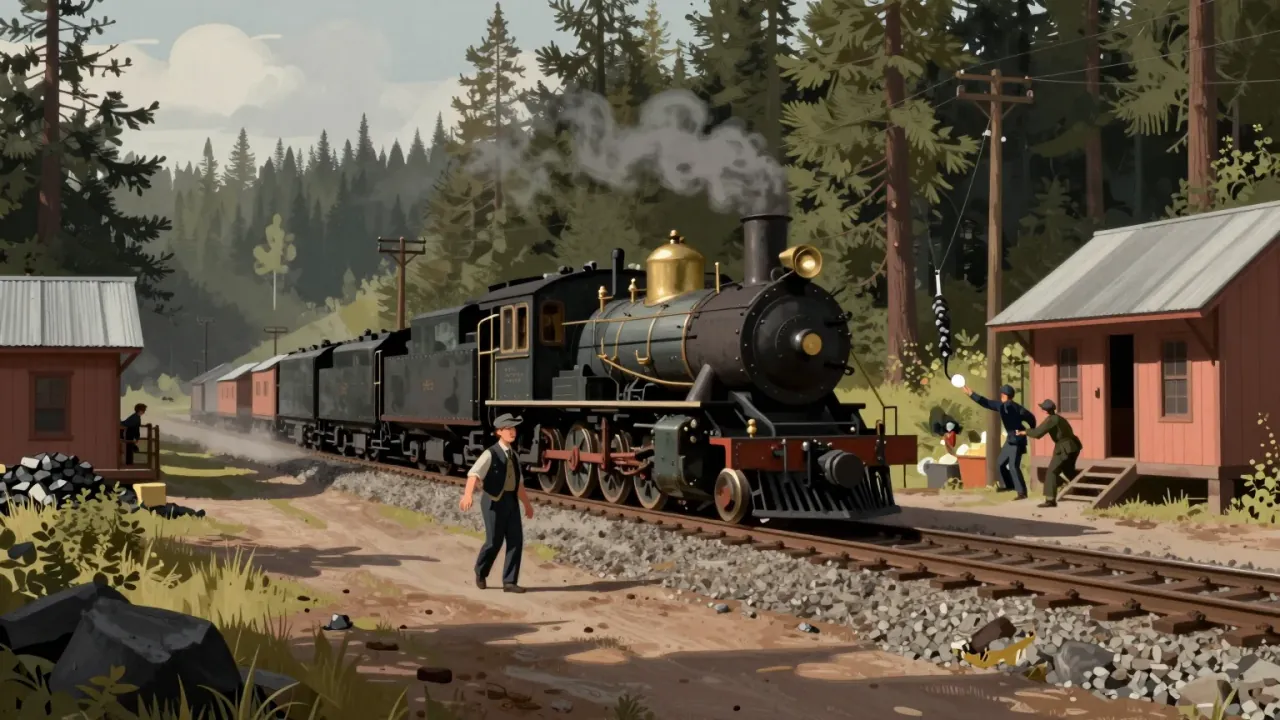
What lands is the integrity of the physical world it constructs. The locomotive chase holds attention not because it is fast, but because it is legible: viewers track distances, speeds, gradients, and consequences in real time. Keaton’s stunts — sitting on a coupling rod, tossing ties onto tracks, leaping between cars — land because they obey visible cause and effect, not because they are daring in abstraction. The Oregon locations, vintage engines, and period-accurate props ground the comedy in tangible reality, making the absurd feel inevitable rather than arbitrary. Even the battle scenes avoid caricature: soldiers move like men hauling weight, not cartoon figures. The film’s sense of time — measured in train schedules, sunrise, and the slow burn of a wood-fired boiler — gives it a gravity few comedies possess. Its humour arises from friction between intention and environment: Johnnie’s plans constantly misfire, but never illogically. The result is a comedy that breathes at the pace of machinery, not punchlines. Word count: 150
The gaps
What does not land is the romantic thread. Annabelle Lee remains functionally inert — less a character than a plot device to trigger Johnnie’s motivation and punctuate his resolve. Her agency is confined to being captured, rescued, and briefly operating a telegraph key. The film’s refusal to develop her beyond that feels less like restraint and more like omission, especially given Marion Mack’s evident capability. Some early critics were right to call the pacing uneven: the middle stretch, where Johnnie wanders alone through enemy lines, drags not from slowness but from lack of counterpoint — no parallel action, no escalation in stakes, just repetition of evasion. The Union soldiers, though played with stoic uniformity, never acquire individual presence, flattening the conflict into scenery. And while the film’s moral inversion — Confederates as heroes — is historically grounded in Keaton’s stated intent, it sits uneasily without irony or critique, leaving modern viewers to supply context the film pointedly omits. Word count: 152
The kind of courage
The themes that matter are competence, fidelity, and the quiet authority of systems. Johnnie’s love for his locomotive is not metaphorical: it expresses a deeper commitment to order, maintenance, and functional harmony — values tested by war’s entropy. The film treats machinery not as cold metal but as extension of will: when he repairs The General, he restores himself. Fidelity appears in three forms — to craft (his engineering), to person (Annabelle), and to place (the railway line, the town, the South). None is sentimentalised; each is demonstrated through action, not declaration. There is also a theme of misrecognition: Johnnie is dismissed as cowardly because he lacks theatrical bravery, yet his courage is procedural, cumulative, and rooted in observation. The film quietly argues that heroism need not be loud to be consequential — that watching, calculating, and acting within known parameters can alter outcomes more reliably than grand gestures. It is a film about how things work, and how working things make meaning possible. Word count: 149
Who it fits
This film is for viewers who value spatial intelligence in cinema — those who watch action not to feel adrenaline but to understand geometry, weight, and sequence. It rewards patience with long takes, comfort with silence, and interest in pre-digital craftsmanship. It suits people who find pleasure in seeing a plan executed precisely, even when the plan is absurd. It is not for those who rely on character interiority, verbal wit, or rapid emotional shifts; nor for viewers uncomfortable with the film’s unexamined Southern perspective, which some will read as tacit endorsement. Those who expect satire or irony in its treatment of war may leave disappointed — its tone is earnest, not subversive. A viewer who finds slapstick exhausting but admires balletic timing will connect deeply; one who needs psychological scaffolding for empathy will not. Word count: 150
The evening
Yes, it is worth your evening — provided you approach it as a masterclass in cinematic mechanics, not as light entertainment. Its seventy-five minutes pass with the steady rhythm of a piston stroke: unhurried, exact, and self-assured. It repays close attention not because it hides meaning, but because it builds meaning incrementally — in the tilt of a smokestack, the angle of a rail joint, the duration of a pause before a jump. Some will find its restraint alienating; others will feel its discipline like relief. It is not universally accessible, but its achievement is unassailable: a comedy that trusts physics more than psychology, and succeeds. To dismiss it as ‘old-fashioned’ is to mistake rigour for rigidity. Word count: 150