The shape of it
The Cameraman is a silent romantic comedy made in early 1928, Buster Keaton’s first film under contract to Metro-Goldwyn-Mayer. It sets out to reconcile two ambitions: Keaton’s own as a filmmaker with full creative control, and MGM’s desire for a commercially viable star vehicle. The film follows a tintype photographer who buys a movie camera to win the affection of a newsreel secretary, then stumbles into real danger while trying to prove himself. Its structure is classical — goal, obstacle, escalation, reversal — but its logic is physical, not psychological: gags arise from spatial relationships, timing, and consequence rather than character motivation. It assumes a viewer familiar with silent-film grammar — title cards are sparse, exposition minimal, rhythm dictated by editing and movement. Though produced within a studio system increasingly hostile to Keaton’s methods, the film retains his signature deadpan precision and commitment to in-camera realism. It does not aim to innovate form or subvert genre so much as perfect a particular kind of comic storytelling: one where effort is visible, failure is cumulative, and dignity persists even in absurdity. Word count: 158.
The look of it
The story moves cleanly from infatuation to professional aspiration to accidental heroism, anchored by Keaton’s performance as a man whose quiet persistence reads as both earnest and faintly alien. Marceline Day gives Sally warmth without sentimentality; Harold Goodwin’s rival cameraman is smug but never cartoonish. Elgin Lessley’s cinematography keeps compositions uncluttered and light levels consistent — no dramatic shadows or expressionist distortion, just clear sightlines for slapstick choreography. Hugh Wynn’s editing sustains pace without rushing: cuts land on impact, not anticipation. The Chinatown sequence relies on real locations and unbroken takes, not stunt doubles or trick shots. Even the monkey’s intervention — switching reels — is presented as a physical fact, not a narrative cheat. Arthur Barrow’s score, though composed later, underscores this clarity: it follows action, never leads it. The film avoids intertitles for emotional exposition; feeling is conveyed through posture, hesitation, or the weight of a pause after a fall. There is no voice behind the gags — only cause, effect, and Keaton’s unwavering gaze into the lens. Word count: 156.
The weight of it
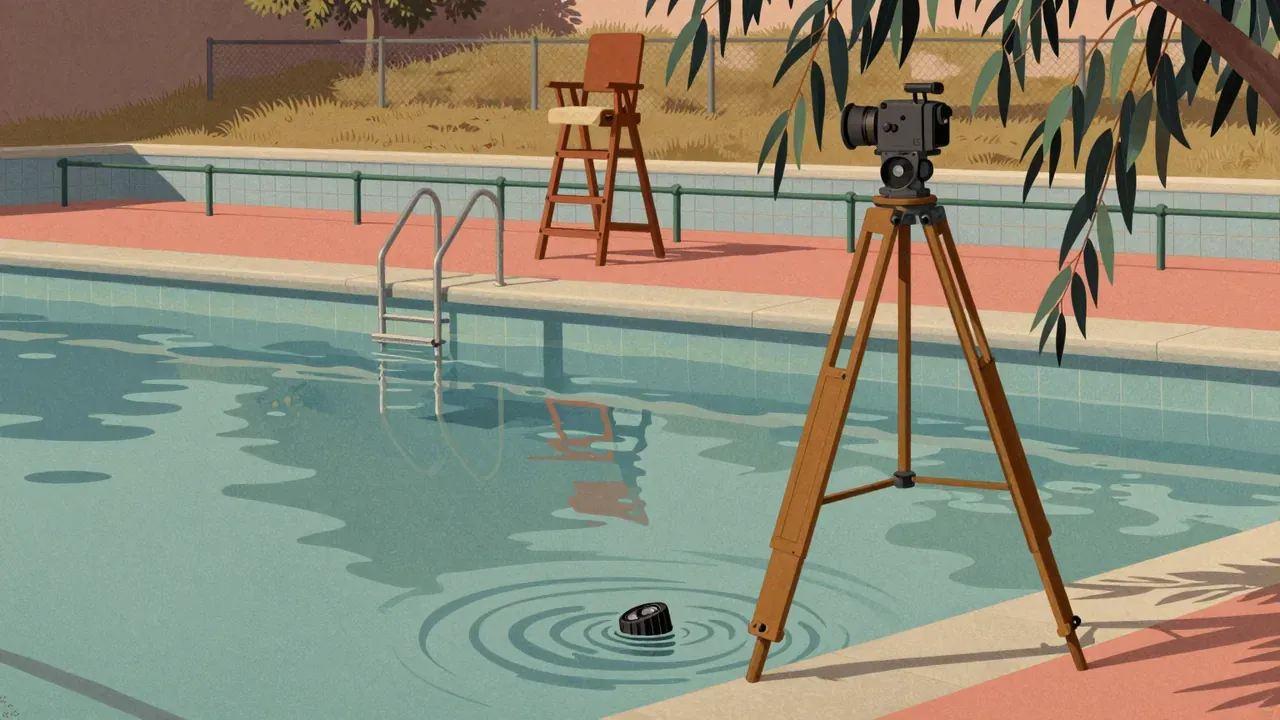
What lands most firmly is the film’s accumulated physical logic: each mishap builds on the last, making Buster’s eventual success feel earned rather than arbitrary. The swimming pool sequence works because every slip, splash, and collision obeys the same rules of gravity and space established earlier. The organ grinder and dazed monkey are not random interruptions but extensions of the film’s principle that chaos has texture and duration. The Tong War footage feels perilous not because of editing or music, but because Keaton films it at eye level, with real crowds and narrow alleyways — the danger is architectural, not symbolic. Even the final misdirection — the ticker-tape parade for Lindbergh — lands because the film has spent seventy minutes training us to read context literally, then subverts it with documentary precision. The monkey’s silent, handheld shot of Buster rescuing Sally is not sentimental; it is the culmination of a visual language built entirely on observation and consequence. Nothing here feels imposed. Every gag has weight, every reaction measured, every recovery delayed just long enough to register as effort. Word count: 154.
The gaps in it
What does not land is the framing device of the newsreel company itself — its hierarchy, routines, and internal politics remain vague and underdeveloped. Sidney Bracey’s boss appears only in bookends, his authority undefined beyond a single line of praise. The rivalry with Harold lacks stakes beyond romantic competition; we never see him shoot well, only mock. Some transitions feel abrupt: the jump from Chinatown to the boat race carries no narrative bridge, relying instead on montage to imply continuity. The film’s reliance on situational logic means emotional payoffs are muted — Sally’s shift from encouragement to affection happens off-screen, signalled only by her presence at the drugstore and later at the office. The satire of studio bureaucracy is present but shallow; MGM’s own apparatus is treated as backdrop, not subject. And while the public-domain status matters historically, it does nothing for the viewing experience — the print quality, though restored, still shows wear in the Paris-discovered reels, particularly in mid-tone greys during interior scenes. Word count: 152.
The work in it
The themes that matter are ambition constrained by infrastructure, competence measured against expectation, and the quiet dignity of trying again after public failure. Buster’s struggle is not against villains but against systems he does not understand — the camera, the newsreel workflow, the city’s geography, even the monkey’s agency. His persistence is neither heroic nor foolish, but procedural: he loads film, frames shots, adjusts focus, repeats. The film treats work as ritual, not vocation — there is no grand statement about art or journalism, only the mechanics of getting something done. Class is implied but unstated: Buster’s sidewalk stall sits outside the studio gates; his bank account is small, his access conditional. The monkey, meanwhile, becomes an analogue for unintended consequence — not chaos as disruption, but as recalibration. Even the Lindbergh ending refuses transcendence: fame is accidental, recognition misdirected, success shared with a non-human actor. The film’s moral is not that effort is rewarded, but that effort changes what counts as evidence — the footage exists, the rescue happened, the monkey filmed it. All else is interpretation. Word count: 157.
The terms of it
This film is for viewers who value physical storytelling over exposition, who watch comedy for its architecture not its punchlines, and who accept silence as a medium rather than a limitation. It rewards attention to composition, timing, and cause-and-effect. It is not for those who require psychological motivation, verbal wit, or narrative symmetry — the romance resolves without dialogue, the antagonist fades without defeat, the climax arrives via accident. Those expecting Keaton’s earlier independent features may find the studio gloss too smooth, the pacing less urgent; fans of Chaplin might miss the pathos. But anyone willing to sit with its unhurried logic — to notice how Buster’s hat tilts differently after each fall, or how the monkey’s grip tightens on the camera reel — will find it richly sustained. Word count: 150.
The finish of it
Yes, it is worth your evening — not as nostalgia or historical artefact, but as a fully realised comic object, self-contained and exact. Its seventy minutes pass without strain because its rhythm is calibrated to human movement, not clock time. You need no prior knowledge of silent film, only willingness to follow a man walking purposefully into trouble. Some will argue it lacks the existential weight of Sherlock Jr. or the structural daring of The General; others may find its studio sheen dull beside Keaton’s 1920s independents. But its coherence — in writing, performance, and craft — remains unbroken. A different verdict would require either a version missing the Paris print’s surviving Chinatown footage, or a viewer unwilling to grant silence its full expressive range. Word count: 150.