The shape of him
The Horse’s Mouth is a British adaptation of Joyce Cary’s 1944 novel, directed by Ronald Neame and written by Alec Guinness, who also stars as the painter Gulley Jimson. It attempts to translate Cary’s picaresque, philosophically charged portrait of artistic obsession into cinematic form — not as biography or social commentary, but as a sustained character study in motion. The film narrows the novel’s scope: it drops much of the political texture and moral ambiguity surrounding Jimson’s relationships with patrons and institutions, focusing instead on his physical and psychological momentum — the way he moves through London, barges into rooms, commandeers walls, and treats people as materials for his next stroke. Guinness’s script preserves the novel’s verbal energy and self-mythologising narration, but reorients its gravity toward spectacle, slapstick, and visual invention. It is less about what art means than how it behaves — how it interrupts, invades, and outlives its maker. The ambition is structural as much as thematic: to make a film whose rhythm, editing, and colour scheme all serve the logic of an unruly creative impulse.
The pace of it
The story follows Jimson across a series of escalating transgressions — from petty theft and pawnbroking to mural-scale vandalism — each episode calibrated to test the limits of tolerance, legality, and structural integrity. Guinness performs Jimson with precise physicality: a shuffling gait, a rasping voice, eyes that flicker between cunning and exhaustion. Kay Walsh’s Coker grounds the film with quiet, weathered resolve; Renée Houston’s Sara carries a muted, unyielding dignity. Arthur Ibbetson’s Technicolor cinematography avoids painterly prettiness: interiors are cramped and grainy, exteriors washed in flat winter light, the Thames rendered in muddy greys and ochres. Anne V. Coates edits with brisk, almost impatient cuts — no lingering on reaction shots, no smoothing over of tonal shifts. Kenneth V. Jones’s score, arranged from Tristram Cary’s sketches, leans into jaunty dissonance, mimicking Prokofiev without imitation. The paintings themselves — John Bratby’s expressionist works — are deliberately crude, urgent, and unrefined, anchoring Jimson’s genius in tangible, imperfect labour rather than mystique.
The weight of him
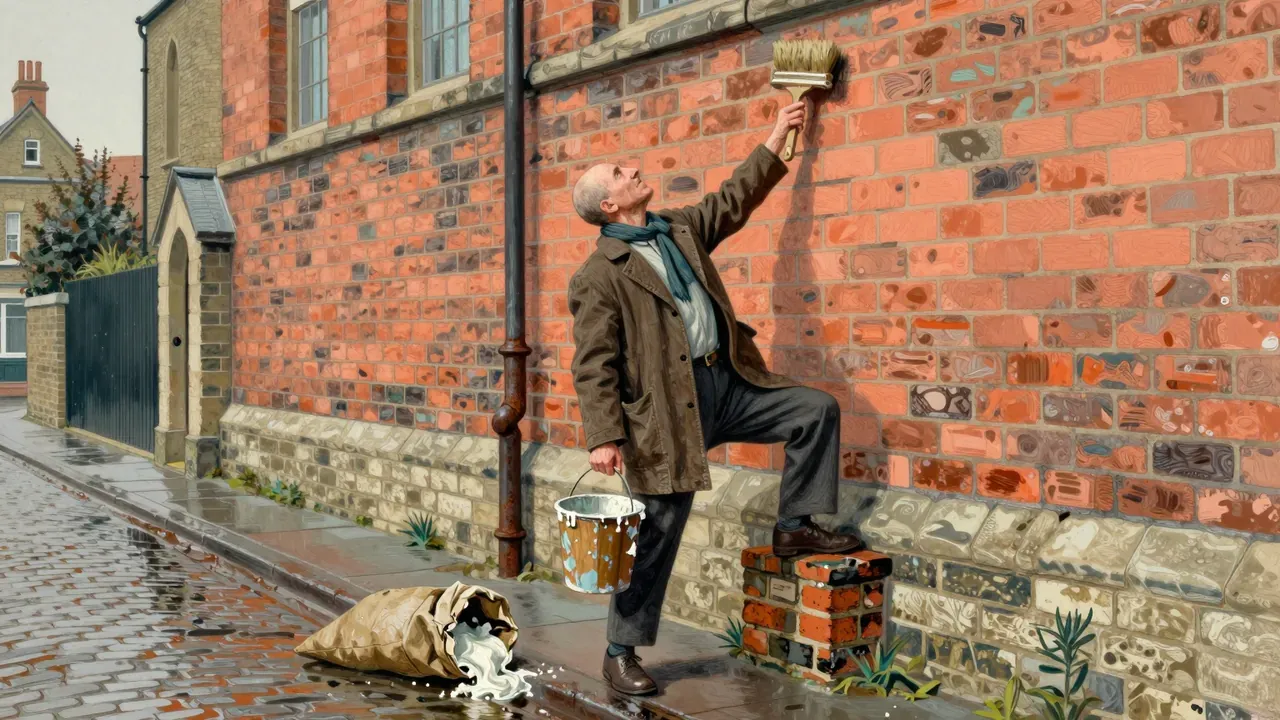
What lands most decisively is the film’s central performance and its physical grammar. Guinness does not impersonate an artist so much as inhabit the posture of one — the way he grips a brush like a weapon, the way he stares at blank walls not with contemplation but with tactical assessment. The houseboat scenes, the Beeders’ ruined drawing room, the final church wall — these are not backdrops but antagonists, surfaces to be conquered or destroyed. The comedy arrives not from set-ups but from velocity: Jimson’s refusal to decelerate, even when chased, bankrupt, or ill. The film’s pacing mirrors this — scenes rarely settle, dialogue often overlaps or cuts off mid-sentence, and the camera stays close, refusing distance. Even minor characters register: Ernest Thesiger’s Hickson is a masterpiece of brittle authority, Michael Gough’s Abel a blunt-force foil, Reginald Beckwith’s Captain Jones a pocket-sized relic of imperial order. The film’s vitality is real, earned not by polish but by insistence — a refusal to let Jimson become quaint, nostalgic, or safely contained.
The cost of it
What does not land is the film’s attempt to reconcile its anarchic energy with the novel’s deeper ethical unease. The ending — Jimson driving a bulldozer through his own mural — reads as triumphant self-annihilation in the book, but here it feels more like a gag, undercut by the preceding slapstick and the lack of sustained moral weight. Several supporting figures veer into caricature: the Beeders are too brittle, the council official too cartoonishly obstructive, and Nosey’s devotion lacks the novel’s layered irony. Ronald Neame’s direction, while efficient, seldom deepens the material — it stages the action but rarely interrogates it. The film’s Ealing-inflected tone softens the novel’s sharper edges: Jimson’s cruelty, his parasitism, his genuine danger to others are smoothed over in favour of charm. There is little sense of real consequence — no lasting injury, no irreversible loss, no true reckoning. The result is a film that feels vivid and alive, but ultimately lighter than its source, trading moral complexity for kinetic clarity.
The need in it
The themes that matter are not those of patronage or post-war Britain, but of creation as compulsion, destruction as completion, and art as something that exists only in the act — never in the archive, the gallery, or the will. Jimson does not paint to communicate, commemorate, or sell; he paints because stopping would mean collapse. The film treats inspiration as physical pressure — a tremor in the hand, a sudden lurch toward a wall, a theft of pigments or tools. It explores the paradox that the artist must both rely on and reject the world: Coker maintains the houseboat, Sara holds the painting, the Beeders provide the wall — yet Jimson betrays, abandons, or ruins each in turn. There is no redemption arc, no growth — only escalation. The film’s strongest idea is that creativity cannot be domesticated: it resists contracts, curators, critics, and even the artist’s own intentions. This is not romanticism but physics — a force with mass, velocity, and inevitable friction. The film’s failure to fully articulate this idea does not erase its presence; it pulses beneath every scene, unspoken but undeniable.
The audience for it
This film is for viewers who value performance as craft, who watch films for how bodies move through space and how voices shape time. It suits those familiar with mid-century British cinema’s rhythms — the compression of dialogue, the restraint of gesture, the dryness of moral ambiguity. It rewards attention to editing choices, costume textures, and the deliberate ugliness of Bratby’s paintings. It is not for those who require narrative closure, psychological realism, or thematic resolution — Jimson remains opaque, his motives shifting, his ethics unexamined. Viewers expecting a conventional biopic or a tidy satire of the art world will find it frustrating. Those who dislike rapid tonal shifts or resist comedy rooted in physical desperation may also struggle. A viewer who values the novel’s philosophical density over its plot will likely feel the film’s omissions acutely. But for someone who trusts a performer’s physical intelligence above exposition, this remains singular.
The leaving of it
Yes, it is worth your evening — not as a definitive statement on art, but as a rare, unapologetic demonstration of how film can embody creative urgency. Its ninety-seven minutes pass with the speed of a brushstroke: uneven, decisive, leaving residue. It works best when watched without expectation of coherence — as a sequence of gestures, not a thesis. Someone who prefers measured pacing or explicit moral framing may find it exhausting, and those seeking historical context or social critique will leave wanting more. But if you respond to the idea that a film can be a body in motion — ragged, stubborn, and unwilling to apologise — then this delivers. Its endurance lies not in perfection but in persistence: a performance that refuses to sit still, a camera that refuses to look away, and a final image — the boat receding down the Thames — that offers no answer, only continuation.