The premise
Riot in Cell Block 11 is a tightly wound, low-budget prison drama that sets out to dramatise systemic failure—not as backdrop, but as causality. It does not ask whether prisoners are good or bad, but whether the institution makes moral response impossible. Written by Richard Collins and produced by Walter Wanger shortly after Wanger’s own incarceration, the film treats the riot not as criminal rupture but as logical consequence: overcrowding, rotten food, sadistic guards, and institutional inertia are named, shown, and sustained as conditions, not plot devices. Don Siegel directs with procedural restraint—no flashbacks, no romantic subplots, no voiceover justification. The film’s ambition is narrow and exact: to stage a protest inside a cage and hold the audience inside it too, without recourse to heroism or catharsis. Its realism is structural, not stylistic: it avoids expressionist shadows or jazzy cuts, relying instead on location shooting at Folsom State Prison, real inmates as background figures, and dialogue that lands like deposition testimony. It aims for argument, not atmosphere. (158 words)
The look of it
The story unfolds over roughly thirty-six hours, compressed into eighty minutes without ellipsis or relief. Neville Brand plays James V. Dunn with coiled stillness—his authority comes from silence, not speech—and Emile Meyer’s warden Reynolds carries the weight of compromised decency. Leo Gordon, a former San Quentin inmate, plays Carney with unvarnished menace, his physicality rooted in lived experience rather than performance. Russell Harlan’s cinematography uses natural light and deep focus to flatten hierarchy: guard towers, cell bars, and newsroom microphones all occupy the same visual plane. Herschel Burke Gilbert’s score is sparse, functional—strings enter only when tension peaks, then recede. Siegel blocks scenes in long takes across cramped corridors and tiered galleries, refusing to isolate characters visually; even hostages and captors share frame space. Dialogue is terse, often interrupted by off-screen shouts or radio static. There are no monologues explaining motive; demands are read aloud from a typed list, then filed away. The craft serves compression and credibility, not flourish. (159 words)
The turning point
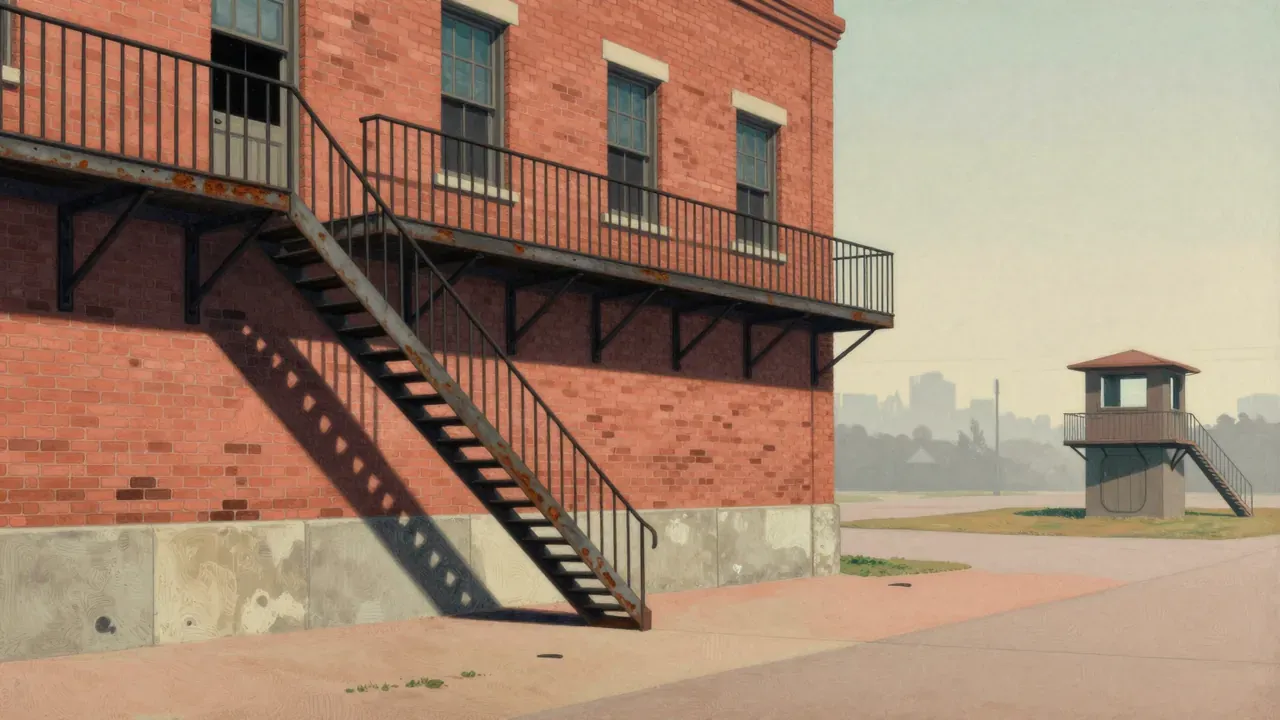
What lands is the cumulative pressure of institutional refusal. The film’s power resides in its refusal to let anyone off the hook—not the politicians who veto the governor’s agreement, not the warden who complies with orders he knows are unjust, not even Dunn, whose tactical discipline cannot override the system’s capacity to absorb dissent. The final scene, where Dunn learns the legislature has voided the deal, lands with quiet devastation because it follows no dramatic crescendo—just a knock on the door, a walk down a corridor, and a single line delivered without inflection. The use of real Folsom locations grounds every shot: the damp brick, the iron staircases, the echo in the yard—all feel documented, not designed. The casting of actual inmates as extras adds texture without spectacle; they move like people who know the rhythm of lockdown, not actors mimicking it. Even the newspaper headline—‘Prisoners Win’—is shown not as triumph but as irony, printed in the same font as ads for soap and cigarettes. The film trusts its audience to register the gap between appearance and outcome. (157 words)
The politics
What does not land is the attempt to sketch internal prisoner factions. A brief subplot involving rival inmates vying for control dissolves without consequence or clarity—neither motivation nor resolution is offered, and the characters involved vanish before their roles register. The state police assault sequence feels rushed, its stakes undercut by the human-shield gambit, which arrives without prior setup or psychological weight. Whit Bissell’s district attorney is a cipher, delivering exposition about legislative override without grounding in character or context. Some performances verge on theatricality: Frank Faylen’s guard, though physically imposing, slips into caricature during interrogation scenes, his sneer too broad for the film’s otherwise muted register. The ending’s coda—the warden’s admission of small concessions—is narratively necessary but emotionally thin; it names reform without showing its mechanism or cost. These moments do not break the film, but they dilute its precision. They suggest where budgetary haste or script cuts left gaps the direction could not fully bridge. (159 words)
The concession
The themes that matter are accountability without agency, reform without recourse, and protest as documentation rather than liberation. The film treats the prison not as an aberration but as a concentrated version of civic failure: elected officials defer to bureaucracy, bureaucrats defer to precedent, and precedent defers to silence. The riot succeeds only in making visible what was already true—hence the newspapers, not the negotiations, become the measure of victory. Class is present but unspoken: the prisoners are almost exclusively white, working-class men, their grievances framed in terms of dignity and procedure, not identity or ideology. Justice appears only as process—legal, administrative, journalistic—not as outcome. The film’s most persistent theme is the asymmetry of power: the state can revoke a promise with a pen; the prisoners need a siege to get one acknowledged. There is no redemption arc, no moral awakening among the authorities—only incremental, reversible concessions, brokered under duress and revoked at convenience. (156 words)
The silence after
This film is for viewers who value narrative economy, historical specificity, and moral ambiguity over emotional release or character arcs. It suits those familiar with mid-century American social realism—films like Edge of the City or The Phenix City Story—or readers of Carey McWilliams and Jessica Mitford. It is not for viewers who require clear protagonists, narrative closure, or tonal consistency; the abrupt shifts between procedural negotiation and sudden violence may unsettle without preparation. Those expecting the stylised fatalism of noir or the mythic scale of later prison films—Cool Hand Luke, say—will find it austere, even withholding. Its pacing assumes attention to detail: a glance between guards, a pause before signing a document, the way a cigarette burns down while no one speaks. Anyone needing exposition, backstory, or thematic signposting will leave frustrated. It rewards patience, not investment. (158 words)
The length
Yes, it is worth your evening—not as entertainment, but as calibration. At eighty minutes, it occupies less time than a commute, yet its structure and restraint recalibrate expectations of what a ‘prison film’ can be: no escape tunnels, no buddy bonds, no last-minute reprieves. Its value lies in its refusal to flatter the viewer with resolution or virtue. You will not leave uplifted, but you may leave clearer-eyed about how institutions absorb dissent. Those who reject it tend to cite its bleakness or lack of ‘relatable’ characters—but that is the point, not a flaw. A different verdict would follow only if the film had softened its ending, added a romantic subplot, or granted Dunn legal exoneration. As it stands, its austerity is its argument. It is worth watching once, attentively, and not necessarily again—its power is in its singularity, not its rewatchability. (159 words)