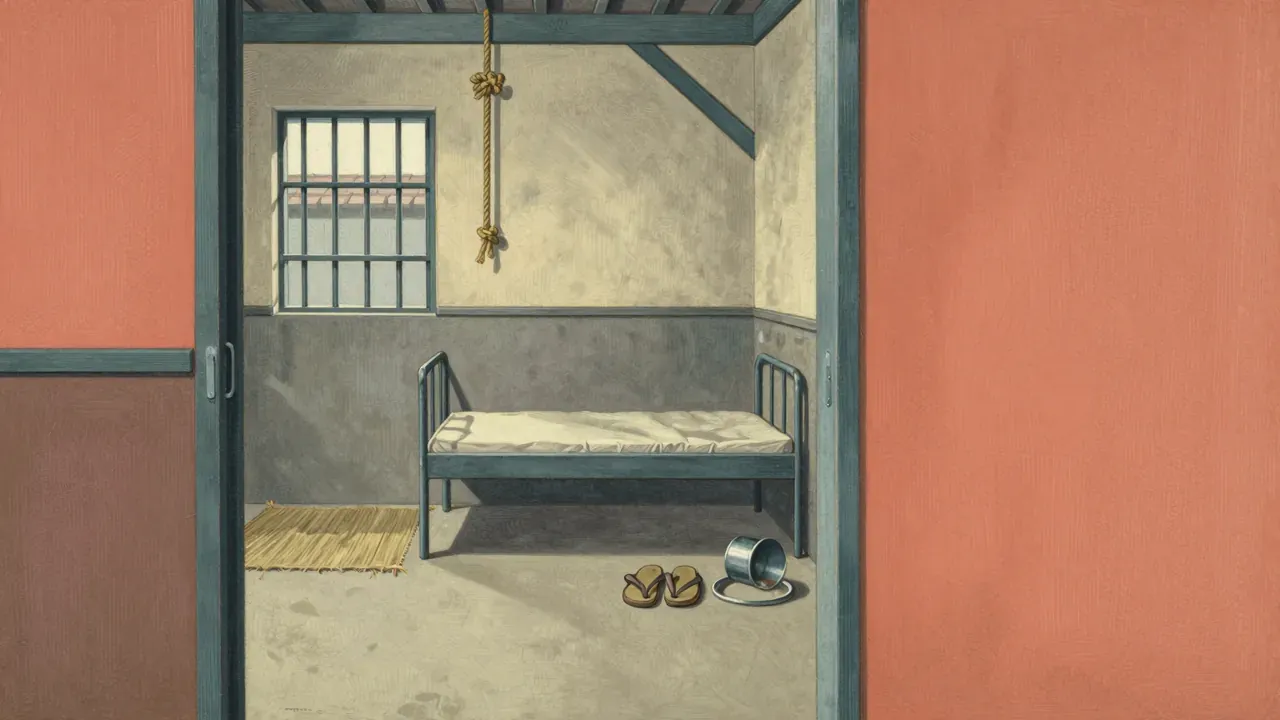
The thickness of the walls
The Thick-Walled Room is a 1956 Japanese war drama that examines the psychological and moral condition of Japanese soldiers imprisoned in Sugamo Prison as Class B and C war criminals. It does not seek to deny their acts — the film names them plainly: shootings on command, forced participation in torture, bayonet killings — but insists on framing those acts within coercive hierarchy, systemic pressure, and post-surrender disorientation. Its aim is not exoneration, but interrogation: of how responsibility distributes across rank, ideology, and occupation; of whether justice administered by a foreign power can be impartial when it follows total military defeat; and of what happens to memory under prolonged confinement and institutional silence. The film treats the prison not as a neutral container for guilt, but as a thick-walled room in both literal and metaphorical senses — a space where time distorts, testimony fractures, and moral clarity dissolves under repetition and isolation. It is an early, unsentimental exercise in structural critique, less concerned with individual innocence than with the architecture of accountability.
The look of it
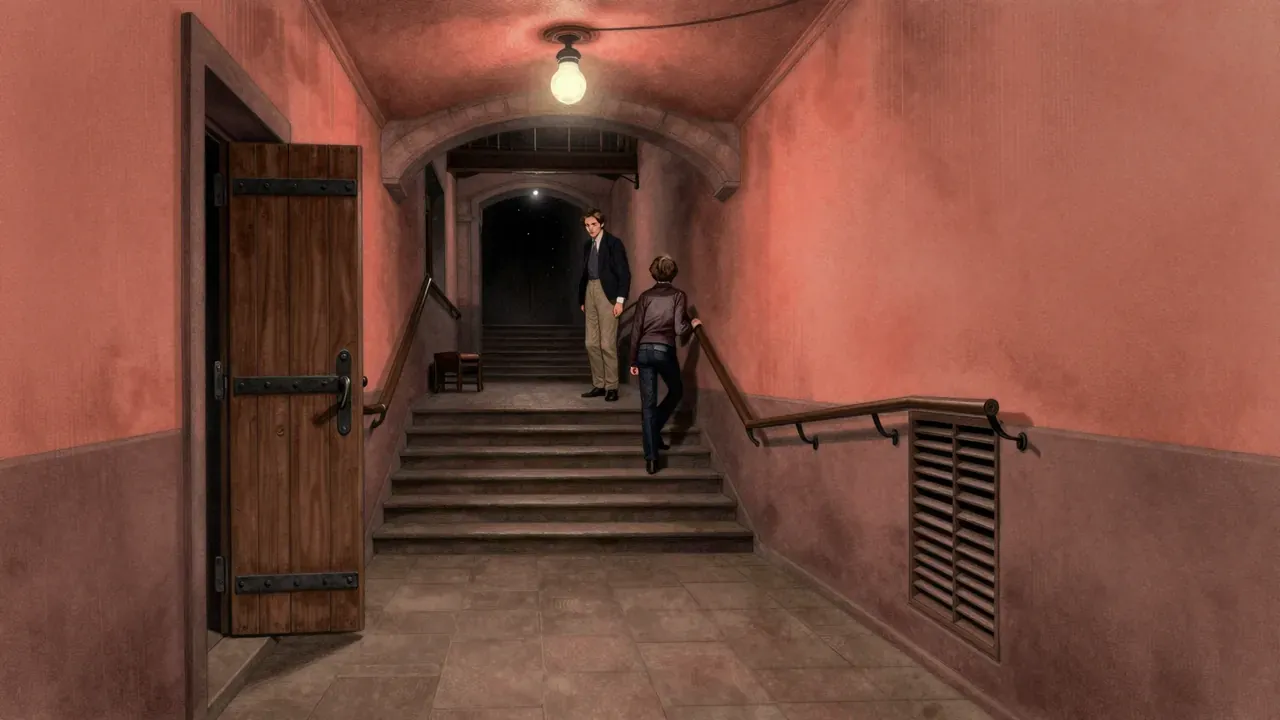
The film works through restraint: its narrative moves in tight circles, anchored in cell-block routines, fragmented flashbacks, and terse dialogue. Kōbō Abe’s screenplay adapts published diaries, and the script retains their flat, unadorned tone — no rhetorical flourishes, no courtroom theatrics. Performances are muted but precise: Torahiko Hamada as Yamashita conveys simmering grievance without grand gestures; Kō Mishima’s Yokota holds himself apart, his quietness reading as both shame and resistance. Cinematography by Kazuo Miyagawa avoids dramatic lighting or movement; interiors are dim but legible, faces often half-shadowed, compositions favouring static frames and medium shots that refuse to flatter or condemn. Editing is deliberate, with cuts timed to breath or pause rather than emphasis. There is no score — only diegetic sound: distant shouts, clanging doors, rain on concrete. The absence of musical punctuation forces attention onto speech, silence, and gesture. Even the brief exterior sequence — Yamashita’s furlough — feels drained of release, its Tokyo streets grey and indifferent, its human encounters hollowed by time and mistrust.
What stays with you
What lands is the cumulative weight of moral exhaustion. The film makes palpable the way guilt and victimhood coexist without resolving — not as paradox, but as lived contradiction. Yamashita’s aborted revenge, his return to prison, and the small act of handing over sweets register not as redemption, but as resignation to a logic he cannot escape: the system that condemned him remains intact, and forgiveness becomes a private gesture with no public consequence. The suicide of Kawanishi lands with quiet finality — not melodrama, but the logical endpoint of a mind that cannot hold two truths at once: that he obeyed orders, and that he killed. The film’s refusal to offer catharsis or resolution lands precisely because it refuses comfort. Its realism is procedural, not photographic: it shows how institutions wear down perception, how memory degrades under repetition, how solidarity among prisoners forms not from shared virtue but from shared constraint. That this emerges without voiceover, without exposition, and without editorialising gives it a rare kind of authority — one earned by withholding, not asserting.
Where it stops short
What does not land is the film’s implicit distinction between ‘ordinary’ soldiers and systemic culpability. While it names specific acts — the shooting, the flagellation, the bayoneting — it treats them as isolated incidents, committed under duress or confusion, rather than as expressions of a militarised culture that trained obedience to override conscience. The American interrogators appear as blunt instruments, but the film never asks how Japanese military law, propaganda, or chain-of-command practices enabled those same acts before surrender. Hamada is cowardly, not ideological; his profiteering is personal, not structural. This flattens the historical complexity the film otherwise honours. It also risks sentimentalising the prisoners’ suffering while underplaying their agency — not as individuals, but as members of an army that occupied, coerced, and executed across Asia. Critics like Sandra Wilson note this omission directly; the film’s moral focus narrows to the moment of arrest and incarceration, leaving the war itself as backdrop, not subject. That narrowing weakens its claim to social criticism, turning indictment into lament.
What it keeps asking
The themes that matter are confinement as epistemology, memory as contested terrain, and justice as performance. The thick-walled room is not just physical — it is the limit of what the men may know, say, or believe about themselves. Their recollections are unreliable not because they lie, but because time, trauma, and institutional pressure have reshaped them into fragments that resist coherence. The film treats testimony not as evidence, but as survival strategy: Yokota clings to Yoshiko not for love, but to anchor himself against dissolution; Yamashita rehearses his version of events not to convince others, but to hold onto a self he fears is vanishing. Justice appears only as procedure — trial, appeal, furlough — never as principle. The film suggests that when legal process is severed from historical context, it becomes ritual, not reckoning. And hierarchy matters more than ideology: Hamada’s betrayal is not political, but hierarchical — he shifts blame downward, then profits from the ruins. The film’s enduring concern is not who is guilty, but how guilt gets assigned, displaced, and absorbed — and who bears the weight when no one else will.
Who it is for
This film is for viewers who approach cinema as ethical inquiry, not entertainment — those willing to sit with unresolved tension, moral ambiguity, and formal austerity. It rewards patience with its slow accumulation of detail and its refusal to simplify motive or outcome. It is not for those seeking narrative propulsion, emotional release, or clear moral binaries. Viewers expecting the moral urgency of Kobayashi’s later The Human Condition may find this earlier work too restrained, too inward, too reluctant to name systems beyond the prison walls. Those who require historical context to be dramatised, not implied, will likely feel the film’s omissions as gaps rather than choices. A viewer who values cinematic craft over plot, and who understands that silence and stillness can carry argument as surely as speech, will find it compelling. Anyone needing affirmation of clear right and wrong, or who reads historical complexity as indecision, will leave unsatisfied — and rightly so, since the film’s purpose is not to resolve, but to persist in the question.
Is it worth your evening?
Yes, it is worth your evening — but only if you accept that its value lies in duration, not diversion. Its 110 minutes ask for sustained attention, not passive reception. It repays close viewing not with spectacle or revelation, but with incremental insight: how light falls on a cell wall at dusk, how a pause lengthens under interrogation, how a package of sweets carries more weight than a speech. Those who watch it expecting catharsis or closure will find neither — and that is the point. Critics like Stephen Prince argue it marks Kobayashi’s mature voice; others, like Donald Richie, find its moral framing debatable. What changes the verdict is not the film’s politics, but the viewer’s willingness to treat ambiguity as substance. If you measure worth by emotional payoff alone, it fails. If you measure it by rigour, restraint, and the courage to withhold judgment, it succeeds — quietly, insistently, and without fanfare.