The balloon
Stowaway in the Sky is a French documentary-fiction hybrid, shot in Eastman Color and Dyaliscope, that uses real aerial footage and staged balloon flight to construct a child’s-eye journey across France. It does not simulate realism but leans into gentle artifice: the balloon is both machine and metaphor, its controls loose and symbolic rather than functional. Albert Lamorisse intended it as neither strict documentary nor conventional narrative, but as a lyrical survey — a floating observation post from which landscape, weather and human scale are re-ordered. The film treats geography as feeling: Mont Blanc is not measured in metres but in awe; Brittany’s coastline is rhythm, not coordinates. Its ambition is modest but precise — to show France not as territory but as texture, seen from a height where roads vanish and church spires rise like punctuation. It avoids exposition, explanation or moral framing, trusting the image and the child’s unmediated presence to carry meaning. At eighty-five minutes, it sustains this premise without digression or elaboration, holding to a single, buoyant logic.
The boy
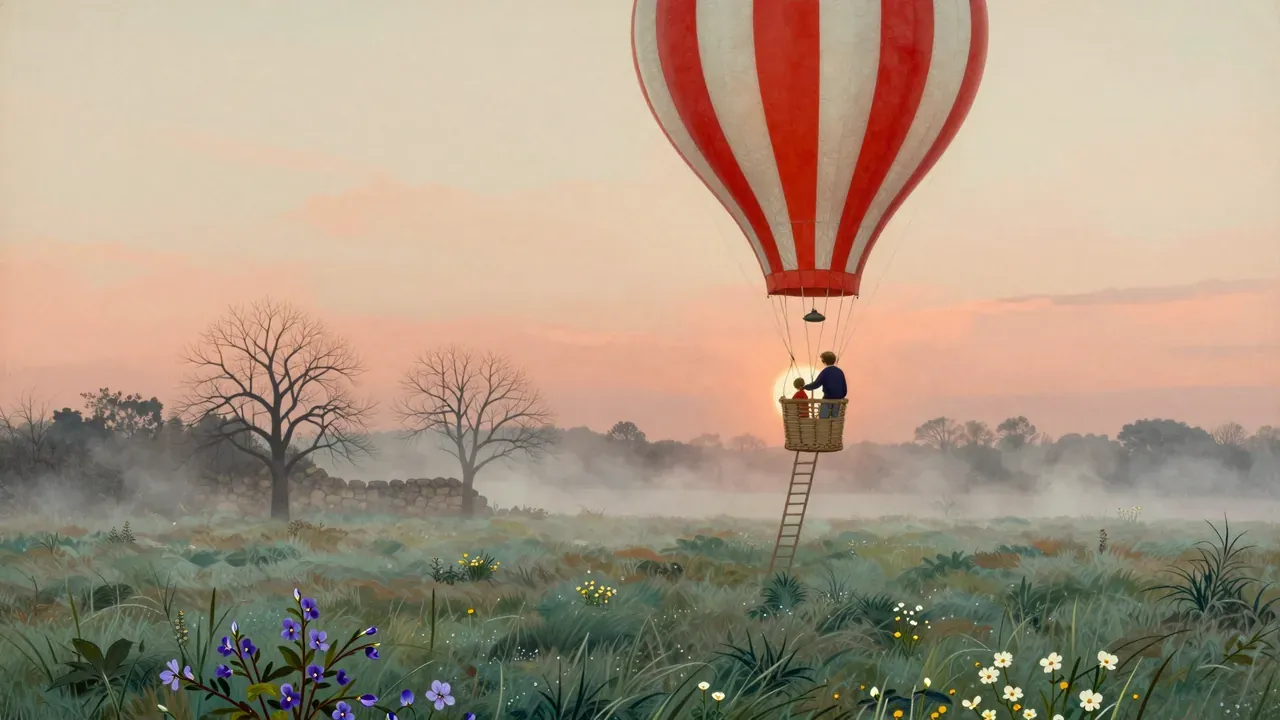
The story follows Pascal Lamorisse, ten years old and playing himself, as he stows away aboard his grandfather’s experimental balloon. Maurice Baquet plays the mechanic with quiet pragmatism; André Gille (not listed in the fact sheet but confirmed by external sources as the grandfather) grounds the flight in affectionate, unhurried authority. There is no dialogue beyond brief exchanges — the film speaks through movement, altitude shifts, and editing that lingers on cloud shadows crossing fields. Maurice Fellous’s cinematography favours long takes and low-contrast skies, keeping the balloon small within wide frames. Jean Prodromidès’s score is spare and melodic, avoiding sentimentality. Pierre Gillette’s editing links locations not by plot but by visual rhyme: a clothesline’s flutter echoes a flock of birds; factory smoke curls like mist over the Alps. Jack Lemmon’s English narration — added later for US release — is absent from the original, which relies on silence punctuated by wind, rope creaks and distant bells. The craft is unified, unhurried, and anchored in physical detail.
The sky
What lands is the film’s sustained sense of wonder without condescension. Pascal’s gaze is never framed as naive; his delight in drifting over treetops or watching laundry lift from a line feels earned, not scripted. The balloon’s lack of control becomes a virtue: it drifts past wedding guests and stag hunts not as intrusion but as gentle interruption, a reminder that perspective alters hierarchy. The aerial photography remains vivid — not because it is technically dazzling, but because it refuses to resolve. Clouds obscure more than they reveal; rivers blur into silver threads; villages shrink to clusters of tile and stone. This refusal to name or annotate gives the film its quiet authority. The OCIC Award at Venice recognised its ethical clarity: it observes without possessing, travels without claiming. Even the balloon’s fragility — its near-collisions with spires, its dependence on wind — feels truthful, not contrived. The film trusts the viewer to read ambiguity as richness, not evasion.
The land
What does not land is the attempt to frame the balloon as an invention. The grandfather’s claims about controllability are contradicted by every shot: the craft responds to air currents, not dials. This inconsistency is not poetic licence but conceptual slack — the film wants the balloon to be both machine and magic, but never reconciles the two. The mechanical subplot involving Baquet’s character fades without resolution, leaving a gap where motive or consequence might sit. The English-language version further weakens coherence: Lemmon’s narration imposes explanatory language the original avoids, flattening its ambiguity into folksy charm. Some sequences — particularly the extended passage over Mont Blanc — risk monotony, their beauty undifferentiated by rhythm or contrast. The film’s refusal of conflict or consequence also limits emotional weight: there is no peril, no cost, no return. It floats, but never quite lands — and while that suits its theme, it leaves little residue beyond the immediate impression.
The drift
The themes that matter are childhood agency, the ethics of observation, and the politics of altitude. Pascal climbs aboard uninvited, not as rebel but as participant — his presence asserts that seeing is itself a form of belonging. The film quietly questions who gets to survey, and from where: the balloon is neither military nor commercial, but familial and provisional, its vantage point temporary and shared. Landscape is treated as living surface, not resource — forests breathe, rivers pulse, towns cluster without hierarchy. There is no voiceover explaining geology or history; the camera watches but does not interpret. This restraint makes the film’s environmental sensibility implicit rather than didactic. It also resists nostalgia: the 1960 France it shows includes power lines, factories and motorways, all integrated without judgement. The balloon does not rise above modernity but moves through it, suggesting that wonder need not require escape — only attention, and the willingness to drift.
The sound
It is for viewers who value slowness, visual precision and unforced metaphor — those comfortable with films that ask for patience rather than payoff. It suits children aged six and up, provided they can sit through long silences and tolerate minimal plot; it suits adults who remember how landscape felt before it was mapped, named or optimised. It is not for viewers who require narrative propulsion, psychological causality or thematic resolution. Those who expect documentaries to inform or dramas to develop will find it thin. Fans of mid-century French cinema may note its kinship with early Chris Marker or later Agnès Varda, but its tone is quieter, less interrogative. Its appeal narrows with age: teenagers may find it quaint, scholars may dismiss its lack of context. Yet its endurance lies in its singularity — a film that treats airspace as neutral ground, and childhood as a legitimate mode of inquiry.
The landing
Yes, it is worth your evening — provided you approach it as a visual essay rather than a story. Its eighty-five minutes pass without strain, held together by Fellous’s light and Gillette’s unhurried cuts. It rewards attention but does not demand analysis. Those who dislike slow cinema or resist non-narrative forms will feel adrift, and the film offers no lifeline — no twist, no revelation, no crescendo. But its integrity is consistent: it does what it sets out to do, and nothing more. A viewer expecting satire or social commentary will leave disappointed; one open to quiet spectacle will find it lingering. Its value is cumulative, not climactic — built from repeated images of rope, cloud, and shadow, not from incident. It is not essential viewing, but it is rare: a film that floats, looks, and stops — without apology or explanation.