The look of it
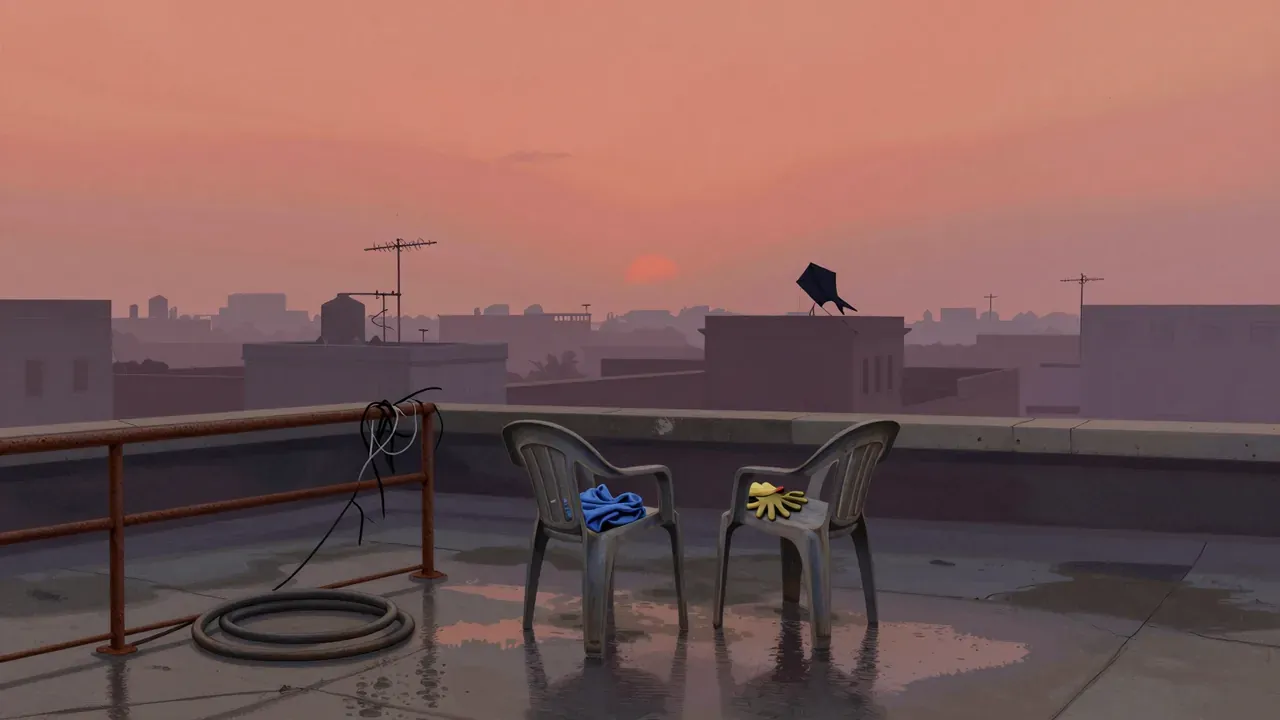
All That Breathes is a documentary about two brothers, Mohammad Saud and Nadeem Shehzad, who run an informal bird clinic in Wazirabad, Delhi, specialising in injured black kites. It is not a campaign film or an exposé, nor does it aim to diagnose Delhi’s pollution crisis with data or policy proposals. Instead, Shaunak Sen structures the film around duration, repetition, and proximity: long takes of hands cleaning wounds, of kites blinking under fluorescent light, of rainwater pooling on cracked concrete. The film tries to hold space for care as a quiet, unheroic practice — one that persists without institutional support, without fanfare, and often without visible success. It treats the brothers’ work not as a solution but as a rhythm, a counterpoint to the city’s accelerating decay. Its ambition lies in aligning the physical scale of the birds — small, wounded, airborne — with the vast, invisible systems that shape their survival: air quality, municipal neglect, religious custom, sectarian tension. It does not explain those systems; it lets them accumulate in the frame.
The way it moves
The film unfolds through observational sequences shot over several years, with cinematography by Ben Bernhard, Riju Das and Saumyananda Sahi. Their cameras stay close: low angles from inside the clinic’s cramped rooms, static shots of kites perched on rusted balconies, slow pans across smog-hazed horizons where the sky bleeds into rooftops. Roger Goula’s score uses layered synths and resonant pulses, avoiding melody in favour of atmosphere — a sonic counterpart to the visual texture. Editing by Charlotte Munch Bengtsen and Vedant Joshi favours ellipsis over exposition: scenes of the brothers preparing medicine cut to shots of rats scurrying in walls, then to a kite lifting off a rooftop, all without voiceover or title cards. There are no interviews, no talking heads, no archival inserts. The brothers speak in Hindi, untranslated except where context makes meaning clear; their voices are part of the soundscape, not narration. Performances are not performed: Saud and Nadeem move with habitual gravity, their exhaustion and tenderness registered in posture, in the way they cradle a bird’s wing, in silences that last longer than necessary. The craft serves restraint — every decision defers interpretation to the viewer.
What stays
What lands is the weight of continuity. The film’s power accumulates slowly: in the recurrence of certain images — a kite’s talon gripping a wire, a drop of saline falling onto feathers, Saud wiping sweat with the same blue cloth each time. These repetitions do not feel like motifs but like evidence of endurance — of time spent, breath taken, wounds cleaned. The interplay between the brothers’ Muslim identity and the rising political hostility toward minorities in Delhi is never stated outright, yet it registers in glances at news reports on a neighbour’s television, in the way they hesitate before opening the clinic door to strangers, in the quiet pride with which they describe feeding kites as a childhood ritual. The ecology is not abstract: it is the grit in a bird’s eye, the smell of antiseptic mixed with wet cement, the sound of a generator kicking in during a power cut. These details cohere into something more than portraiture — a tactile register of life persisting within compromised conditions. The film earns its stillness because it refuses to rush past what care looks like when it has no audience.
Where it holds back
What does not land is the attempt to widen the frame beyond the clinic’s walls without deepening it. A sequence showing Saud visiting a government office for permits feels detached, its bureaucratic frustration generic rather than specific to his situation. A brief montage of Delhi traffic and construction sites leans on visual shorthand — smokestacks, flyovers, crowds — without connecting them materially to the birds’ decline or the brothers’ labour. The film’s resistance to explanation becomes a limitation when it comes to structural context: we see the effects of pollution but not how particulate matter interacts with raptor physiology; we sense communal anxiety but not how it shapes access to veterinary supplies or municipal waste collection. The absence of context is deliberate, but it leaves some transitions feeling like gaps rather than ellipses — moments where the film assumes shared knowledge or asks the viewer to supply causality it declines to name. This is not a flaw in execution, but a risk in strategy: withholding explanation only works if every withheld fact is replaced by something equally precise.
What it’s really about
The themes that matter are interdependence and attenuation. Not the grand idea of ‘nature and humanity as one’, but the granular reality of shared air — how the same particles lodge in a kite’s lungs and a child’s throat, how the same monsoon rains wash toxins from rooftops into the drains where the brothers collect water for baths. The film treats religion not as doctrine but as embodied habit: the act of tossing meat skyward, the recitation of prayers while stitching a wing, the way faith and pragmatism coexist in the same gesture. Class appears not in speeches but in infrastructure — the clinic’s lack of refrigeration, the brothers’ reliance on donated antibiotics, the way a single power cut disrupts weeks of recovery. Ecology here is not a system to be mapped but a condition to be breathed: opaque, uneven, indifferent. And resilience is shown not as triumph but as repetition — the same wound cleaned, the same bird released, the same sky watched, day after day, without guarantee of return.
Who it’s for
It is for viewers who value sustained attention over exposition, who find meaning in texture rather than argument, and who accept ambiguity as a condition of honesty. It is not for those who require narrative propulsion, clear stakes, or solutions-oriented storytelling — people who leave a film asking ‘what should I do?’ may feel adrift here. Those expecting a conventional environmental documentary will find its refusal to name causes or assign blame frustrating. Viewers unfamiliar with Delhi’s spatial and political geography may miss subtle cues about location and tension, though the film does not depend on that knowledge. It also assumes tolerance for long stretches of near-silence, for scenes that resist interpretation, for beauty that does not flatter. Anyone needing moral clarity or emotional resolution will find the film withholding. Change the verdict? Only if the film were restructured to foreground cause-and-effect, add expert testimony or data overlays — but that would contradict its central proposition: that care precedes understanding.
Is it worth your time?
Yes, it is worth your evening — provided you watch it on a screen large enough to hold its detail, with sound that carries the low frequencies of Goula’s score and the layered ambience of Delhi’s margins. It rewards patience not with payoff but with recalibration: after ninety-seven minutes, the scale of a single feather, the weight of a brother’s sigh, the opacity of a Delhi sky begin to carry new significance. It is not ‘important’ in the way of urgent journalism, nor ‘entertaining’ in any conventional sense. Its value lies in the discipline of its gaze — how it watches without judging, records without interpreting, honours without mythologising. Some will call it slow; others will feel its pace is the only honest speed for reckoning with collapse that happens incrementally, invisibly, in real time. It does not ask for action, only attention — and that, for ninety-seven minutes, is enough.