A Case, Not a Chronicle
Native Land is a 1942 American documentary film that seeks to bear witness to the violent suppression of labour organising in the United States during the 1930s. It does so not through conventional reportage but by weaving together archival footage, newsreel excerpts, and staged dramatisations drawn from testimony gathered by the La Follette Committee — a US Senate subcommittee investigating corporate espionage and anti-union violence. The film’s aim is forensic and polemical: to name names, map tactics, and make visible the coordinated machinery of intimidation deployed against unionisers, particularly in agriculture and mining. It treats the labour struggle as a civil rights issue, foregrounding racial solidarity between Black and white sharecroppers while insisting on economic justice as inseparable from constitutional rights. Its form rejects neutrality; every cut, every voiceover, every lingering shot on a clenched fist or a broken window serves the argument that repression was systematic, state-tolerated, and lethal. It is not an overview of labour history but a prosecution brief in cinematic form — tightly focused, legally grounded, morally urgent. (158 words)
The Look of It
The film works through a hybrid structure: documentary sequences — grainy, handheld, often silent — alternate with reenactments shot in stark, high-contrast compositions by Paul Strand, whose cinematography recalls both Soviet montage and Depression-era photography. Leo Hurwitz shapes the rhythm, editing for cumulative pressure rather than narrative ease. Paul Robeson’s narration anchors the film in moral gravity, his voice low and deliberate, never declamatory but unshakeable. Performances are restrained, almost ritualistic: actors avoid naturalism in favour of emblematic presence — Fred Johnson as the farmer Fred Hill carries weight not through psychology but posture and silence; Howard Da Silva’s informer Jim registers less as a character than a function of betrayal. Marc Blitzstein’s score uses dissonant brass and percussive strings to underscore tension without melodrama. There is no diegetic sound design; voices and music dominate. The staging leans into tableau — figures arranged like figures in a courtroom sketch or a WPA mural — which gives scenes a solemn, liturgical quality. This is not cinema of immersion but of indictment, and its craft serves that purpose without concession to fluency or comfort. (159 words)
What Holds the Frame
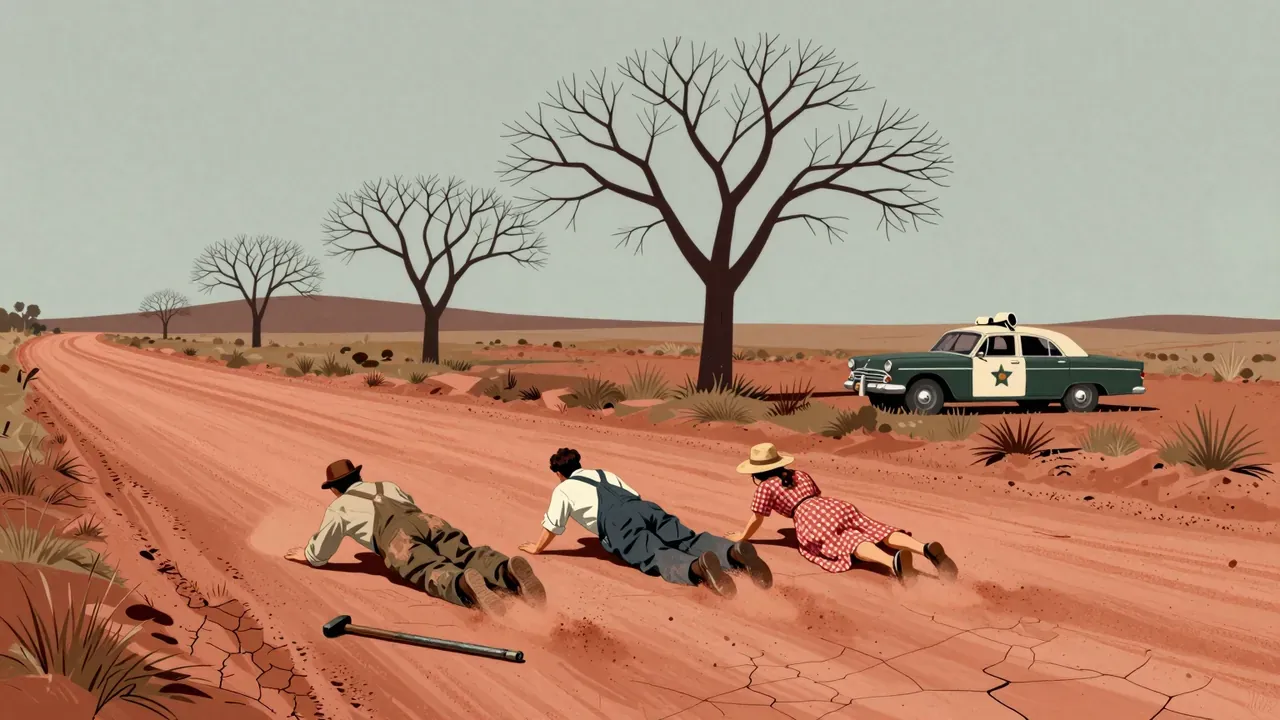
What lands is the film’s unblinking clarity of purpose and its refusal to soften its subject. The sequence depicting the beating of union organisers in a Southern town lands with physical force because it avoids close-ups of pain and instead holds on wide shots of bodies falling into dust, then cuts to a static shot of a sheriff’s badge pinned to a lapel — the implication clear without exposition. Robeson’s narration gains authority not from rhetorical flourish but from cadence and restraint; when he names corporations by name, the effect is chillingly matter-of-fact. The juxtaposition of real congressional hearing transcripts with dramatised testimony also works: it collapses the distance between record and representation, making the fiction feel like evidence. The film’s moral architecture — built on reciprocity between Black and white workers, on the idea that union-busting is conspiracy, not competition — remains legible and persuasive. Its urgency does not feel dated because the mechanisms it documents — surveillance, blacklisting, paramilitary contractors — have reappeared in different forms. What lands is not nostalgia but continuity: the film feels less like a relic than a precedent. (156 words)
Staged Truths
What does not land is the dramatic scaffolding itself — the reenactments, though formally coherent, lack psychological texture and can feel stilted next to the raw immediacy of the archival material. Characters such as the informer Jim or the thug with the crowbar remain types, not people, and their dialogue — written in a heightened, quasi-legal register — sometimes strains under its own didactic weight. The transitions between documentary and dramatisation are abrupt, not bridged by tone or motif, so the shifts risk fragmentation rather than synthesis. Some scenes, particularly those set in urban offices or boardrooms, rely on visual shorthand — cigar smoke, tilted fedoras, shadowed faces — that borders on caricature without irony to temper it. The film assumes its audience shares its political premises, and offers no counter-argument even as foil; this makes its polemic powerful but not dialectical. A viewer unfamiliar with the La Follette hearings may struggle to parse the significance of certain names or institutions without context the film declines to supply. Its rigour is also its limitation: it sacrifices ambiguity, irony, and individual vulnerability in service of collective testimony. (157 words)
The Machinery of Suppression
The themes that matter are institutional violence masked as legality, the weaponisation of labour law against workers, and the entanglement of race and class in the American South. Native Land treats union recognition not as a bargaining issue but as a threshold of citizenship — a line crossed only when workers gain the right to speak, assemble, and testify without fear. It insists that economic coercion is inseparable from racial terror: the shared plight of Black and white sharecroppers is shown not as alliance but as structural fact, enforced by the same landlords and vigilantes. The film also explores archives as sites of resistance — the La Follette Committee’s report is framed not as bureaucratic output but as salvage work, rescuing truth from erasure. Its theme of surveillance anticipates later concerns: private detectives hired by corporations, wiretaps, informant networks — all rendered not as plot devices but as infrastructure. There is no theme of redemption or resolution; the final image is not victory but vigilance. The film’s enduring relevance lies in how precisely it maps power: not as monolithic force, but as delegation — from boardroom to sheriff’s office to rented thug — and how easily that chain can be reassembled. (158 words)
Who It Meets Halfway
This film is for viewers who approach documentary as argument, not illustration — for students of labour history, film historians interested in the pre-war docudrama, and anyone tracking the lineage of activist cinema from Eisenstein to present-day investigative non-fiction. It rewards attention to editing rhythm, vocal timbre, and compositional symbolism. It is not for viewers seeking narrative propulsion, psychological realism, or tonal variety; its austerity is deliberate, not incidental. Those who require exposition, character arcs, or contextual framing may find it impenetrable without prior knowledge of the La Follette hearings or 1930s labour struggles. A critic might argue it is too narrowly focused to function as cultural history — but that narrowness is its strength. Its value would change if viewed alongside contemporaneous government films like The Plow That Broke the Plains, which offer contrasting visions of federal agency; seen alone, Native Land risks appearing isolated rather than embedded. Still, its integrity is unwavering: it asks for engagement, not empathy. (159 words)
What Remains After the Credits
Yes, it is worth your evening — provided you watch it as a primary source, not entertainment. Its eighty minutes accumulate like evidence: each sequence tightens the case, each pause deepens the implication. It repays slow viewing, especially with awareness of its restoration history — the 2011 UCLA print reveals textures lost in earlier screenings, particularly in Strand’s negative, where shadow detail in interior scenes now reads as intentional, not degraded. A viewer expecting pacing or catharsis will leave frustrated; but one attuned to rhetorical construction, sonic weight, and historical precision will find it galvanising. Those who dismiss it as ‘dated propaganda’ misunderstand its method: it does not persuade by charm but by accumulation — of names, dates, tactics, injuries. Its power lies in what it refuses: ornament, equivocation, spectacle. To call it ‘difficult’ is accurate; to call it ‘unrewarding’ is to misread its contract with the viewer. It demands nothing more than attention — and returns, in turn, a calibrated, unflinching view of how power defends itself. (159 words)