The shape of the story
Round Midnight is a fictionalised portrait of an American jazz saxophonist’s exile and return, set against the transatlantic jazz culture of the 1950s and early 1960s. It does not dramatise a real person but draws from documented lives — chiefly Lester Young and Bud Powell — and from Francis Paudras’s memoir of Powell’s time in Paris. The film aims to render the texture of that world: its clubs, its silences between notes, its reliance on mutual care among musicians, and the quiet violence of addiction as it erodes agency without spectacle. Tavernier avoids biopic conventions; there are no flashbacks to childhood trauma or rise-to-fame montages. Instead, the film treats jazz not as backdrop but as grammar: rhythm governs pacing, improvisation shapes dialogue, and silence carries narrative weight. It is a drama built on listening — to music, to hesitation, to what is left unsaid between men who speak in phrases rather than paragraphs. The ambition is modest in scope but precise in intention: to hold space for dignity amid decline, and to do so without condescension or myth-making.
The weight of the player
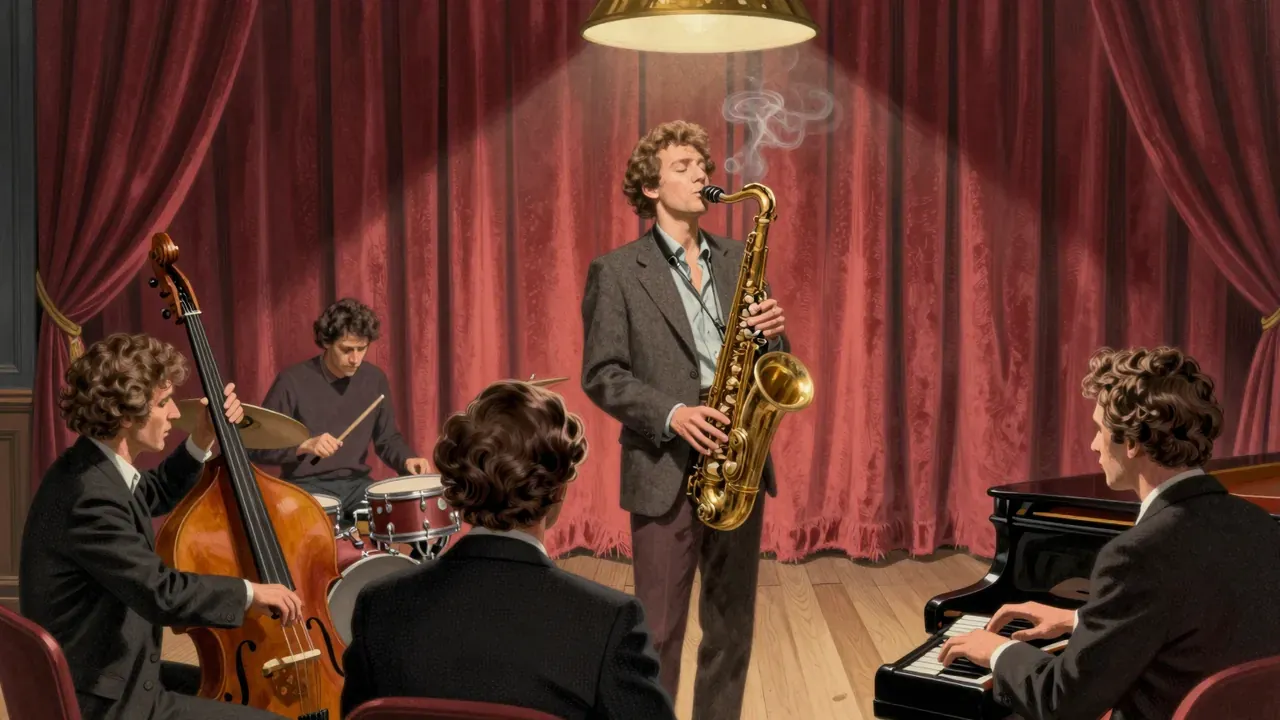
The story follows Dale Turner’s move from New York’s exhaustion to Paris’s tentative shelter, then back again — a structure that mirrors the call-and-response form of the music. Dexter Gordon, a tenor saxophonist with direct experience of Powell’s circle and of Parisian expatriate life in the early 1960s, plays Turner with stillness and gravity; his performance relies on posture, breath control, and the weight of pauses more than line delivery. François Cluzet as Francis gives a grounded counterpoint: earnest but never naive, observant but not omniscient. Bruno de Keyzer’s cinematography favours shallow focus and muted interiors — Le Blue Note’s amber light, Francis’s cramped apartment, hospital corridors stripped of decoration. Herbie Hancock’s score uses Monk’s ‘’Round Midnight’ as spine and refrain, weaving original cues around standards owned by Warner Bros. Editing by Armand Psenny sustains duration: a solo lasts as long as it needs to, a conversation lingers past resolution. Jazz musicians appear not as extras but as participants in scenes where music is work, not entertainment.
The space between notes
What lands is the film’s refusal to separate music from lived consequence. When Turner plays, it is never decorative: each solo emerges from fatigue, anticipation, or grief, and the camera stays on Gordon’s face, hands, and the instrument’s brass — not the crowd. The Paris sequences carry warmth without sentimentality; Francis’s devotion is shown in small acts — adjusting a chair, reheating coffee, waiting outside a clinic — not declarations. The hospital scenes avoid melodrama; Turner’s decline is registered in slurred consonants, delayed reactions, and the way he grips doorframes. The final New York sequence — the misstated age, the diner encounter, the telegram — lands because it refuses catharsis. There is no last-minute redemption, no symbolic reconciliation beyond the song written for his daughter. The film trusts the audience to sit with ambiguity: that care can be sustained and still fail, that art can endure while the artist does not. This restraint makes the emotional impact cumulative rather than climactic.
The limits of witnessing
What does not land is the framing of Francis as near-saintly witness. His devotion borders on abstraction — he has no professional stakes, no visible financial strain, no inner conflict beyond concern for Turner. Christine Pascal’s character, though present, remains underwritten; her relationship with Francis feels functional rather than felt. The New York return lacks the specificity of the Paris sections: club names, street textures, and musical context thin out. Martin Scorsese and Philippe Noiret appear in cameos that add name recognition but no narrative function. The script’s revisions by Gordon helped ground Turner’s voice, but the supporting characters retain a schematic quality — they serve the central dyad rather than inhabit their own logic. The film also sidesteps structural questions about race in 1950s New York: Turner’s marginality is rendered as personal and chemical, not systemic. That choice is defensible, but it leaves unexamined how racial exclusion shaped the very conditions of his exile and return.
The rhythm of decline
The themes that matter are endurance without triumph, the ethics of witnessing, and the difference between rescue and accompaniment. The film treats addiction not as moral failure or medical case study but as a condition that reshapes perception, memory, and time — evident in Turner’s disorientation about his daughter’s age, his confusion over dates, his inability to sustain a thought across a room. Francis’s role is not to fix but to hold space: he offers shelter, not solutions; presence, not prescriptions. The film also explores translation — linguistic, cultural, musical — as labour: Francis learns jazz phrasing to understand Turner; Turner learns French syntax to navigate daily life; Hancock translates Monk’s harmonic language into cinematic mood. Ageing appears not as decline but as accrual: Turner’s body bears history, his sound contains decades of listening and loss. Mortality is not foreshadowed but embedded — in the grain of Gordon’s voice, in the slight tremor of his fingers, in the way silence after a solo feels less like rest than residue.
Who the film is for
This film is for viewers who value sustained mood over plot propulsion, who listen to jazz as language rather than soundtrack, and who accept that some stories conclude with absence rather than arrival. It suits those familiar with mid-century jazz history — not as trivia but as context for gesture, timing, and hierarchy within ensembles. It is not for viewers who require clear cause-and-effect arcs, psychological exposition, or closure that names a lesson. Those expecting a conventional biopic or recovery narrative will find it withholding. A viewer who values tight plotting over atmospheric fidelity may feel adrift in its longueurs. Its pace assumes patience with stillness, and its emotional register assumes comfort with understatement. Change the casting — replace Gordon with a trained actor — and the film collapses; its power rests entirely on embodied authenticity, not scripted revelation.
Why it lasts
Yes, it is worth your evening — provided you approach it as one might a late-night set at a small club: with attention, without demand for explanation, and willingness to sit with unresolved resonance. Its 133 minutes unfold at the tempo of lived time, not narrative efficiency. The film earns its length through accumulation: of glances, of repeated motifs, of musical phrases that return altered. It rewards rewatching not for hidden clues but for shifts in emphasis — how a line reads differently the second time, how a cut lingers longer when you know what follows. Those who dismiss it as slow mistake deliberation for inertia. Others may find its restraint alienating — particularly viewers accustomed to films that diagnose before depicting. But its integrity lies in refusing to translate jazz into cinematic shorthand. If you trust that silence can carry meaning, and that a single note held too long can say more than dialogue, then this film repays every minute.