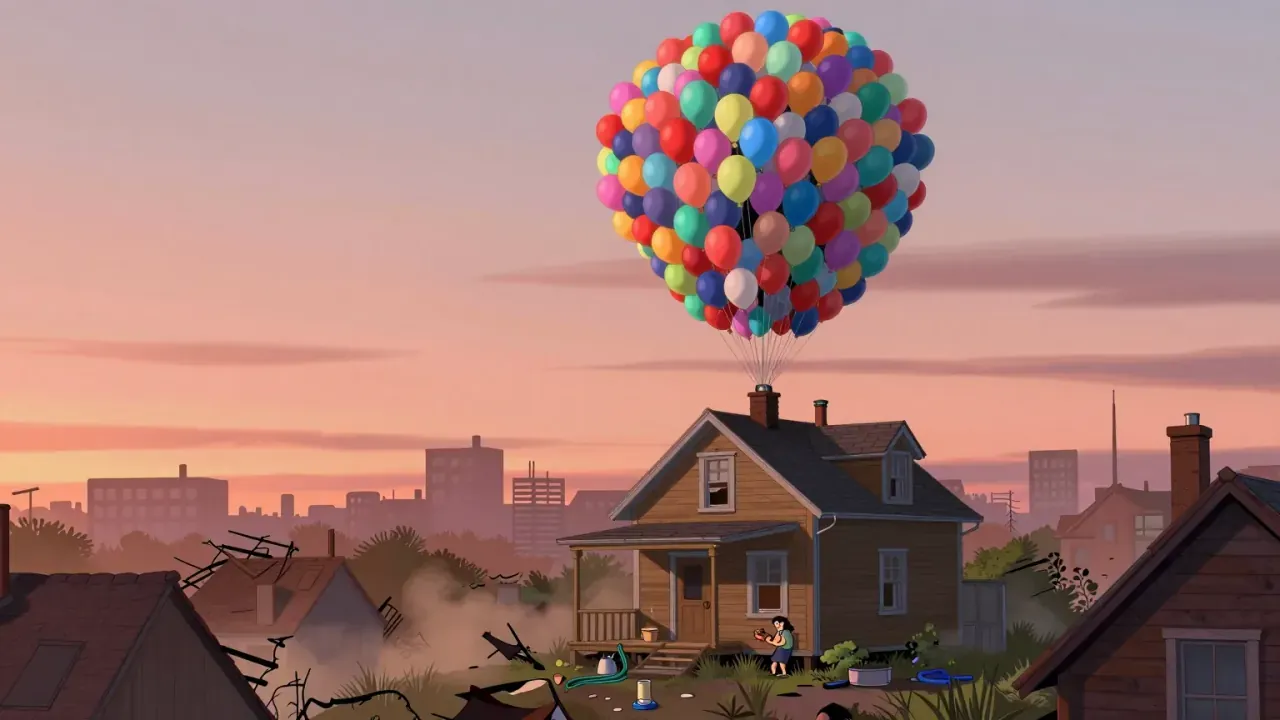
A marriage told in four minutes, without speeches
Up, directed by Pete Docter and released by Pixar in 2009, follows Carl Fredricksen, an elderly widower who ties thousands of helium balloons to his house and flies it to Venezuela to keep a promise he made decades earlier to his late wife Ellie. The premise began, by Docter’s own account, as a fantasy of escaping ordinary life when it becomes too irritating to bear, rooted in his own difficulty with social situations growing up, and the film never entirely lets go of that starting point even once the plot turns into something more conventionally adventurous with talking dogs and a villain from Carl’s youth.
A house that leaves the ground for a reason
The film’s most discussed sequence covers the whole of Carl and Ellie’s relationship, their marriage, their unfulfilled dream of visiting South America, and her eventual death, in roughly four minutes with almost no dialogue, scored by Michael Giacchino, establishing in near silence what most feature films would need a full act to build up to convincingly. Everything that follows, the flight, the talking dogs, the confrontation with Muntz, is staged against the fact that Carl is not really seeking adventure so much as trying to finish something he started decades earlier with a person who is no longer there to see it through.
An eight-year-old who was not supposed to be there
Russell, an eight-year-old Wilderness Explorer who stows away on Carl’s porch just before the house lifts off, was cast after director Pete Docter auditioned 400 boys and chose Jordan Nagai for how he behaved during the audition rather than for a polished rehearsed reading, and the character’s function in the story is blunt: he forces an isolated, grieving old man back into contact with someone else’s needs and chatter. The film does not pretend this adjustment is comfortable for Carl, and much of the middle stretch is built patiently around his visible reluctance to let Russell matter to him at all.
A childhood hero who curdled
Charles Muntz, Carl’s childhood explorer idol turned villain, was partly modelled on Howard Hughes, and functions less as a straightforward antagonist than as a mirror held up to Carl’s own possible future: Muntz’s decades of isolated obsession, spent chasing one rare bird across the wilderness to prove a scientific claim right, is exactly what Carl’s own grief could calcify into if nobody had interrupted it in time. The jungle-set action built around Muntz is more conventional than the film’s opening promised, and it is the one place the film’s larger ambitions dip closer to a standard adventure plot.
What the balloons are actually carrying
What Up is actually about is the difference between a promise kept out of love and a promise kept out of guilt, and whether an old man can eventually let go of a plan made with someone who has died without that letting go feeling like a second betrayal of her memory. The film resolves this without ever resorting to a neat closing speech, instead letting Carl’s own actions, what he chooses to keep and what he finally chooses to leave behind in the jungle, do the arguing on his behalf.
Who should watch it
This suits families prepared for an opening act that is genuinely, unflinchingly about death and grief rather than sanitised for easy comedy, and adults who have experienced real loss and will recognise Carl’s particular stubbornness as familiar rather than exaggerated for effect. Very young children expecting the lighter adventure-comedy the poster and marketing promise may find the emotional weight of the first fifteen minutes considerably heavier than they are prepared for going in. It is best watched with an adult present who can talk through the opening afterward if needed.
A short runtime carrying real weight
At 96 minutes, Up became only the second animated film ever to receive a Best Picture nomination at the Academy Awards, grossed $735 million worldwide against a $175 million production budget, and won Academy Awards for both Best Animated Feature and Best Original Score. It is a short film that does not waste any of its limited runtime pretending its central loss does not matter, and it holds up as one of the stronger arguments for taking animation seriously as a vehicle for adult storytelling, one that a family film rarely attempts this directly.