The look of it
Ministry of Fear is a wartime spy thriller adapted from Graham Greene’s 1943 novel, directed by Fritz Lang for Paramount Pictures in 1944. It attempts to translate Greene’s dense psychological guilt narrative into a streamlined American noir framework: a man newly released from a mental asylum stumbles into a Nazi espionage ring operating under the cover of a charitable organisation in Blitz-era London. The film leans into Lang’s visual command and the genre’s atmospheric conventions — shadowed interiors, sudden violence, paranoid pacing — rather than sustaining the novel’s moral ambiguity or interior torment. It substitutes Greene’s slow-burn reckoning with conscience for a more conventional pursuit plot, pivoting on stolen microfilm, coded messages, and a climactic rooftop confrontation. The adaptation tightens chronology, removes entire narrative layers (including the protagonist’s institutional amnesia and prolonged psychological unraveling), and reshapes character motivations to fit studio-era expectations of clarity and resolution. This is not a faithful transcription but a strategic reworking: Lang and screenwriter Seton I. Miller treat Greene’s material as source architecture, not scripture.
The shape of the story
The story moves briskly across 83 minutes, its structure built on escalating suspicion and narrow escapes. Ray Milland plays Stephen Neale with controlled fatigue — less haunted than watchful, his post-asylum disorientation rendered through physical restraint rather than overt instability. Marjorie Reynolds’ Carla Hilfe carries quiet tension, her loyalty ambiguous until the final act. Dan Duryea’s Cost is all slippery charm and abrupt menace, though his screen time is brief. Henry Sharp’s cinematography avoids expressionist distortion but sustains a low-key, rain-slicked realism: interiors are dim without being theatrical, street scenes are fogged but legible, and the Underground shelter sequence uses practical lighting to ground emotional revelation. Victor Young’s score underscores mood without melodrama; Archie Marshek’s editing maintains rhythm without flash. The craft serves function over flourish — no single shot lingers for symbolic weight, but the cumulative effect is one of persistent unease, anchored in tangible wartime textures: air raid sirens, ration books, blackout curtains, the weight of a cake wrapped in brown paper.
What sticks in the memory
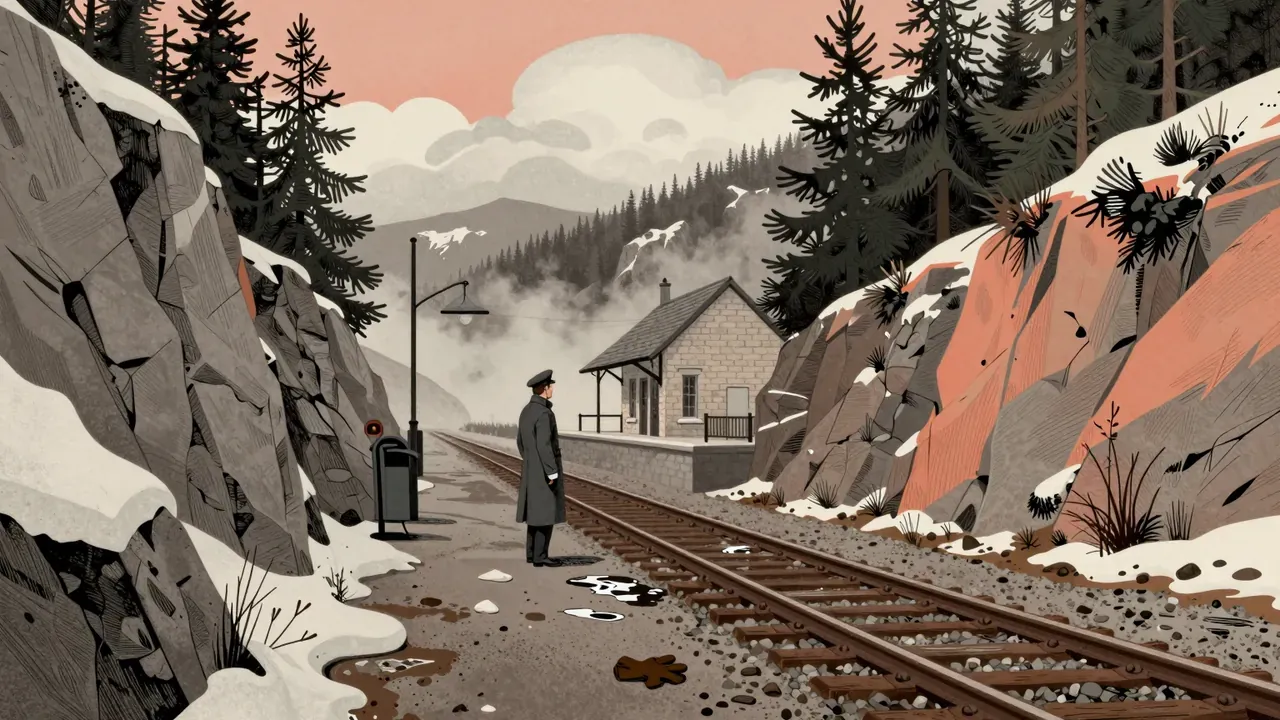
What lands most firmly is the film’s sense of place and period. The London of Ministry of Fear feels lived-in and pressured: not a backdrop but a participant, its infrastructure frayed by bombing, its institutions compromised by infiltration. The Mothers of Free Nations charity operates with bureaucratic plausibility — fundraising stalls, séances as social events, volunteers vetted through official channels. That banality makes the espionage more chilling. The train sequence, where Neale realises his blind companion is neither blind nor benign, works because it hinges on small, credible details: the crumbling cake, the pause before the air raid, the unblinking stare when the lights go out. Similarly, the bookstore bomb — delivered casually, almost bureaucratically — lands with grim efficiency. These moments succeed not through spectacle but through cause-and-effect logic and spatial coherence. The film trusts the audience to follow implication: a glance exchanged, a name repeated, a book title glimpsed on a shelf. Its best passages rely on what is withheld, not what is revealed.
Where the adaptation pulls back
What does not land is the emotional core of Greene’s novel — the suffocating, self-accusing guilt that drives the protagonist’s perception of reality. The film reduces Neale’s culpability to a procedural footnote: he procured poison at his wife’s request, she used it, he served time. This strips the character of his defining moral tremor. Without that inner pressure, his paranoia reads as situational rather than existential — reasonable caution, not psychological fracture. The supporting characters suffer from compression: Alan Napier’s Inspector Prentice has authority but no texture; Carl Esmond’s Dr. Forrester is a cipher of professional respectability, never given room to breathe as the novel’s insidious manipulator. The rooftop shootout, while kinetic, feels tonally dissonant — a Hollywood climax grafted onto a story whose power lies in quiet dread. The film’s resolution is clean, its villains neatly dispatched, its lovers unburdened — a structural choice that sacrifices resonance for closure.
What the film is really about
The themes that matter are surveillance, institutional trust, and the erosion of private conscience in total war. The film treats Britain’s wartime apparatus — the Ministry of Home Security, psychiatric oversight, charity regulation — not as protective but porous, easily co-opted by those who understand its language and procedures. Neale’s vulnerability stems not from madness but from having been inside systems designed to assess mental fitness and moral reliability: he knows how easily diagnosis becomes containment, how easily volunteerism masks subversion. The recurring motif of disguise — the blind man, the young medium posing as an old woman, the tailor posing as a businessman — reflects a world where identity is performative and verification impossible without deeper access. Fear here is not abstract but administrative: it lives in forms, signatures, referrals, and the quiet authority of men in suits who cite regulations while undermining them. The film’s lasting interest lies in this mapping of fear onto bureaucracy, not onto shadowy alleys or storm-lit castles.
Who it is for
This film is for viewers who value tightly constructed mid-century thrillers with restrained performances and a grounded sense of historical texture. It rewards attention to procedural detail, to how information circulates in closed systems, and to the visual grammar of studio-era noir. It is not for those seeking psychological depth comparable to Greene’s novel or Lang’s own M or Fury — its moral landscape is flatter, its character psychology less interrogated. Nor is it for viewers who require clear ideological stakes: the Nazis are present but thinly sketched, their motives functional rather than ideological. Those expecting the metaphysical dread of The Third Man or the formal audacity of Lang’s German films will find Ministry of Fear too pragmatic, too bound by its runtime and studio constraints. Its pleasures are modest but precise: a well-timed cut, a line of dialogue that lands because it is understated, a set whose wallpaper bears faint water damage from a recent raid.
Is it worth your evening
Yes, it is worth your evening — provided you approach it as a specific kind of artefact: a 1944 studio thriller shaped by wartime production limits, directorial pragmatism, and transatlantic adaptation pressures. Its 83 minutes pass without drag, its suspense is earned through cause-and-effect plotting rather than contrivance, and its vision of London remains tactile and persuasive. It would not hold up for someone seeking profound moral inquiry or stylistic innovation — those looking for either would point to Lang’s earlier work or Greene’s prose. But for those interested in how genre frameworks absorb literary material, or how American studios interpreted British wartime anxiety, it delivers consistent, unsensational craft. Its value lies in its competence, its period authenticity, and its quiet insistence that danger wears a cardigan and quotes Home Office guidelines.