A film made to order
Henry V is a British wartime film adaptation of Shakespeare’s history play, made in 1944 under explicit instruction from Winston Churchill to serve as morale-boosting propaganda for British troops during the final phase of the Second World War. It is not a neutral or scholarly interpretation but a deliberate act of national mythmaking: it recasts Henry’s conquest of France as an ancestral parallel to the Allied campaign then unfolding in Normandy and northern France. The film opens with a handbill descending over a miniature London — a gesture that anchors the story not in Elizabethan theatre or historical record, but in a constructed continuity between Tudor England and mid-twentieth-century Britain. Its dedication to Commandos and Airborne Troops makes its purpose unambiguous. Olivier’s direction, writing and performance all subordinate fidelity to Shakespeare’s text to this civic aim: the script omits Henry’s most morally ambiguous acts — the execution of traitors, the threat to sack Harfleur, the slaughter of prisoners at Agincourt — and replaces them with heightened pageantry, choral unity and visual grandeur. This is not Shakespeare adapted for cinema; it is Shakespeare repurposed for statecraft. (158 words)
The look of it
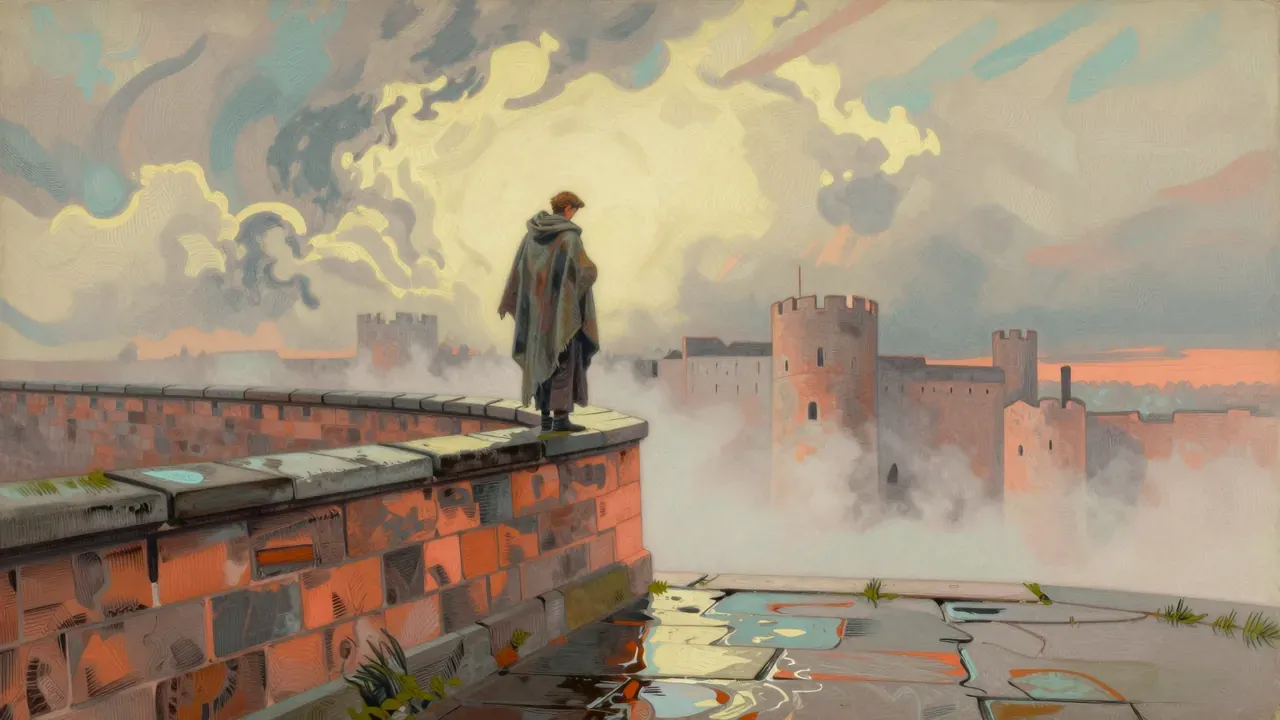
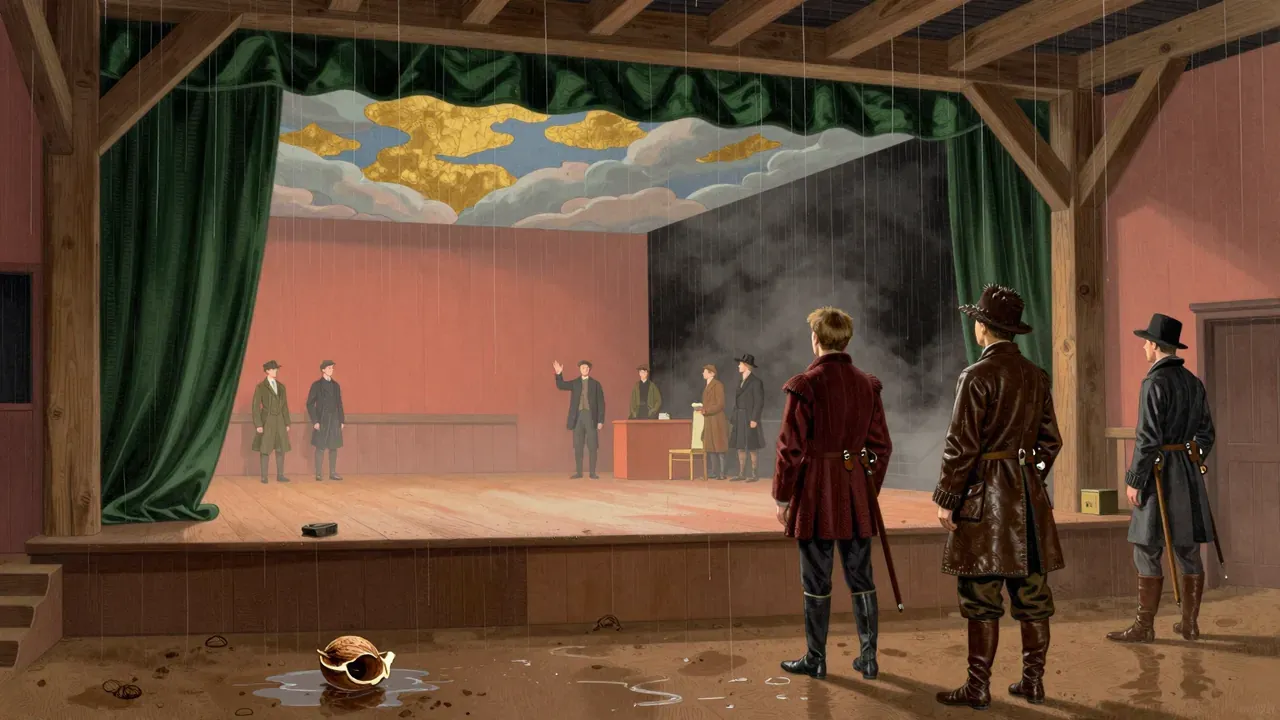
The film moves through three distinct visual registers: the stylised, painterly world of the Très Riches Heures — used for court scenes and diplomatic negotiations — the vivid, rain-slicked immediacy of the Globe Theatre prologue, and the naturalistic, mist-draped fields of Ireland where Agincourt is staged. Jack Hildyard and Robert Krasker shoot in three-strip Technicolor, the only such camera available in the UK at the time, lending saturated reds and golds to costumes and sets while keeping shadows deep and textures legible. Reginald Beck’s editing sustains rhythm without haste: long takes anchor speeches, and transitions — like the dissolve from miniature London to the Globe flag — are precise, ceremonial. Olivier’s performance avoids psychological interiority; instead, he projects authority through posture, diction and stillness, especially in the St Crispin’s Day speech, delivered not to soldiers but to the camera. Supporting actors work within this register: Robert Newton’s Pistol is broad but never cartoonish; Esmond Knight’s Fluellen carries the quiet weight of a recently blinded naval veteran; Renée Asherson’s Katherine is courteous, watchful, never coquettish. William Walton’s score swells with brass and choir, but never overwhelms dialogue. (159 words)
What holds
What lands most firmly is the film’s sense of collective occasion — the feeling that history is being enacted, not observed. The opening sequence, moving from aerial model to Globe stage to painted French court, establishes a layered reality where artifice serves conviction rather than irony. The Agincourt battle, shot on the Powerscourt Estate in County Wicklow, gains force from its restraint: no sweeping crane shots, no frantic cutting — just muddy ground, close-ups of faces under helmets, horses shifting uneasily, and Henry speaking from horseback in near-darkness. The decision to cast real war veterans — Knight, Leo Genn — lends authenticity that no costume or set can replicate. The use of the Très Riches Heures as design source is neither pastiche nor homage but functional: its calendar miniatures become narrative devices, their seasonal logic clarifying Burgundy’s lament for a ruined France. Even the ending — returning to the miniature Tower of London as credits roll — closes the circle not with nostalgia but with continuity: the same city, different century, same sovereign duty. These choices cohere because they serve a single, unambiguous intention: to make history feel present, shared, and binding. (157 words)
What slips
What does not land is the attempt to reconcile Shakespeare’s moral complexity with wartime simplification. Henry’s omissions — the Southampton Plot executions, the Harfleur ultimatum, the killing of prisoners — leave his character flattened into pure archetype: noble, resolute, divinely sanctioned. The added deathbed scene for Falstaff, voiced by Olivier but unseen, feels tacked on, a concession to pathos that lacks dramatic integration. The Globe framing device, though visually rich, becomes tonally inconsistent: the hecklers and rain shower suggest theatrical imperfection, yet the rest of the film insists on seamless, elevated spectacle. Some performances suffer from this tension — Robert Helpmann’s Dauphin is so archly contemptuous he borders on caricature, and Frederick Cooper’s Exeter, though dignified, never escapes the stiffness of formal address. The film’s colour palette, while sumptuous, occasionally overwhelms spatial clarity: interiors at Denham Studios are so densely decorated that depth cues blur. Most tellingly, the Chorus’s function — to beg the audience’s imagination — is undermined by the very abundance of visual invention: when everything is rendered, little is left to the mind. The film’s confidence in its own imagery becomes, at times, its limitation. (156 words)
What it thinks about
The themes that matter are sovereignty as stewardship, language as instrument of unity, and history as inheritance rather than archive. Henry’s kingship is defined not by birthright alone but by his willingness to move among his men, to speak plainly before Agincourt, to absorb their fear and convert it into resolve. His English is deliberately plain in those moments — a contrast to the ornate French of the court scenes — making language itself a site of political action. The film treats translation not as barrier but bridge: Katherine’s halting English, Henry’s patient repetition, their shared laughter over body parts — these are not romantic interludes but acts of statecraft, rehearsing the linguistic fusion required for the Treaty of Troyes. The recurring motif of miniature and painting — the London model, the Très Riches Heures, the snow-blanketed château — suggests that national identity is not discovered but assembled: from fragments, pigments, memory, and will. There is no ‘real’ past here, only a usable one — shaped, coloured, and passed on. This is not escapism; it is pedagogy disguised as pageantry. The film’s enduring power lies in how seriously it takes the idea that stories — especially old ones — are tools for holding societies together in crisis. (159 words)
Who it is for
This film is for viewers who accept that historical adaptation is always an act of selection, not replication — for those who value craft over realism, ceremony over psychology, and whose interest in Shakespeare begins with how his texts travel across time rather than how faithfully they are preserved. It rewards attention to costume, colour grading, and the physical presence of actors trained in classical voice and movement. It is not for viewers who require moral ambiguity, psychological realism, or narrative irony — those who find Henry’s omissions ethically troubling or the wartime framing too heavy-handed will likely resist its tone. Nor is it for those allergic to formal address, verse-speaking, or extended monologue: there are no shortcuts here. A viewer expecting the kinetic pacing of modern war films or the intimate character study of later Shakespeare adaptations will find its rhythms stately, even austere. That said, its accessibility is higher than often assumed: the clarity of diction, the strength of visual storytelling, and Walton’s score all serve as entry points. To dismiss it as ‘dated’ is to mistake its discipline for its age. (159 words)
Is it worth your evening?
Yes, it is worth your evening — not as a casual watch, but as an encounter with a singular cultural artefact: a film made under wartime constraint that chose grandeur over grit, unity over division, and beauty over verisimilitude. Its 143 minutes unfold with unhurried authority, each frame calibrated to sustain belief in its own world. You do not need to know Shakespeare’s play to follow its arc, nor to feel the weight of its closing image — the Tower, gleaming white, then fading — as both monument and promise. Those who prefer fragmented narratives, handheld camerawork or naturalistic dialogue may find it remote, but remoteness is part of its design: it asks you to step into a different register of attention. Its restoration to HD has sharpened, not softened, its impact — the textures of wool, paint, and wet grass now more legible. It remains vital not because it is ‘timeless’, but because it shows how urgently a society can remake its past to meet its present. To watch it is to witness form and function fused without compromise. (158 words)