The shape of it
The 39 Steps is a British spy thriller made in 1935, produced by Gaumont-British as a prestige export vehicle for the UK film industry. It adapts John Buchan’s 1915 novel only loosely — discarding its imperial adventure framework and reworking it into a tightly wound chase narrative about mistaken identity, espionage, and evasion. Hitchcock and his writers refocused the story on Richard Hannay, a Canadian civilian in London who stumbles into a conspiracy after a spy’s death, then flees northward under false accusation. The film aims to sustain suspense through pace, misdirection, and physical peril rather than exposition or moral ambiguity. Its structure follows a clear trajectory: inciting incident at a music hall, flight across England and Scotland, confrontation with the spy ring, and resolution at a public venue. It does not seek psychological depth or historical fidelity but operates as a calibrated machine of mounting tension, built for audience engagement across national markets — particularly the US, where its stars had prior recognition and its rhythms aligned with emerging Hollywood thriller conventions. Word count: 148
The pace of it
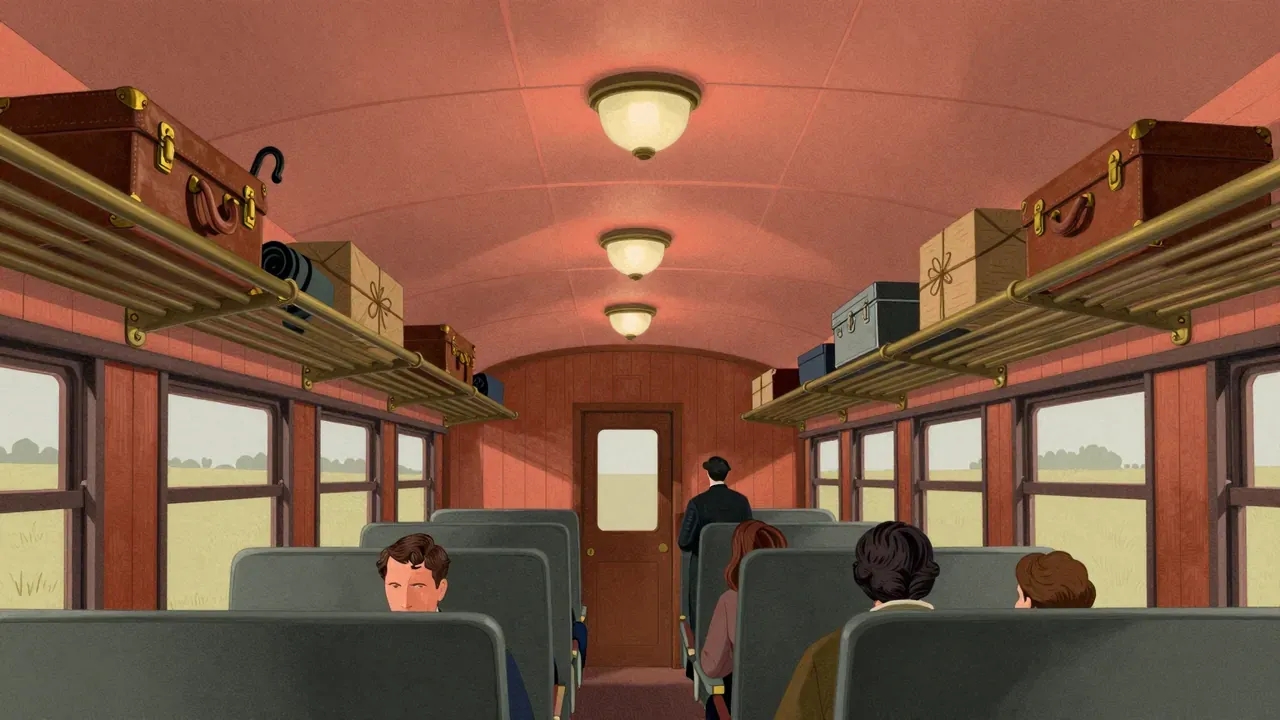
Bernard Knowles’ cinematography keeps interiors dim and exteriors crisp, using deep focus and careful framing to maintain spatial clarity during chases and crowd scenes. Derek Twist’s editing sustains momentum without resorting to rapid cutting; transitions are often motivated by movement — a bus pulling away, a train pulling in, a door closing. Charles Williams’ score underlines action but avoids melodrama, favouring rhythmic propulsion over thematic repetition. Robert Donat gives Hannay wit and physical plausibility: he stumbles, sweats, improvises. Madeleine Carroll’s Pamela begins resistant and ends reluctantly complicit, her frostiness undercut by small shifts in posture and glance rather than speech. Lucie Mannheim’s Annabella is brief but vital — a catalyst whose urgency sets the plot in motion. Hitchcock’s direction privileges geography: King’s Cross, the Forth Bridge, a Scottish moor, a crofter’s cottage — each location is legible, consequential, and used to tighten the noose around Hannay. The script, credited to Bennett, Reville, Beith and Buchan, tightens the novel’s episodic sprawl into cause-and-effect sequences, even where coincidence remains — such as the hymn book stopping the bullet. Word count: 156
The look of it
What lands most firmly is the rhythm of pursuit: the way Hannay’s flight feels both urgent and plausible, grounded in real places and real transport — buses, trains, roads, bridges. The Forth Bridge sequence works not because it is spectacular, but because it is precarious and specific: narrow girders, wind, vertigo, and a man clinging to ironwork while being hunted. The chemistry between Donat and Carroll builds through friction — their handcuffed walk across the moor is sustained by mutual irritation, not romance — and gains weight from its refusal to soften. Mr. Memory’s music-hall act lands because it is rooted in period authenticity and functions as both spectacle and plot pivot. Hitchcock’s cameo — walking past the bus — is unobtrusive but anchors the film in a tangible London geography, reinforcing the sense that this world exists beyond the frame. Even the fake death — Hannay slumping after the gunshot — lands because it is abrupt, visually unambiguous, and followed by a quiet, physical reveal: the bulge of the hymn book in his coat. These moments succeed because they trust the audience to follow logic, not exposition. Word count: 152
The gaps in it
What does not land is the spy ring itself: its members lack distinction, its motives remain vague, and its name — ‘The 39 Steps’ — is never explained beyond a passing reference to a clandestine organisation. The MacGuffin — the silent aeroplane engine — serves its function but carries no weight; it is abstract, technical, and emotionally inert. Some supporting performances verge on caricature: Godfrey Tearle’s Professor Jordan is theatrically sinister without nuance, and Jerry Verno’s comic relief as the crofter’s brother feels tonally dissonant against the film’s prevailing restraint. The Scottish accents are inconsistently rendered, and the rural settings occasionally slip into pastoral cliché — the crofter’s cottage scene leans on visual shorthand rather than lived detail. The film’s reliance on coincidence — the map with Alt-na-Shellach circled, the chance encounter with Pamela on the train — strains credulity more now than it likely did in 1935, when audiences accepted such devices as genre convention. None of this derails the film, but it leaves gaps where character or motive might have deepened the stakes. Word count: 150
The weight of it
The themes that matter are innocence under pressure, the fragility of reputation, and the mechanics of belief — how quickly a stranger can be cast as guilty, and how little evidence is needed to sustain suspicion. The film treats identity as provisional: Hannay assumes roles — fugitive, lover, prisoner — not out of deception but necessity, and each shift is marked by costume, posture, or setting. Class surfaces obliquely: the music hall is working-class entertainment; the ballroom is elite; the crofter’s cottage sits outside both, a space of temporary refuge and moral ambiguity. There is no overt politics, but the presence of foreign spies and military secrets reflects interwar anxieties about vulnerability and surveillance — not of citizens by the state, but of the state by unseen actors. The film also explores the limits of individual agency: Hannay acts decisively, yet much of his progress depends on others’ choices — Annabella’s warning, the crofter’s silence, Pamela’s eventual cooperation. It is a thriller about being swept up, not about mastery. Word count: 149
The audience for it
This film is for viewers who value narrative economy, physical storytelling, and the craft of classical studio filmmaking — those comfortable with 1930s pacing and willing to meet the film on its own terms of suspense rather than shock. It suits fans of Hitchcock’s later work who want to see the foundations of his techniques: the MacGuffin, the innocent man on the run, the public-space climax. It is less suited to viewers who require psychological realism, thematic explicitness, or contemporary notions of character development. Those expecting the novel’s imperial scope or its protagonist’s introspective voice will find this version too streamlined. Anyone put off by stiff upper lips, formal dialogue, or the absence of modern scoring or editing rhythms may struggle to settle in. A viewer who values historical context over immersion — say, a film student tracing the evolution of the thriller — might engage differently than someone seeking pure diversion. Word count: 147
The time for it
Yes, it is worth your evening — not as a flawless artefact, but as a precisely engineered piece of popular cinema that still moves with purpose and intelligence. Its 86 minutes pass without slack, its set pieces remain tactile and tense, and its central performance retains charm and grit. It rewards attention to composition, timing, and spatial logic — pleasures that deepen on repeat viewings. Those who find pre-war British films mannered or distant may disagree, but the objection would stem from expectation, not failure: this film makes no claim to naturalism or interiority. What would change the verdict? A longer runtime would dilute it; a modern remake would lose its period-specific textures — the bus routes, the music-hall acoustics, the railway timetables. Its value lies in its compactness, its confidence, and its place in a lineage — not as a relic, but as a working model. Word count: 149