The world it lives in
Strange Days is a science fiction thriller set in Los Angeles on the last two days of 1999, built around a speculative technology — SQUID recordings — that lets users relive another person’s sensory and emotional experience. It attempts to fuse film noir structure with near-future dystopia, using the device not as spectacle but as moral probe: what happens when empathy becomes consumable, editable, and weaponisable? The film positions itself at the intersection of surveillance culture and embodied memory, drawing direct lines from the Rodney King beating and the 1992 riots into its visual grammar and character motivations. Its ambition is structural and political: to render systemic violence through subjective sensation, to make voyeurism tactile, and to treat the millennium’s end not as celebration but as rupture — a moment when power, race, gender and perception all recalibrate under pressure. It does not aim for plausibility in its tech but for fidelity in its consequences: every recorded memory has weight, consequence, and asymmetry.
The look of it
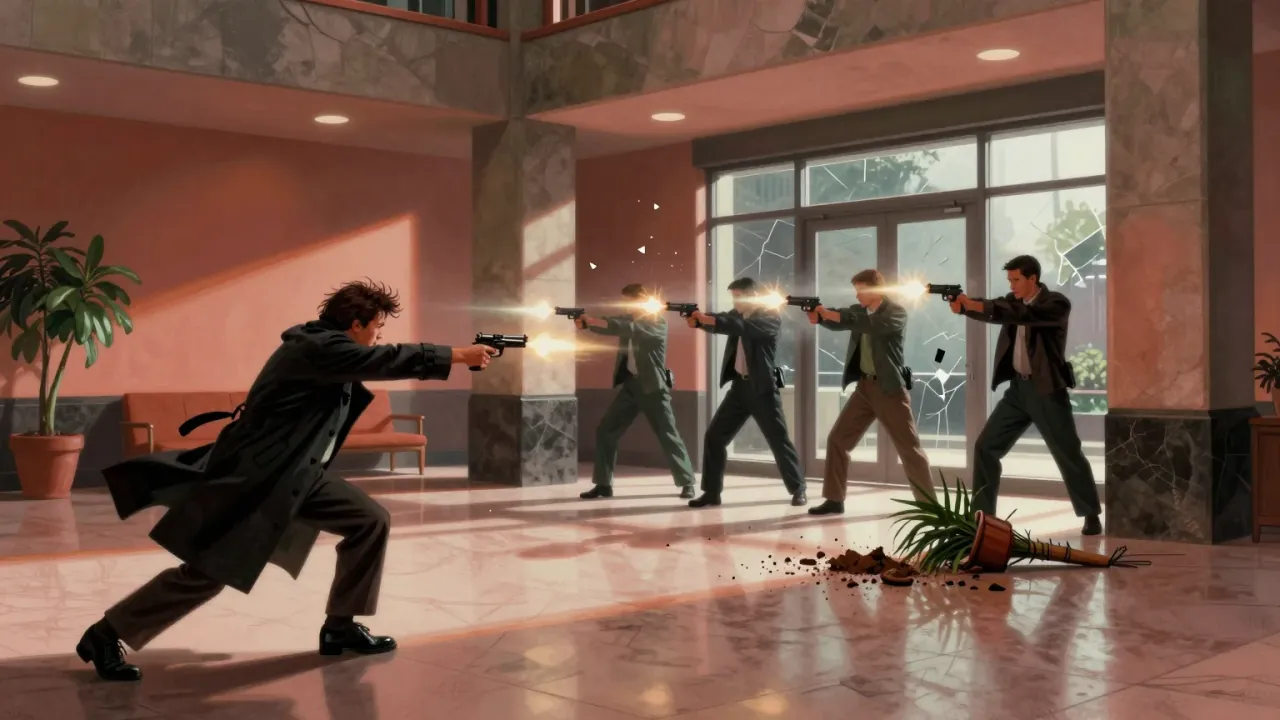
The story follows Lenny Nero, a disgraced ex-cop turned black-market SQUID dealer, who becomes entangled in a conspiracy after receiving a recording implicating powerful figures in the death of a sex worker. Angela Bassett’s Mace Mason — a pragmatic, grounded limousine driver and bodyguard — anchors the film’s moral centre, her presence countering Lenny’s spiralling detachment. Ralph Fiennes plays Lenny with coiled restraint, avoiding melodrama even in collapse; Juliette Lewis’s Faith is brittle and volatile, never reduced to victim or ornament. Matthew F. Leonetti’s cinematography favours tight frames, low angles, and deliberate motion — the camera often feels like an uninvited guest, especially in the SQUID sequences, where multi-camera rigs simulate first-person disorientation without digital smoothing. Graeme Revell’s score blends industrial textures with ambient strings and Lori Carson’s vocal motif, reinforcing unease over exposition. Editing avoids flash-cutting; transitions are weighted, sometimes jarringly so — as in the opening rooftop jump, which stitches helmet cam, Steadicam and hidden cuts into a single breathless take.
The weight of the performances
What lands is the texture of late-1990s Los Angeles as lived space: the grime of alleyways, the glare of neon on wet asphalt, the claustrophobia of cramped apartments and surveillance-laced nightclubs. The SQUID sequences succeed not as novelty but as narrative pivot — each playback alters the viewer’s relationship to truth, shifting perspective without clarifying motive. Bassett’s performance lands with cumulative force: her physicality, her refusal to be sidelined, her quiet command in scenes where others shout or posture. The film’s pacing, though deliberate, sustains tension across its 139 minutes by tying plot turns to emotional stakes — not just who did what, but who remembers it, how, and at what cost. The final sequence — a crowd celebrating midnight at Fifth and Flower — lands with irony and exhaustion rather than release, its scale undercut by the characters’ isolation within it. The production design avoids sleek futurism; instead, it layers analog decay over digital promise, making the world feel worn-in, contested, and real.
Where the edges cut too clean
What does not land is the film’s handling of sexual violence as plot catalyst. The rape sequence involving Iris is rendered with clinical precision but lacks sufficient interiority or aftermath for the survivor; it functions more as evidence than experience, and its resolution feels narratively expedient rather than ethically engaged. The character of Philo Gant, played by Michael Wincott, remains underwritten — his menace is stylised but unmoored from motive or history. Some supporting roles — particularly Vincent D’Onofrio’s corrupt cop — verge on caricature, their dialogue leaning on noir shorthand rather than lived contradiction. The budgetary strain shows in inconsistent sound design: certain SQUID playback moments lack the visceral weight promised by their setup, while ambient city noise sometimes flattens rather than deepens immersion. The film’s political urgency occasionally hardens into didacticism, especially in monologues about media complicity, where subtext gives way to summary. These are not failures of intent, but of execution — moments where thematic clarity overrides dramatic necessity.
What it says about watching
The themes that matter are surveillance as intimacy, memory as property, and the racialised geography of fear. Los Angeles is not backdrop but participant: its fault lines — economic, spatial, institutional — shape every decision Lenny and Mace make. The SQUID device literalises the act of looking, but the film insists that looking is never neutral: it is mediated by access, privilege, and consequence. Racism operates structurally — in police deployment, in who gets believed, in whose trauma is archived and whose is erased. Voyeurism is framed not as individual failing but as infrastructure: news feeds, security cameras, and black-market recordings all feed the same economy of attention. The film treats rape not as aberration but as extension of that economy — a violent assertion of control over another’s sensorium. Its millennial setting is less about prophecy than about compression: everything that has been deferred — justice, accountability, repair — is due at midnight. That deadline doesn’t bring resolution. It brings reckoning without remedy.
Who it speaks to
This film is for viewers who value atmosphere over exposition, who trust slow-burn moral ambiguity, and who can sit with discomfort without demanding catharsis. It suits those familiar with 1990s LA history, or willing to engage it as context rather than colour. It is not for viewers who require clear heroes or linear cause-and-effect, nor for those unsettled by extended depictions of non-consensual violence whose narrative function outweighs its psychological rendering. Anyone put off by long takes, muted performances, or sound design that prioritises texture over clarity may find it alienating. Those expecting a conventional sci-fi action film — given the rooftop jump or the train sequence — will misread its tempo and tone. A viewer who values thematic rigour over narrative neatness will find it rewarding; one who judges films by plot efficiency alone will not. Its cult status rests on this divide — not on obscurity, but on insistence.
Why it stays with you
Yes, it is worth your evening — provided you watch it as a period artefact with present-day resonance, not as escapism. Its 139 minutes unfold with deliberation, but never waste time: every scene accrues weight in relation to the central question — what does it cost to know someone else’s truth? The film’s commercial failure and critical polarisation upon release do not diminish its coherence or craft; if anything, they underscore its unwillingness to compromise on tone or implication. Those who dismiss it as dated miss how precisely its anxieties — about algorithmic intimacy, performative outrage, and the monetisation of trauma — prefigure current conditions. It demands patience, but repays it with sustained mood, disciplined acting, and a vision of the future that feels less invented than excavated. To call it ‘ahead of its time’ mistakes its purpose: it was of its time, and remains of ours.