The world it builds
House of Flying Daggers is a wuxia fantasy set in ninth-century Tang China, built not as historical drama but as a choreographed spectacle of movement, colour and moral ambiguity. Zhang Yimou directs it as a formal exercise in sensory orchestration: every frame calibrated for tonal contrast, every fight sequence designed as rhythmic punctuation rather than narrative necessity. It attempts no realism — not in physics, chronology or psychology — but instead commits fully to a heightened, almost pictorial logic where snow falls indoors, bamboo bends like silk, and emotion registers in the tilt of a head or the pause before a thrown bean. The script’s nominal plot — two officers infiltrating a rebel group via a blind dancer — serves less as story than as scaffolding for set pieces: the Echo Game, the snowfield ambush, the bamboo forest duel. Its ambition lies in sustaining that register across 119 minutes without collapsing into self-parody or visual fatigue. It is not trying to convince, but to envelop; not to explain, but to imprint.
The look of it
The film works through disciplined craft rather than psychological depth. Zhao Xiaoding’s cinematography treats light as a physical substance: snow reflects off white robes like ground glass, lanterns bleed amber into indigo night, and the birch forest glows with a cool, even luminescence. Zhang Ziyi’s Mei moves with tactile precision — her blindness rendered not through mannerism but through weight distribution, breath control and the way her hands map space before her feet do. Andy Lau’s Liu and Takeshi Kaneshiro’s Jin are deliberately underwritten, their rivalry expressed in posture and timing rather than dialogue. Shigeru Umebayashi’s score avoids leitmotif in favour of recurring timbral textures — shakuhachi breath, koto pluck, distant drum — that rise and recede like weather. Editing (Long Cheng) favours long takes punctuated by sudden, percussive cuts: a sword draw held for three seconds, then a whip-pan to a falling leaf. Even the snow — filmed in Ukraine’s Hutsul Region during early snowfall — becomes a compositional element, its irregularity absorbed into the film’s deliberate imperfection.
What holds the eye
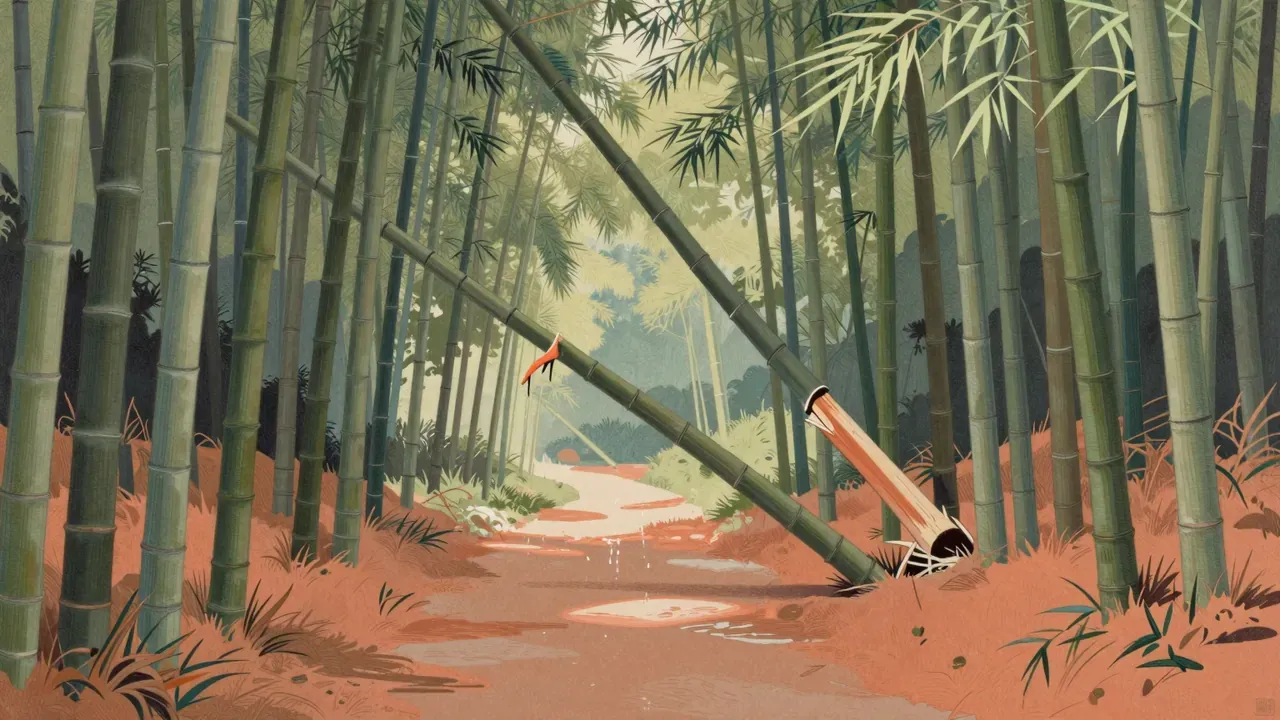
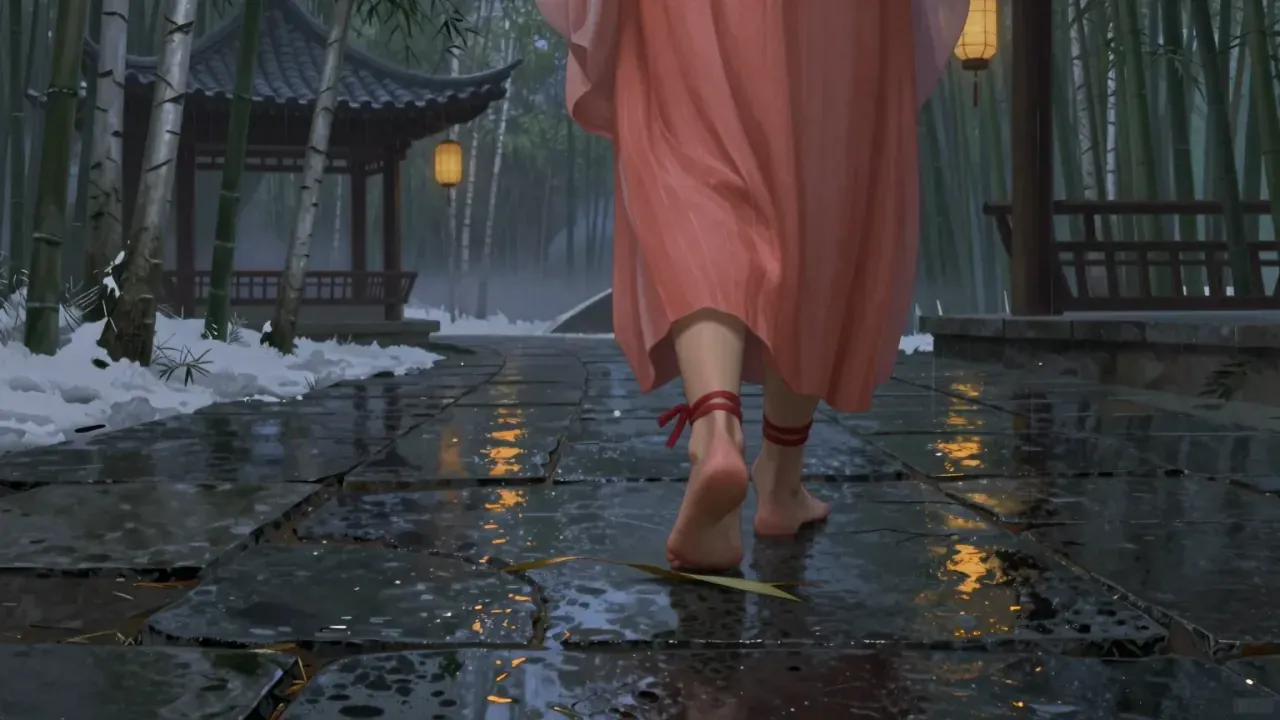
What lands is the film’s unwavering commitment to its own grammar. The Echo Game sequence — Mei identifying hidden officers by sound alone — succeeds because it trusts silence as much as motion, turning acoustics into narrative engine. The bamboo forest fight does not rely on speed but on vertical rhythm: bodies suspended, then released, then caught again in gravity’s delay. Zhang Ziyi’s physical performance anchors the film not through exposition but through continuity of gesture — the way she adjusts her sleeve before drawing a blade, or how her bare feet grip wet stone. Zhao Xiaoding’s use of saturated primaries against monochrome backdrops — crimson sashes against grey snow, jade robes against ash-birch trunks — creates a visual syntax legible without translation. Even the film’s structural repetitions — the return to the same courtyard, the re-use of the same musical phrase — feel intentional, not economical. These are not flourishes added to story; they are the story’s operating system.
Where it slips
What does not land is the emotional architecture beneath the surface. The love triangle between Mei, Liu and Jin lacks psychological traction because none of the three is permitted interiority beyond what their stance conveys. Dialogue serves only to trigger action or confirm allegiance, never to reveal contradiction or doubt. The political premise — rebels stealing from the rich in a decaying Tang dynasty — remains decorative, stripped of economic texture or ideological friction. The film’s irony about wuxing colour theory feels academic rather than felt: red signifies both passion and danger, green both growth and deception, but these associations never complicate character choice or shift audience alignment. When Mei chooses between loyalty and love, the decision arrives without antecedent — not because it is mysterious, but because the film has withheld the conditions for understanding it. The result is not ambiguity but vacancy: a beautiful vessel with no liquid inside.
What it’s really about
The themes that matter are discipline as devotion, perception as limitation and artifice as truth. Mei’s blindness is not a disability to be overcome but a mode of attention — one that privileges echo over image, texture over outline, duration over instant. The film’s repeated emphasis on training — the dancers’ rehearsals, the officers’ drills, the rebels’ weapon-handling — frames skill not as talent but as accumulated time. Colour functions thematically too: the palette shifts with location and allegiance, but never with character development — suggesting that identity here is assigned, not earned. The snow, the bamboo, the fog — all are natural phenomena made artificial through framing and timing, reinforcing the idea that authenticity resides not in fidelity to reality but in consistency of form. Even the film’s dedication to Anita Mui, who withdrew before shooting, becomes thematic: absence as presence, loss as compositional principle. This is not a film about rebellion or romance, but about the cost and clarity of sustained focus.
Who it’s for
It is for viewers who value composition over causality, who watch films for the weight of a glance or the geometry of a leap, and who accept that emotional resonance can arrive through rhythm rather than revelation. It is not for those who require motivation before action, backstory before betrayal, or coherence between plot beats. A viewer expecting psychological realism or political nuance will find the film hollow; a viewer attuned to the grammar of movement — how a wrist turns before a strike, how breath suspends before a fall — will find it exacting. The film assumes patience with repetition, tolerance for elliptical cause, and pleasure in surfaces that refuse to yield metaphor. Those who dislike slow-motion, saturated colour or non-linear chronology should not begin here. Its pleasures are formal, not discursive — and its demands are aesthetic, not intellectual.
Whether it’s worth your time
Yes, it is worth your evening — provided you approach it as you would a dance performance or a textile exhibition: for the integrity of its making, not the urgency of its telling. Its 119 minutes pass without drag because every shot has been weighted, every transition calculated, every silence placed with intention. It rewards attention to detail — the pattern of frost on a sleeve, the tremor in a hand before it closes — not because these details advance plot, but because they constitute the film’s substance. Someone who values narrative propulsion over visual logic may find it inert; someone who watches for how light falls across skin or how fabric catches air will find it generous. The verdict does not change if the story were stronger — the film’s success lies elsewhere. What would change it is a different directorial priority: one that treated character as more than silhouette, or politics as more than backdrop.