The shape of it
Swing Time is a 1936 RKO musical built to showcase Fred Astaire and Ginger Rogers as dancers first, characters second. It does not aim to reinvent narrative structure or deepen psychological realism; instead, it constructs a slender scaffolding of plot — a gambler delaying his wedding to raise money, meeting a dance instructor, falling in love, miscommunicating, parting — solely to justify successive, self-contained choreographic set pieces. George Stevens directs with functional clarity, keeping the camera steady and the staging uncluttered so that movement remains legible. The film’s ambition lies in rhythmic invention, spatial precision, and tonal contrast between numbers: from the buoyant syncopation of ‘Pick Yourself Up’ to the slow, heavy grief of ‘Never Gonna Dance’. It treats song and dance not as emotional exposition but as autonomous formal achievements — each routine a discrete argument about timing, weight, partnership, and swing. Jerome Kern’s score, written expressly for the film, supplies thematic cohesion without narrative obligation. The project is neither satire nor social commentary; it is craft elevated to ritual.
The look of it
The story follows Lucky Garnett’s flimsy moral crisis — he must earn $25,000 before his wedding or forfeit his fiancée — but the script by Howard Lindsay and Allan Scott never develops this into sustained tension. Victor Moore and Eric Blore provide dependable comic relief, yet their roles are underwritten and episodic. Astaire and Rogers carry the film not through dialogue but through physical intelligence: her grounded articulation of rhythm, his airborne lightness and uncanny control of momentum. David Abel’s cinematography avoids flourish — low-contrast lighting, shallow depth of field, minimal camera movement — ensuring focus stays on feet, hands, and the space between bodies. Editing by Henry Berman respects duration: long takes dominate, especially in the dance sequences, allowing phrases to breathe. Hermes Pan’s choreography integrates character gesture into step — a shrug becomes a pivot, a glance triggers a turn. The blackface sequence ‘Bojangles of Harlem’ is staged with technical ingenuity but rests on a premise the film neither interrogates nor contextualises, making its presence a dissonant artefact rather than an integrated element.
The sound of it
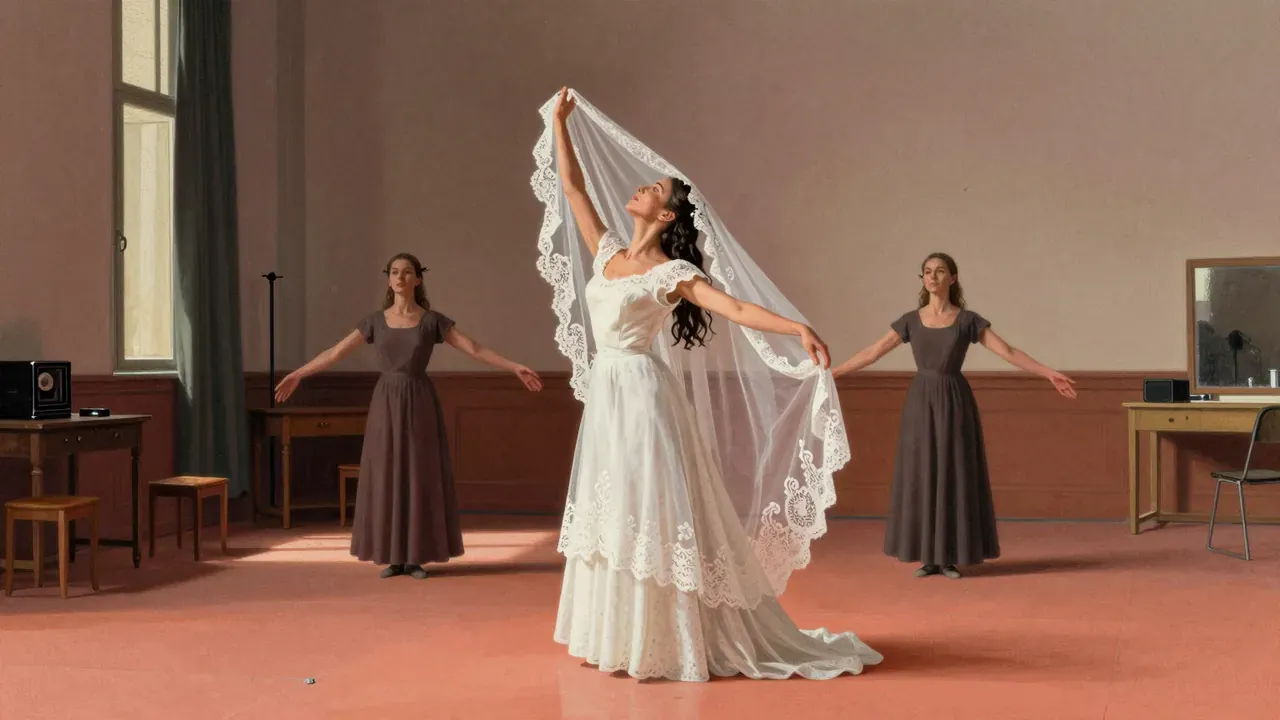
What lands most decisively is the architecture of the dance itself: the way ‘Waltz in Swing Time’ overlays triple metre with syncopated tap, turning elegance into something restless and tender; how ‘The Way You Look Tonight’ uses domestic banality — a woman washing her hair offscreen — to frame romantic intimacy without sentimentality; how ‘Never Gonna Dance’ builds its emotional arc not through words but through tempo shifts, spatial separation, and the gradual collapse of posture. Rogers’s performance is consistently richer than Astaire’s in its emotional specificity — her exasperation, hesitation, and quiet resolve register even when she is silent. The score holds up as music independent of image: Kern’s melodies have harmonic gravity, Dorothy Fields’s lyrics balance wit and ache. Stevens’s direction gives the ensemble breathing room — no frantic cutting, no competing visual noise — so that a single sustained shot of Rogers leaning into Astaire’s shoulder during the waltz carries more weight than ten pages of exposition. The film’s formal confidence makes its contrivances feel like necessary concessions, not failures.
The weight of it
What does not land is the dramatic spine. Lucky’s motivation evaporates after the first twenty minutes, and his moral stakes — breaking a promise, deceiving his fiancée — are never tested beyond superficial embarrassment. Betty Furness’s character exists only to be jilted, and her brief appearances lack dimension or consequence. Georges Metaxa’s performance as the nightclub owner is stiff and unconvincing, failing to anchor the central conflict. The screenplay’s reliance on coincidence — mistaken identities, last-minute reprieves, arbitrary deadlines — feels less like playful convention and more like structural laziness. The blackface number, however technically accomplished, cannot be separated from its historical weight: it offers no critique, no irony, no framing device — just Astaire dancing in makeup while mimicking caricatured gestures. The film’s refusal to acknowledge this dissonance undermines its otherwise rigorous self-awareness. Later scenes suffer from pacing drift: the freight yard interlude and several comic asides run longer than their function warrants, exposing the thinness of the through-line.
The touch of it
The themes that matter are discipline, reciprocity, and the poignancy of impermanence. Dance here is not escapism but labour — Astaire spent eight weeks rehearsing, and every routine bears the imprint of that effort. Partnership is treated as a physical contract: trust is measured in split-second weight transfers, not declarations. The film repeatedly contrasts surface polish with underlying fragility — the gleaming tap shoes versus the worn floorboards, the flawless smile during ‘A Fine Romance’ versus the exhaustion in Rogers’s eyes moments later. Nostalgia is not sentimental but structural: ‘Waltz in Swing Time’ quotes ‘The Way You Look Tonight’, and ‘Never Gonna Dance’ reprises both that melody and the choreographic vocabulary of earlier routines, turning memory into choreographic grammar. Class is present but flattened — the New York setting registers as backdrop, not context; wealth is assumed, poverty ignored. What endures is the idea that beauty emerges not from stability but from the precise management of instability — in rhythm, in balance, in feeling.
The audience for it
This film is for viewers who value choreographic literacy over narrative immersion — those who watch dance not for what it says but for how it thinks in time and space. It rewards attention to footwork, phrasing, and the subtle negotiation of proximity between two bodies. It is not for those who require psychological plausibility, socially grounded conflict, or ethical coherence in their musicals. Anyone unsettled by blackface — and anyone who believes its inclusion demands explicit reckoning, not omission — will find the film’s silence on the subject a material flaw, not a period detail. A viewer expecting satire or social observation will leave disappointed; the film’s world has no economic pressure, no political texture, no moral ambiguity beyond whether a man should keep a promise. Those who approach it as a masterclass in swing-era musical construction, however, will find its rigour uncompromising. Its pleasures are formal, not discursive — and that is its design, not its limitation.
The time for it
Yes, it is worth your evening — provided you watch it as a series of choreographic propositions rather than a story with songs. Its ninety-minute runtime moves with purpose once the opening exposition clears, and its four major dance sequences occupy nearly forty minutes of screen time, each distinct in rhythm, tone, and technical demand. To skip it is to miss the clearest distillation of Astaire and Rogers’s collaborative logic: how romance is built in counterpoint, how grief can be danced in triple time, how joy requires exact timing. It is not for viewers who need narrative propulsion or moral resolution — but then, few musicals of its era were. Those who dismiss it as dated or hollow misunderstand its terms: it is not trying to be timeless, only exact. Its endurance comes not from universality but from the sheer density of its craft decisions — each one visible, repeatable, arguable. That density repays close attention, even eighty-eight years on.