What the album became
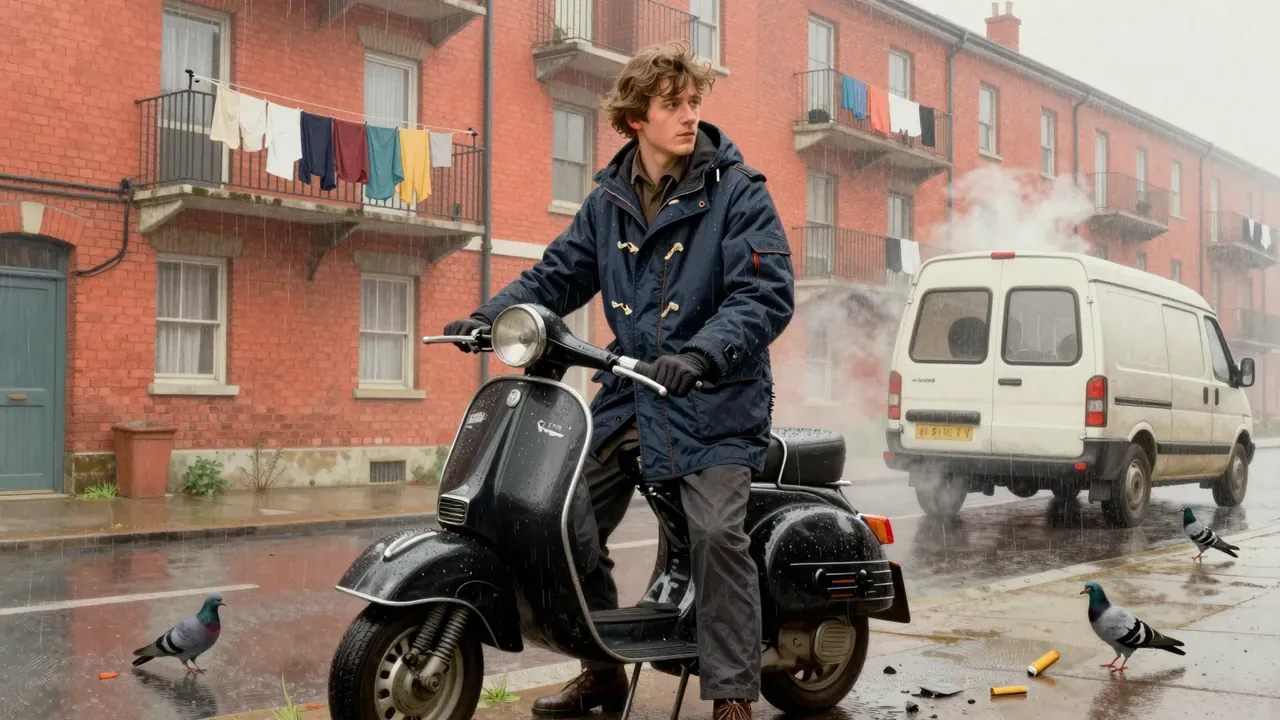
Quadrophenia is a British teen drama from 1979, adapted by Franc Roddam and Pete Townshend from the Who’s 1973 rock opera. It is not a musical: the band does not appear, and no character sings diegetically. Instead, it uses the album’s structure and emotional arc to anchor a naturalistic portrait of a London mod in 1964–65 — Jimmy Cooper, played by Phil Daniels — whose rebellion is enacted through scooter rides, amphetamine use, dance-hall posturing, and violent clashes with rockers. The film aims to render adolescent alienation as physical fact: cramped flats, fluorescent office lighting, rain-slicked pavements, the vibration of a Vespa engine, the sour taste of Dexamyl tablets crushed on a spoon. It treats mod identity not as costume or nostalgia but as a desperate, collective grammar for feeling something real in a world offering only dead-end work and indifferent parents. Its fidelity is to texture over exposition, to group behaviour over individual psychology, and to the specific weight of class-bound youth in mid-1960s Britain. It attempts no universal uplift; its ambition is documentary precision within a heightened, rhythm-driven frame. (158 words)
How it moves
The story follows Jimmy across three compressed weeks: his disintegration at home and work, a botched drug run, the Brighton bank holiday riot, and its aftermath. Phil Daniels carries the film with tightly coiled physicality — his face rarely opens, his posture stays braced, his voice remains low and sullen even in outbursts. Sting, as the charismatic but hollow Ace Face, underplays with chilling ease. Brian Tufano’s cinematography avoids stylisation: interiors are lit with practical sources, daylight is flat and ungenerous, crowd scenes are shot wide and handheld, with minimal coverage. Sean Barton’s editing sustains momentum without resorting to montage — cuts land on glances, revving engines, falling bodies, the flicker of a TV screen showing the Who. Pete Townshend’s score is used sparingly, mostly as source music or underscore beneath dialogue; the silence between songs matters more than their presence. The production’s insistence on location shooting — only one scene filmed in studio — gives the film a weathered, unvarnished surface. Every performance feels sourced from observation, not rehearsal. (159 words)
The grammar of the group
What lands is the film’s unblinking attention to ritual: the precise way mods adjust their parkas before mounting scooters, the choreographed shuffling in ballrooms, the shared glance before a punch is thrown. These are not flourishes but behavioural evidence — proof that belonging is performed, rehearsed, and fragile. The Brighton sequence works because it refuses climax: the riots escalate without catharsis, dissolve into exhaustion, and leave no victors. Jimmy’s final walk along Beachy Head is not symbolic but logistical — he arrives there because the bus stops nearby, and because he has nowhere else to go. The film’s authenticity rests in such details: the cheapness of the pills, the damp wool smell of wet coats, the way a magistrate’s courtroom feels both absurd and crushing when you’re nineteen and broke. Even minor characters register — Ray Winstone’s Chalky is all knuckles and nervous laughter; Toyah Willcox’s Steph moves with a quiet agency that never softens into romance. The film trusts its audience to read meaning from gesture, not speech. That trust is repaid. (157 words)
Where the edges blur
What does not land is the film’s occasional drift into schematic contrast: mods versus rockers reads less as lived antagonism and more as a binary imposed by the script’s need for escalation. Some supporting characters — particularly Dave and Spider — remain functional rather than felt, their motivations thin beyond loyalty to Jimmy. The subplot involving Jimmy’s mother feels truncated, her expulsion of him arriving without the domestic history needed to make it sting. A few scenes — notably the café breakfast after Brighton — suffer from underwritten dialogue that lapses into period cliché rather than character voice. The film’s refusal to explain Jimmy’s interior life becomes a limitation in its final third: his collapse feels inevitable but not fully earned, because we see his actions more clearly than his reasoning. Critics who find the film emotionally distant — Ken Hanke, for instance — are responding to this gap. It is not a flaw in the craft but in the choice to privilege exterior over interior, and that choice does not serve every beat equally. (156 words)
The material of belonging
The themes that matter are not rebellion or identity in the abstract, but the material conditions of both: how class dictates access to transport, drugs, music, and even space — Jimmy’s bedroom is barely wider than his bed, his workplace a windowless postroom where he sorts mail for an advertising firm selling things he cannot afford. The film treats subculture as infrastructure: scooters are transport and status symbol; amphetamines are stimulant and social lubricant; dance floors are neutral territory where hierarchy is temporarily suspended. It shows how masculinity is policed not by institutions but by peers — Jimmy’s shame after failing to stop the beating of Kevin is sharper than any punishment from police or parents. Nostalgia is absent; the past here is not romanticised but rendered with the same drab specificity as the present. The film’s enduring power lies in its refusal to flatter its subject: the mods are neither heroic nor tragic, but young people trying, often badly, to assert personhood inside narrow social margins. (159 words)
Who it meets halfway
This film is for viewers who value behavioural realism over narrative resolution, who respond to physical performance and environmental detail more than exposition or backstory. It suits those familiar with British working-class cinema of the 1960s — not as homage, but as continuation — and those attentive to how music, fashion, and movement encode social meaning. It is not for viewers who require clear moral framing, psychological exposition, or redemptive arcs. Those expecting a celebratory youth anthem or a faithful musical adaptation will find it withholding. Anyone put off by prolonged sequences of non-verbal tension, ambiguous motivation, or unsentimental depictions of drug use should look elsewhere. The film assumes patience with its rhythms and respect for its silences. A viewer who values thematic clarity over atmospheric accumulation — say, someone drawn to the didacticism of later British social realism — may find Quadrophenia frustratingly oblique. Its demands are formal, not intellectual. (159 words)
Why it stays
Yes, it is worth your evening — not as escapism, but as immersion. Its 117 minutes pass with the density of lived time: nothing is rushed, nothing is explained twice, and nothing is wasted. You emerge with a tactile memory of its world — the grit on the pavement, the buzz in the ears after a club, the weight of a scooter helmet left on a bench. It rewards rewatching not for plot revelations but for shifts in emphasis: how a glance changes meaning on second viewing, how a background extra’s gesture gains significance. Those who dismiss it as dated or narrow — Jeffrey M. Anderson, for example, calling it a ‘low-budget homemade movie’ — mistake its restraint for poverty. What would change the verdict? A tighter edit of the Brighton aftermath, or deeper investment in Jimmy’s home life, might shift the balance. But its current form remains coherent, unsentimental, and quietly formidable. (158 words)