The look of it
Love Story — released in France in January 1943 under its original title Douce — is a French historical romantic drama set in the late nineteenth century, adapted from a novel by Roger Vailland. It attempts to trace the quiet collapse of bourgeois propriety through the triangulated affections of a young heiress, her governess, and the estate manager. The film does not aim for social satire or psychological realism but for a restrained, almost classical tragedy: one where moral ambiguity resides not in motive but in consequence, and where emotional restraint becomes the measure of both dignity and damage. Its ambition lies in sustaining tonal gravity without melodrama, using period detail not as ornament but as pressure — the heavy drapery, the hushed parlours, the unspoken hierarchies — to shape behaviour as surely as law. It works within the conventions of French literary adaptation of the era, prioritising interiority over action, implication over exposition. The film’s project is neither to indict nor to absolve, but to observe how love, when entangled with class and inheritance, distills into something fatal without ever raising its voice. (158 words)
How it holds its breath
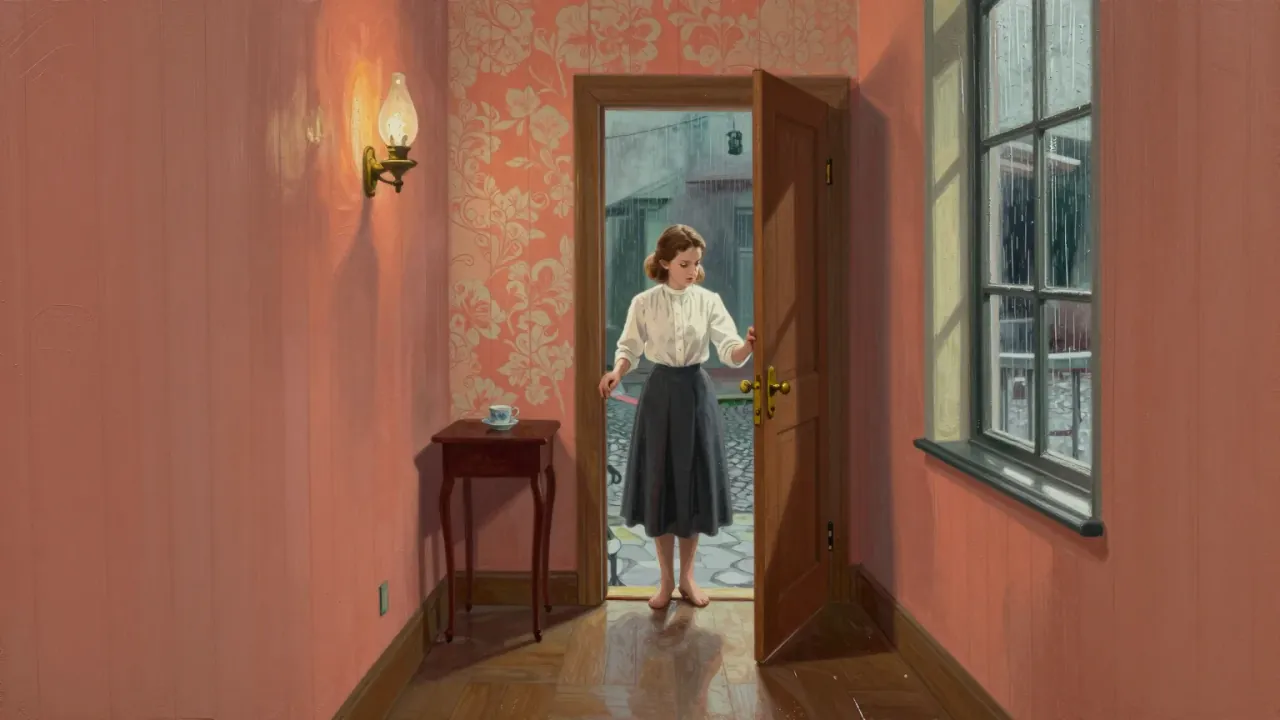
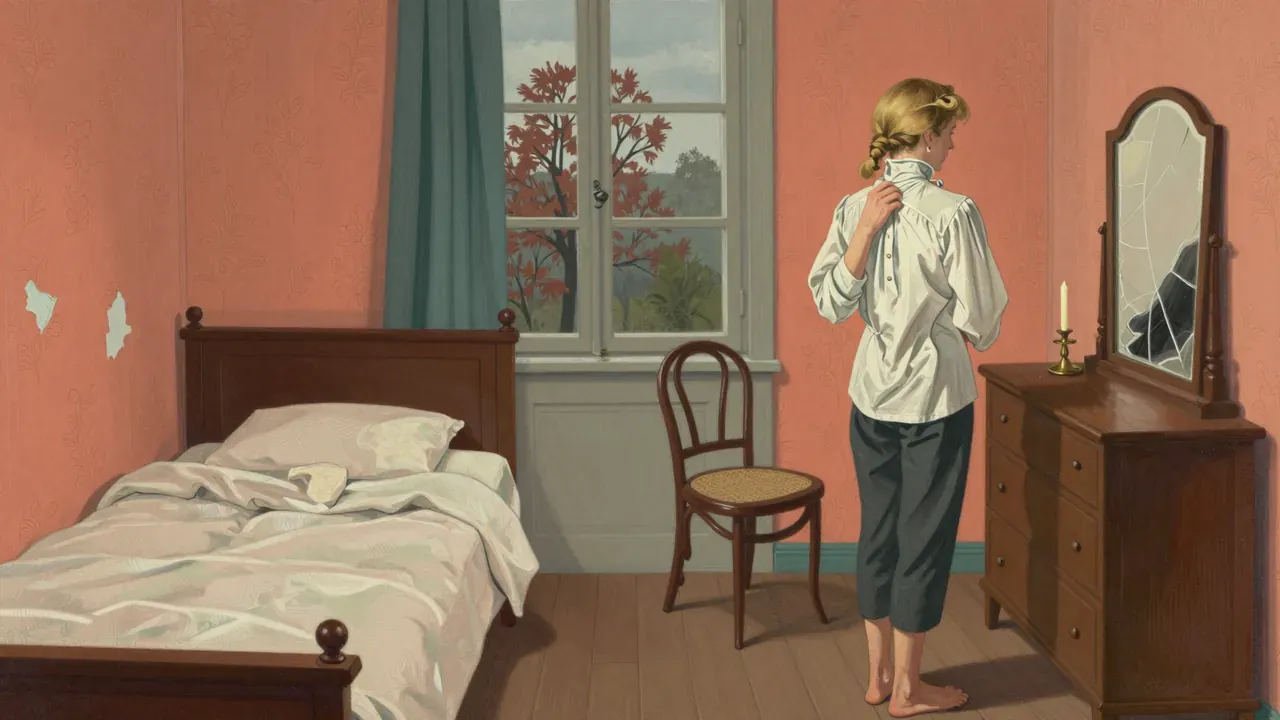
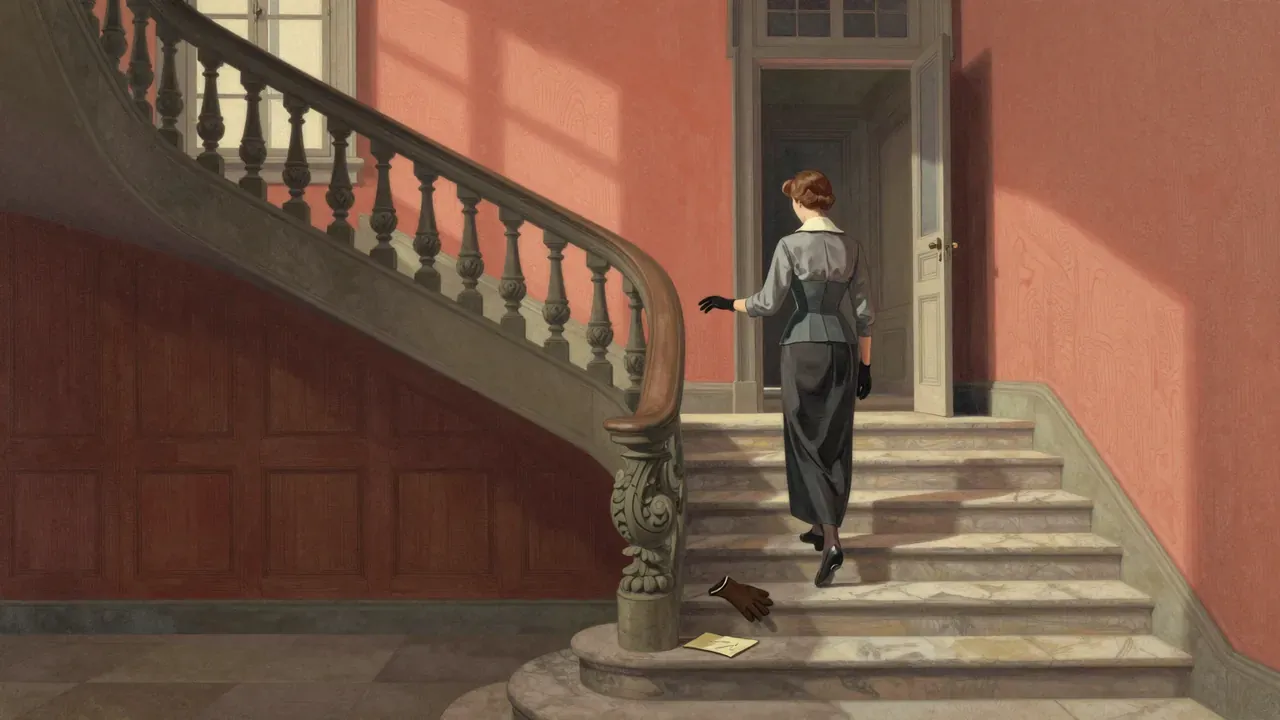
The story unfolds across the Bonafé country house, its rhythms dictated by Philippe Agostini’s cinematography: low-contrast monochrome, shallow depth of field, interiors lit as if by candlelight even in daylight, with shadows pooling in corners like held breath. Odette Joyeux plays Douce with stillness that reads less as passivity than as containment — every glance measured, every gesture deferred. Madeleine Robinson’s Irène moves with sharper articulation, her performance calibrated between calculation and vulnerability; Marguerite Moreno’s Madame Bonafé anchors the household with weary authority, her lines delivered with a dry precision that makes silence feel consequential. Pierre Bost and Jean Aurenche’s script avoids soliloquy, trusting subtext to carry weight: a dropped glove, a delayed reply, a chair left empty at dinner. Madeleine Gug’s editing sustains this tempo — cuts are infrequent, held shots linger just past comfort, and the pacing resists narrative urgency in favour of accumulating emotional density. René Cloërec’s score is sparse, mostly piano and strings, used only to underline transitions, never to explain them. The art direction by Jacques Krauss reinforces hierarchy through space: servants move along corridors while principals occupy rooms whose thresholds they rarely cross. (159 words)
Where the tension lives
What lands most firmly is the film’s atmosphere of suffocated feeling — the sense that emotion is not suppressed so much as metabolised slowly, like tea steeping too long. The tension between Douce and Irène is rendered not through confrontation but through proximity: shared rooms, overlapping duties, glances held a beat too long before being broken. Joyeux’s physical presence — slight, pale, always slightly turned inward — makes Douce’s final decision to leave, and her subsequent death, feel inevitable rather than abrupt. The film’s restraint pays off in moments where nothing happens except a shift in posture or a change in breathing rhythm: Fabien’s hesitation before taking Irène’s hand, Engelbert Bonafé’s silence after reading a letter, the way Madame Bonafé folds a napkin after hearing unwelcome news. These are not flourishes but structural elements — the grammar of a world where speech is costly and gesture carries freight. The period setting is never picturesque; it is functional, grounding each character’s options in material reality: land ownership, dowries, employment contracts, the absence of legal recourse for women outside marriage. That consistency — of tone, of consequence, of social logic — gives the film its quiet force. (157 words)
The pivot that wobbles
What does not land is the central romantic pivot: Fabien’s gradual seduction by Douce feels under-motivated, arriving more as narrative necessity than psychological inevitability. His initial contempt for her — conveyed in early exchanges — is never fully reconciled with his later devotion, and Roger Pigaut’s performance, though technically assured, lacks the granular shifts needed to make the turn credible. The film also struggles with its own moral framing: Irène is positioned as both opportunist and victim, yet the script gives her no interiority beyond desire and regret, reducing her complexity to function. Albert Rémy’s minor role as a visiting cousin adds little beyond exposition, and several supporting characters — including Gabrielle Fontan’s Estelle and Georges Bever’s frotteur — remain decorative, their presence justified by social verisimilitude rather than dramatic purpose. The ending, while tragic, risks abstraction: Douce’s death occurs off-screen, reported second-hand, and its emotional impact depends entirely on what the viewer has invested in her silence — an ask the film does not fully prepare us to meet. Some viewers may find the pacing too deliberate, the stakes too internalised, the resolution too muted to satisfy. (156 words)
The walls around the story
The themes that matter are inheritance — not only of property but of expectation, silence, and emotional debt — and the asymmetry of agency across gender and class. Douce inherits her father’s name and fortune but none of his authority; Irène inherits competence and observation but no claim to belonging; Madame Bonafé inherits duty but no release from it. The film treats love not as liberation but as another form of obligation, one that compounds rather than cancels existing constraints. There is no utopian alternative offered — no flight to Canada succeeds, no rebellion rewrites the rules, no confession brings clarity. Instead, the film insists on consequence as cumulative: a glance, a letter, a refusal to speak, all accrue weight until they become irreversible. It also examines the architecture of domestic space as moral geography: who sits where, who serves whom, who may enter which room — these are not background details but active determinants of possibility. The tragedy is not that Douce dies, but that her life was already circumscribed to the point where survival would have required a self she was never permitted to form. (152 words)
Who it waits for
This film is for viewers who value sustained mood over plot propulsion, who attend to gesture and silence as carriers of meaning, and who accept that emotional gravity need not announce itself with volume or velocity. It suits those familiar with interwar French literature and cinema — particularly the work of Colette or Marcel Pagnol — and those willing to sit with ambiguity rather than seek resolution. It is not for viewers who require clear moral alignment, narrative momentum, or psychological exposition; those expecting a romance in the modern sense will find its withholding frustrating. Anyone needing explicit motivation for character decisions, or who dislikes long takes and minimal scoring, will likely disengage. The film assumes patience as a condition of engagement — not as a virtue but as a prerequisite. A viewer who values thematic density over incident, or who finds power in what is withheld, will respond strongly. Those who prefer narrative clarity, strong arcs, or cathartic release will find it distant, even withholding. Its appeal rests on tolerance for ellipsis — and that tolerance is not evenly distributed across audiences. (158 words)
Why it stays with you
Yes, it is worth your evening — provided you approach it as a chamber piece rather than a sweeping romance, and accept its terms: slow accumulation, emotional reserve, and consequence over climax. It rewards attention not with revelation but with resonance — the kind that lingers in the hollow behind the ribs. Its 104 minutes pass without hurry but also without waste; every scene serves the central tension between longing and constraint. Those who dislike its pace or find its moral landscape too grey may consider it inert — but that is not indifference, it is resistance to the film’s chosen register. To call it ‘slow’ is accurate; to call it ‘empty’ is to mistake economy for absence. Its value lies in its refusal to simplify: Douce’s fate is neither punishment nor triumph, but the logical endpoint of a system that offers no third option. If you believe cinema can hold grief without weeping, desire without declaration, and tragedy without fanfare — then this is time well spent. It does not ask for surrender, only for stillness. (159 words)