The weight of the baby
Fight, Zatoichi, Fight is the eighth entry in Daiei’s Zatoichi series: a chambara film built around ritualised movement, moral arithmetic, and the blind swordsman’s quiet insistence on carrying responsibility where others refuse it. It does not seek to expand the mythos or deepen psychology; it tightens the form. The plot is a single through-line — delivering a baby — but every deviation from that line is calibrated: a gambling win, a stolen whistle, a diaper change mid-ambush. This is not episodic filler. It is structural repetition with variation, like a koto phrase repeated across shifting tempos. The film treats Zatoichi not as a hero but as a node — someone whose presence recalibrates the ethics of everyone he passes. It tries, precisely and without flourish, to hold one man’s integrity steady against a world that trades in debt, denial, and delegated violence. There are no flashbacks, no exposition dumps, no symbolic objects beyond what the script names: a lock of hair, a promissory note, a nightingale whistle. Its ambition is formal discipline, not thematic novelty.
The grammar of violence
The story moves by accretion: each encounter adds a layer of obligation or evasion — the bearers’ opportunism, Oko’s thievery, Unosuke’s repudiation — all orbiting Ichi’s unswerving path. Shintarō Katsu performs Zatoichi with minimal inflection: his voice stays level, his posture unchanged whether holding a baby or drawing steel. Nobuo Kaneko’s Unosuke is all brittle calculation, his denial of paternity delivered with the same clipped cadence he uses to haggle over silkworm cocoons. Kenji Misumi frames fights in tight, shallow space — corridors, temple yards, roadside clearings — so swordplay feels less like spectacle than consequence. Akira Ifukube’s score avoids leitmotif; strings enter only when fire catches cloth or sand flies into eyes. The editing is functional, never expressive: cuts land on feet hitting dirt, hands releasing a sword hilt, a baby’s head lolling sideways. There is no slow motion, no reaction shot after a kill. The craft serves continuity of action, not emotional punctuation. Even the baby is treated as prop and participant — fed, changed, passed between hands — never sentimentalised.
The texture of duty
What lands is the cumulative weight of Ichi’s refusal to offload responsibility. His decision to carry the baby is never justified in dialogue; it follows directly from witnessing the mother’s death and reading her documents. Later, when he pays Oko and sends her away, the gesture reads not as rejection but as boundary-setting — an act as deliberate as drawing his sword. The sequence where he lets wrestlers pummel him while an assassin tries to steal his blade works because it trusts the audience to follow cause and effect without explanation: the sand in the face, the dropped sword, the reach, the cut. The final confrontation in the woods lands for its physical specificity — the whoosh of torches, the smell of burning cloth, the way Ichi rolls twice before rising — not for catharsis. Even Unosuke’s late admission feels earned: not a conversion, but a collapse under the pressure of Ichi’s unbroken attention. These moments do not ask for empathy. They ask for recognition: this is how duty manifests when there is no institution to absorb it.
The looseness in the frame
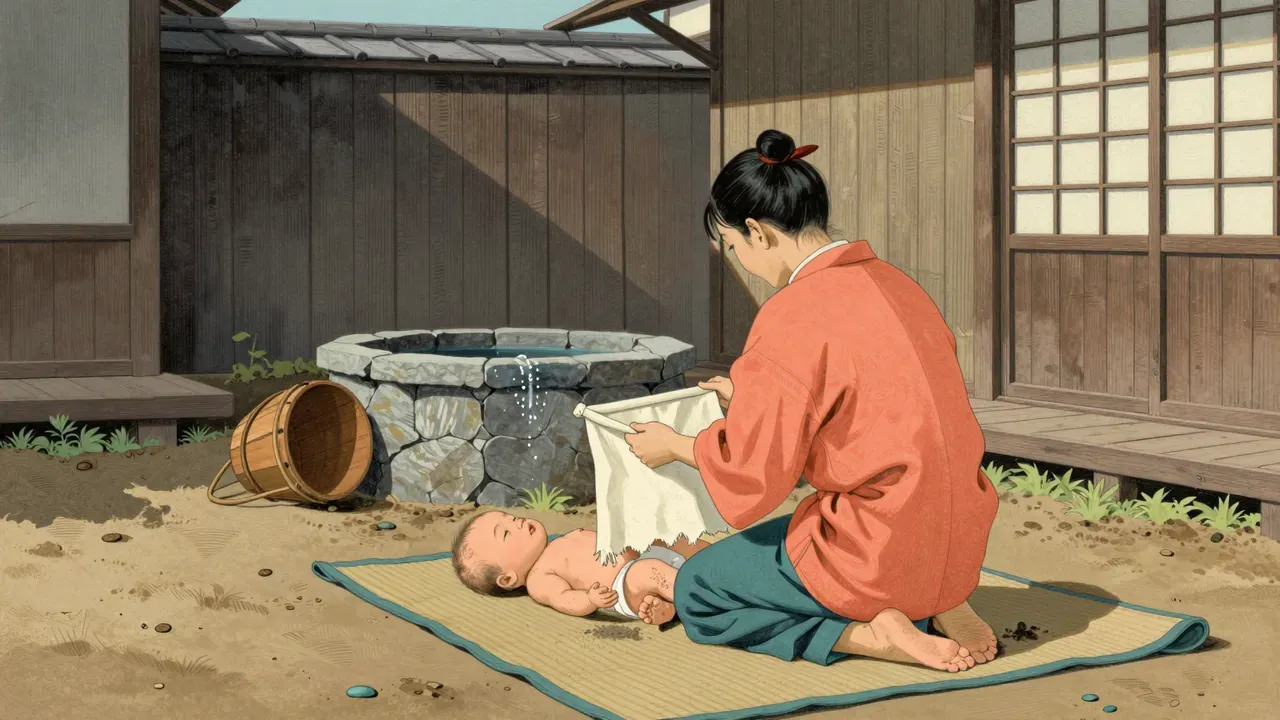
What does not land is the film’s attempt to soften Ichi through domesticity. The scenes with Oko — the diaper-scavenging, the hired prostitute, the baby-splashing incident — drift into tonal uncertainty. They are neither comic nor tender, and lack the rhythmic precision of the fight choreography or document-reading scenes. The gambling sequence, though cleanly staged, introduces a sudden burst of luck that sits oddly beside the film’s otherwise austere causality. Likewise, Hangoro’s introduction feels narratively redundant: his alliance with the Monju clan adds no new pressure, only repetition. The pilgrimage motif — introduced at the start and echoed at the inn — is visually resonant but thematically inert; it signals ‘blindness’ without interrogating perception or dependence. These passages do not break the film, but they dilute its central logic: that moral clarity emerges from constraint, not convenience. A viewer attuned to the series’ economy may find these stretches indulgent — not badly made, but unmotivated by the film’s own terms.
Who carries the child?
The themes that matter are debt, witness, and the materiality of care. Debt appears in three forms: financial (the promissory note), social (the bearers’ fare, Oko’s wages), and ethical (Ichi’s assumption of blame). Witness is literal: Ichi sees the mother die, reads her papers, observes Unosuke’s lie — and each act of seeing binds him. Care is rendered through objects: the lock of hair, the stiff diapers, the nightingale whistle, the baby’s weight in Ichi’s arms. There is no abstract virtue here — only actions that leave traces. The film treats lineage not as blood but as transmission: Ichi carries Otoyo’s hair, then the baby, then the truth to Unosuke, then the child to the temple. When the monk suggests the temple take the child, it is not compassion that persuades Ichi, but the fact that the temple has stone walls and a roof — infrastructure, not sentiment. The film’s quietest theme is endurance as practice: walking sixty miles, changing diapers scavenged from flags, rolling out fire on your own back. These are not metaphors. They are the work.
The viewer’s prior knowledge
This film is for viewers who value narrative economy over exposition, physical precision over psychological revelation, and moral consistency over character growth. It rewards attention to gesture — how Ichi holds a baby, how Unosuke folds a document, how Waheiji shifts his weight before attacking. It is not for those who require motivation spelled out, emotional arcs resolved, or villains given backstory. A viewer expecting irony, satire, or genre subversion will find little here: the film honours its conventions without winking. Those drawn to Katsu’s later, more melancholic Zatoichi performances may find this entry too lean — it lacks the weathered resignation of the 1970s entries. But someone who watches Yojimbo for its geometry of conflict, or High Noon for its ticking clock, will recognise the same rigour. The verdict rests on tolerance for austerity: if you need warmth, it will feel cold; if you need explanation, it will feel opaque.
The silence after the sword
Yes, it is worth your evening — provided you watch it as part of the Zatoichi series, not in isolation. Its power depends on familiarity with Ichi’s stillness, his cane’s tap, the way his sword leaves the scabbard in one motion. Watching it alone, without context, risks misreading its repetitions as slackness rather than structure. Someone who knows the series will see how this instalment sharpens the central paradox: a blind man who sees more clearly than anyone else, not because of insight, but because he refuses to look away. It is not a gateway film, nor a climax — it is a hinge. Those who skip ahead to Zatoichi and the Fugitives or Zatoichi Meets Yojimbo without seeing this miss the moment the series commits fully to its own logic: that justice is not delivered, but carried. To dismiss it as formulaic is to mistake discipline for absence. The film earns its ninety minutes by never wasting one.